China Manufacturing PMI Rises to Fastest Pace in a Year at 50.4 in March 2026
China's NBS Manufacturing PMI rose to 50.4 in March 2026, fastest pace in a year, as output and new orders rebounded sharply.

EcoPulse24 | Beijing
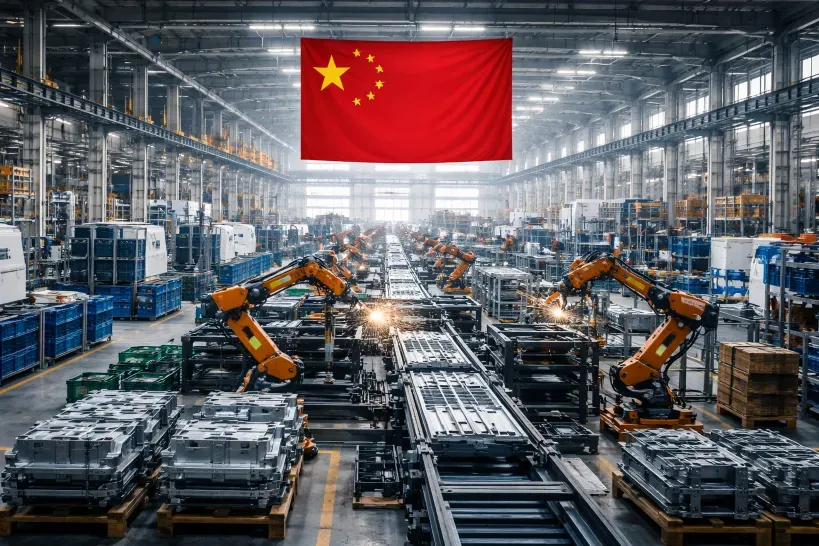
China's official NBS Manufacturing Purchasing Managers' Index rose to 50.4 in March 2026, returning to expansionary territory and beating market expectations of 50.1, according to data released by the National Bureau of Statistics. The reading marks the fastest pace of manufacturing expansion since March 2025 and ends two consecutive months of contraction.
Key Components
Output growth accelerated sharply, rising to 51.4 from 49.6 in February, as factories resumed full operations following the Spring Festival holiday period and supply chains normalized. New orders rebounded strongly to 51.6 from 48.6, signaling an improvement in domestic demand conditions. External demand also showed signs of recovery, with new export orders climbing to 49.1 from 45.0 in the prior month, though they remained below the 50-point expansion threshold.
Buying activity picked up to 50.9 from 48.2, while import volumes rose to 49.8 from 45.6. Employment improved marginally to 48.6 from 48.0 but remained in contraction territory, pointing to continued caution among manufacturers on hiring. Supplier delivery times stayed below the threshold at 49.5, from 49.1, indicating lingering supply-side constraints in certain sectors.
Price Pressures Build
Input costs surged notably, with the input price sub-index climbing to 63.9 from 54.8 in February, reflecting broader commodity inflation in part driven by elevated global energy prices. Output prices also rose, with the relevant sub-index increasing to 55.4 from 50.6. Business confidence eased marginally to 53.4 from 53.2 but remained firmly in optimistic territory, suggesting manufacturers view the near-term outlook constructively despite external headwinds.
Broader Activity Data
The manufacturing PMI improvement was accompanied by a broader recovery in China's economic activity. The NBS Composite PMI Output Index rose to 50.5 in March from 49.5 in February, returning to expansion at its highest level in three months. The NBS Non-Manufacturing PMI improved to 50.1 from 49.5, beating expectations of 49.9 and signaling stabilization of the services sector after two months of contraction.
NBS statistician Huo Lihui noted that production and operations among Chinese enterprises were improving overall, pointing to a broader recovery. The data suggests China's economy is benefiting from government stimulus measures, strong domestic holiday spending, and a rebound in export demand, even as global energy market conditions add uncertainty to the external demand picture.
Implications for Global Trade and MENA
A stronger Chinese manufacturing sector carries significant implications for global commodity demand and supply chains. For the MENA region, China's industrial recovery is relevant both as a major oil consumer and as a primary destination for Gulf petrochemical and energy exports. A rebound in Chinese output and new export orders can support oil demand forecasts, reinforcing the broader energy market picture at a time of heightened focus on supply dynamics.
China's equity markets have shown relative resilience in recent weeks, outperforming many international peers amid global uncertainty. Notable contributors to the positive March PMI include the normalization of Spring Festival distortions, government-backed infrastructure investment, and solid consumer activity during the holiday period.
EcoPulse24 Analysis
EcoPulse24 Analysis: The March manufacturing PMI reading offers a broadly positive signal on China's near-term economic trajectory, though the persistence of employment contraction and elevated input cost pressures warrant continued monitoring. The sharp rebound in new orders and output suggests seasonal distortions have cleared; the key question for Q2 2026 is whether this momentum is sustained given global demand uncertainty. For energy markets and GCC exporters, a firming Chinese industrial base supports the demand side of the oil and petrochemicals equation at a time when supply-side dynamics are already in focus.
Sources & References
Editorial Note
Disclaimer
© 2025 EcoPulse24. All rights reserved.