Data Centers Face Cooling Challenges Amid AI Demand
Data centers face overheating challenges due to AI demands, prompting a shift to liquid cooling and increased investment in cooling tech.

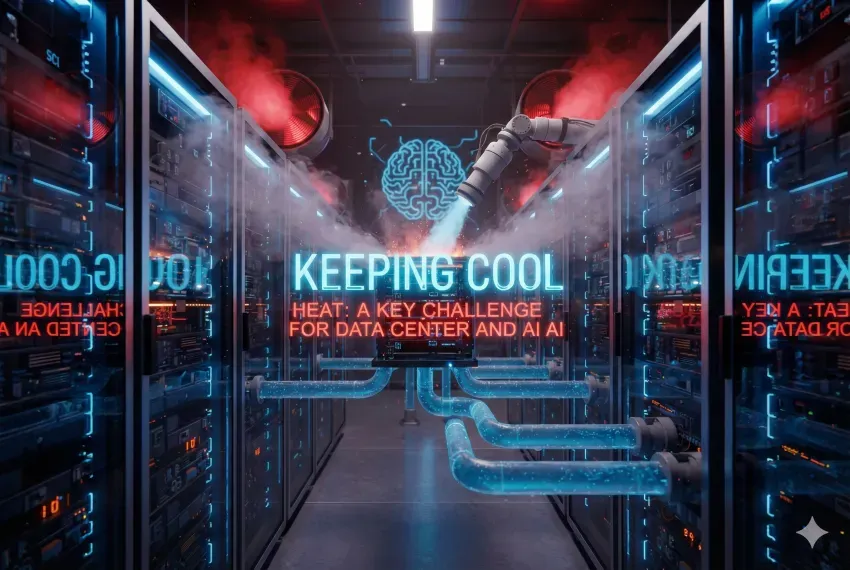
According to Reuters, The global rush to build data centers - driven by the explosion of cloud computing and the soaring power demands of artificial intelligence - has put a spotlight on a growing vulnerability for the industry: how to keep these facilities cool enough to stay online.
A major outage at CME Group, the world’s largest derivatives exchange operator, underscored the scale of the challenge. Trading on its flagship currency platform and futures markets spanning FX, commodities, Treasuries and equities was halted late Thursday after one of its data centers overheated.
The issue originated at a facility run by CyrusOne, a Dallas-based company that operates more than 55 data centers across the U.S., Europe and Japan. The firm said its engineering teams were on-site near Chicago on Friday to restore the cooling system.
WHY DO DATA CENTERS OVERHEAT?
High-performance AI servers and cloud machines process massive volumes of data, consuming enormous amounts of electricity. That power is converted into heat that traditional air-cooling systems often cannot dissipate fast enough.
Inside data centers, racks of servers run continuously and draw heavy power loads. As temperatures rise, cooling becomes a constant, non-negotiable requirement.
“If chips exceed their safe temperature range, they begin to malfunction or shut down entirely,” said Daniel Mewton, a partner at Slaughter and May specializing in energy and infrastructure.
WHAT OPTIONS DO OPERATORS HAVE?
To manage escalating heat levels, many data center operators are turning to liquid cooling, which is up to 3,000 times more efficient than air in transferring heat.
However, liquid cooling brings its own complications:
- Possible leaks
- Corrosion risks
- Highly specialized maintenance
- Significant water usage
Tech companies are looking for ways to reduce reliance on external water sources. Microsoft, for example, unveiled a “zero-water” cooling design last year that uses a closed-loop system, recycling the same water between servers and chillers without drawing fresh supplies.
Some facilities are also adopting systems to capture and reuse waste heat, channeling it for district heating or industrial applications.
HOW COMMON ARE COOLING-RELATED OUTAGES?
According to Mewton, outages in top-tier data centers are extremely rare due to strict contractual uptime requirements that can exceed 99.99% availability.
He notes that while outages do occur, cooling failures are among the least common causes.
“Power problems are what we typically see,” he added.
A SURGE IN COOLING-TECH DEALS
The data center boom has triggered a wave of investment and acquisition activity in cooling technologies, as companies race to expand capacity to support AI-driven workloads.
Law firm White & Case estimates that up to 40% of a data center’s total energy usage goes solely into cooling, making it a multibillion-dollar segment of the industry.
In November, power-management giant Eaton announced a $9.5 billion deal to acquire the thermal-management division of Boyd Corporation from Goldman Sachs Asset Management, seeking to capitalize on AI-related demand.
Meanwhile, Vertiv has entered a $1 billion agreement to buy PurgeRite Intermediate, broadening its liquid-cooling capabilities.
BOTTOM LINE
As AI accelerates global demand for compute power, data centers are becoming hotter, more power-hungry - and more vulnerable. Cooling is no longer a back-office engineering concern; it is now a strategic pillar of digital infrastructure worldwide.
The future of the AI economy may depend as much on innovation in cooling as it does on advances in silicon.
Sources & References
Editorial Note
Disclaimer
Please review the Terms & Conditions.
© 2025 EcoPulse24. All rights reserved.