Fuel prices surge globally as war pushes oil shock directly to consumers
Global fuel prices surge as oil tops $100/bbl amid war, with consumer costs rising and wide price gaps due to taxes and subsidies.

London | EcoPulse24
Global fuel prices jump as oil rally feeds into gasoline and diesel costs
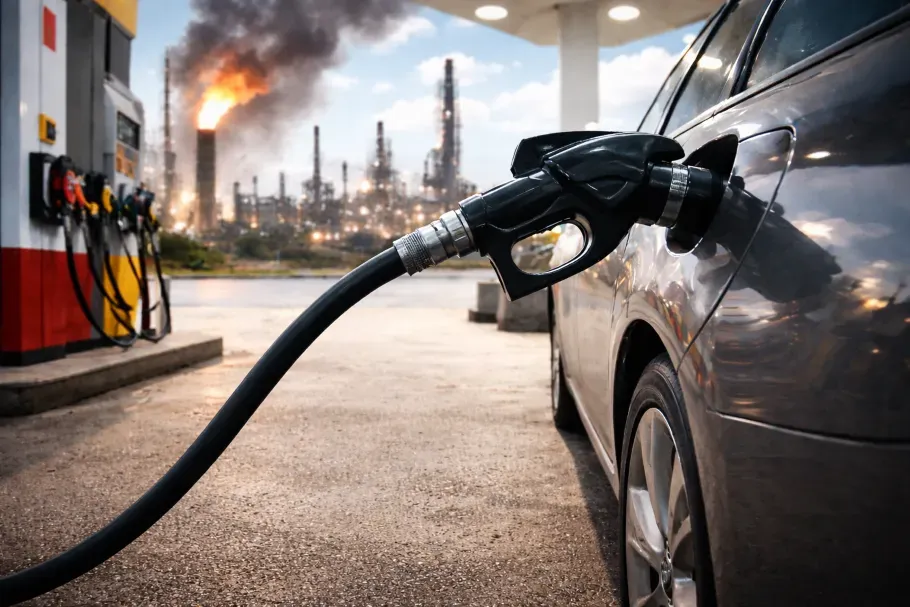
Global gasoline and diesel prices are rising sharply as oil surged above $100 per barrel, driven by escalating geopolitical tensions and growing risks to supply through the Strait of Hormuz, pushing the energy shock beyond crude markets directly into consumer fuel costs.
Brent crude climbed near 109 dollars per barrel, while US crude advanced more than 11%, reflecting a rapid repricing of geopolitical risk in global energy markets, where supply disruption fears are now dominating price formation.
This surge is closely tied to threats around the Strait of Hormuz, a critical chokepoint handling roughly one-fifth of global oil flows, forcing markets to price in potential supply disruptions even before any physical shortages materialize.
The impact has already reached consumers, with US gasoline prices moving above $4 per gallon for the first time since 2022, signaling that the energy shock is no longer confined to futures markets but is translating directly into higher daily costs.
Despite global averages of about $1.44 per liter for gasoline and $1.51 for diesel, price distribution varies widely across countries, driven by taxation, subsidies, and domestic pricing systems rather than crude costs alone.
This explains why regions such as Hong Kong and Europe rank among the most expensive globally, while oil-producing or subsidized economies remain at the lower end of the price spectrum, highlighting structural differences in fuel pricing models.
Highest and lowest gasoline prices globally (selected countries)
The following snapshot highlights the global disparity in gasoline prices driven by taxation and subsidy structures:
| Rank | Country | Price ($/L) |
|---|---|---|
| 1 | Hong Kong | 4.106 |
| 2 | Malawi | 2.858 |
| 3 | Netherlands | 2.736 |
| 4 | Denmark | 2.663 |
| 5 | Singapore | 2.545 |
| 6 | Germany | 2.422 |
| 7 | Liechtenstein | 2.414 |
| 8 | Albania | 2.390 |
| 9 | Greece | 2.364 |
| 10 | Norway | 2.361 |
| 11 | Libya | 0.023 |
| 12 | Iran | 0.029 |
| 13 | Venezuela | 0.035 |
| 14 | Angola | 0.327 |
| 15 | Kuwait | 0.339 |
| 16 | Algeria | 0.353 |
| 17 | Turkmenistan | 0.428 |
| 18 | Egypt | 0.440 |
| 19 | Kazakhstan | 0.514 |
| 20 | Qatar | 0.563 |
Price dynamics are not uniform across markets, as the countries with the highest fuel prices are not necessarily those experiencing the fastest increases, reflecting the role of local policy frameworks in shaping final consumer prices.
Markets with liberalized pricing structures are reacting faster to oil shocks, while regulated or subsidized systems are absorbing part of the impact, delaying the transmission to end users.
This divergence highlights how fuel markets operate at the intersection of global energy pricing and domestic economic policy, where governments play a decisive role in moderating or amplifying inflationary pressures.
EcoPulse24 Analysis
Global fuel markets are entering a phase where energy shocks are transmitted almost instantly from crude oil to end consumers, marking a structural shift in how inflationary pressures develop across economies. The current surge is not merely a price reaction but a systemic response to geopolitical risk embedded within energy supply chains.
The Strait of Hormuz has re-emerged as a central pricing mechanism, not just a transit route, reinforcing how geopolitical chokepoints now function as core drivers of market volatility. Each escalation introduces a new risk premium that feeds directly into fuel costs worldwide.
At the same time, the divergence in fuel pricing across countries underscores the fragmentation of global energy economics, where domestic fiscal policies, subsidies, and taxation frameworks determine how much of the shock is absorbed or passed through.
This dynamic places fuel at the center of the global inflation cycle, linking energy prices directly to transportation, logistics, and production costs, and ultimately to consumer price indices.
As a result, fuel prices are no longer a secondary outcome of oil markets but a leading indicator of economic pressure, shaping expectations for inflation, monetary policy, and growth across both advanced and emerging economies.
This evolving structure suggests that energy-driven inflation will remain a dominant theme, particularly if geopolitical risks persist, reinforcing a global environment where supply security becomes the primary determinant of price stability.
Sources & References
Editorial Note
Disclaimer
© 2025 EcoPulse24. All rights reserved.