UK Faces Economic Contraction and Expected Rate Cut to 3.75% on December 18
UK economy shrank by -0.1%, prompting expected rate cut to 3.75% on Dec 18. Growth forecasts downgraded, inflation remains a challenge.

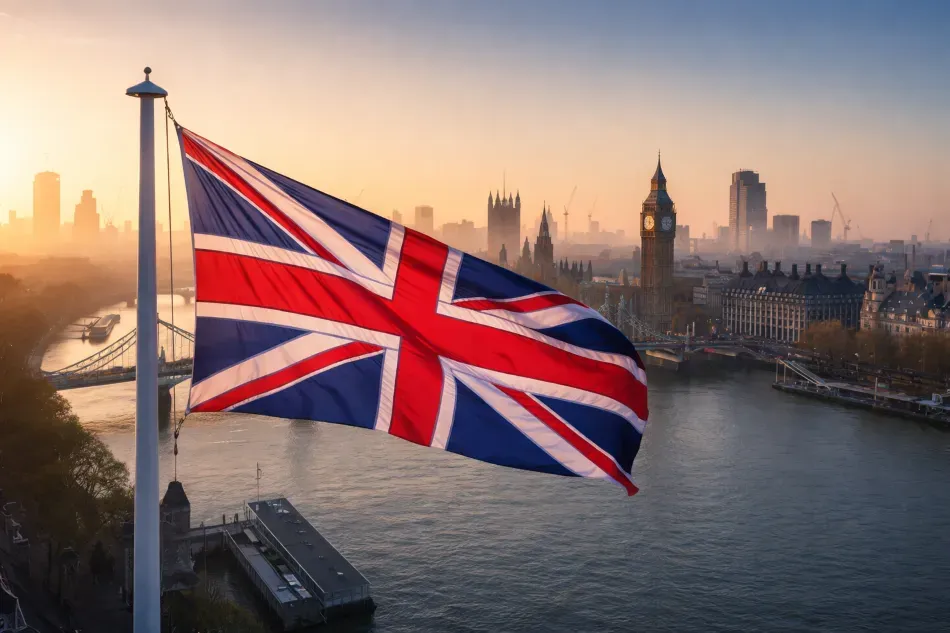
The UK economy shrank by -0.1% in October 2025, following two consecutive months of stagnation, according to data from the UK Office for National Statistics. This reinforces expectations that the Bank of England will cut interest rates at its scheduled meeting on Thursday, December 18, 2025. The British economy, the fifth largest in the world, shows increasing signs of weakness, with growth forecasts not exceeding 0.75%-1.0% for 2025, significantly lower than previous estimates of 1.5%. The labor market is slowing, and business investment is declining due to global uncertainty, putting increasing pressure on the Bank of England to intervene.
The Bank of England kept the interest rate steady at 4.0% at its last meeting on November 6, 2025, but the vote was sharply divided (5-4), with five members voting to maintain rates and four members voting for a 0.25% cut. This division clearly indicates that a rate cut at the December 18 meeting is highly likely, with markets pricing in a 60-65% chance of a 0.25% reduction to 3.75%. Since August 2024, the bank has cut rates five times by a total of 1.25 percentage points from a peak of 5.25% reached in August 2023 in response to inflation peaking at 11.1% in October 2022.
Inflation remains the major challenge for policymakers, standing at 3.6% in October 2025, which is double the central bank’s target of 2%. The Bank of England expects inflation to have peaked and to gradually decline to 3.7% in the third quarter of 2025 before returning to the 2% target by the second quarter of 2027. Governor Andrew Bailey confirmed in recent statements that the bank "expects to be able to lower interest rates further as the process of curbing inflation continues," but warned that "the road ahead will have bumps," indicating ongoing global economic uncertainty.
Analysts are divided on the pace of interest rate cuts in 2026, with most expecting the bank to continue a policy of “one cut per quarter,” implying additional cuts in May, August, and November 2026, bringing rates to 3.25% by year-end. Some analysts, like Callum Pickering from Peel Hunt, see a possibility of the bank acting faster with a potential cut in March 2026 if economic weakness worsens. Long-term forecasts indicate that rates will remain at 3.25% throughout 2026, then may rise slightly to 3.55% in 2027 under a “higher for longer” rate policy to ensure inflation doesn’t return.
The Bank of England is also continuing to reduce its quantitative easing (QT) program, having lowered asset holdings from a peak of £895 billion to £553 billion by December 3, 2025, and plans an additional £70 billion reduction over the year until September 2026. Economic forecasts indicate only 1.0% growth in 2026 before improving to 1.4% in 2027, driven by a recovery in private consumption and business investment. However, risks remain high, particularly with the potential for new US tariffs targeting 22% of UK exports (about £190 billion or 7% of GDP), which could increase pressures on an economy struggling to regain momentum.
Sources & References
Editorial Note
Disclaimer
Please review the Terms & Conditions.
© 2025 EcoPulse24. All rights reserved.