Abu Dhabi Ports Group Posts Record 2025 Results With 20% Revenue Growth, 17% Profit Rise, and First-Ever Free Cash Flow
Abu Dhabi Ports Group saw 20% revenue and 17% profit growth in 2025, achieving free cash flow for the first time since its 2022 listing.

Abu Dhabi | EcoPulse24
Abu Dhabi Ports Group reported record financial and operational results for 2025, fueled by strong performance across its ports, economic cities and free zones, and maritime shipping sectors. According to preliminary unaudited figures for the fiscal year ending December 31, 2025, the group achieved positive full-year free cash flow for the first time since its listing on the Abu Dhabi Securities Exchange in 2022.
Revenue grew 20% year-on-year to AED 20.8 billion, while net profit increased 17% to AED 2.1 billion. EBITDA rose 12% to AED 5.1 billion, with a robust margin of 24.4%, underscoring the strength of the group’s integrated business model and its ability to translate operational growth into higher financial returns.
In Q4 2025, net profit climbed 18% year-on-year to AED 584 million, supported by sustained operational momentum and improved asset utilization across the group’s integrated network.
Operationally, 2025 saw significant growth in container handling volumes at both domestic and international terminals, and the net addition of 3.3 square kilometers of new industrial land leases at KIZAD, boosting demand for warehousing, staff accommodation, and gas supply. The maritime sector also experienced strong momentum, including shipping services, marine operations, and shipbuilding and repair, with new projects launched to enhance operational capacity and logistics network.
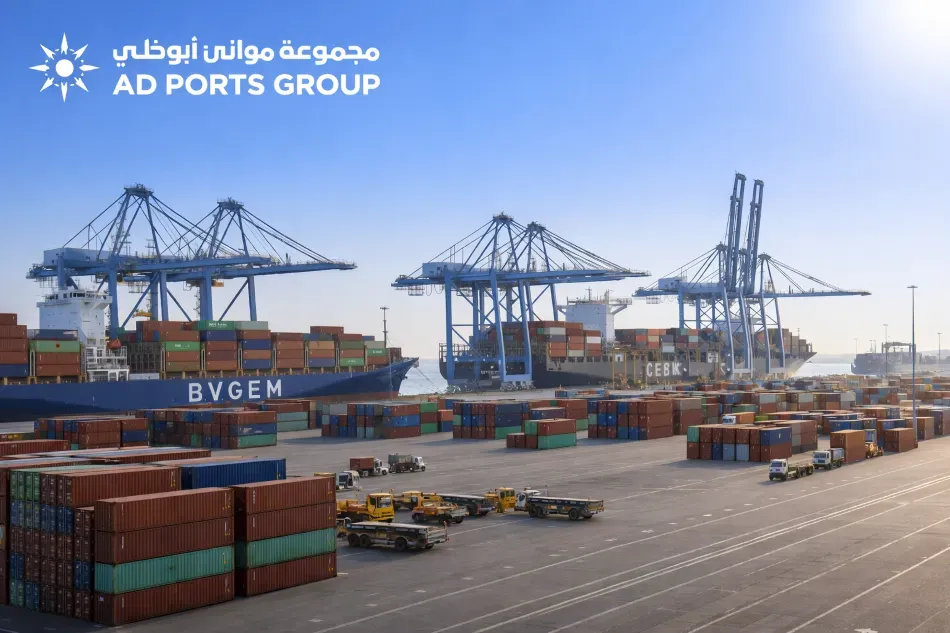
In the ports sector, container throughput rose 23% to 7.7 million TEUs, while general cargo handling grew 7% to nearly 60 million tons. The CMA Terminals Khalifa Port - commencing commercial operations in early 2025 - handled over 1.3 million containers with a 74% utilization rate in its first operational year, reflecting strong demand and operational efficiency.
The economic cities and free zones segment signed net new land lease contracts totaling 900,000 square meters in Q4, bringing total leased area for the year to 3.3 square kilometers. A 4.6 square kilometer land sale worth AED 2.47 billion was also completed at KIZAD, alongside asset monetization deals and an increase in staff accommodation occupancy to 94% by year-end, up from 67% in 2024.
In maritime and shipping, regional container shipping volumes grew 38% to 3.35 million TEUs, with the fleet expanding to 60 vessels and the marine services fleet to 81 vessels, enabling the group to capitalize on shifts in global trade routes and ongoing Red Sea shipping disruptions.
On the financial side, operating cash flow rose 28% to AED 5.05 billion, with a cash conversion ratio above 80%. Despite a rise in annual organic capital expenditure to AED 5.5 billion, the group achieved positive free cash flow, exceeding stated targets. Net debt stood at AED 20.6 billion, with the net leverage ratio stable at 4.1x, reflecting financial discipline and growth funding capacity.
Captain Mohamed Juma Al Shamisi, Managing Director and Group CEO, stated that 2025 was a landmark year as operational and geographic expansion translated into higher returns and stronger cash flows, with ambitions to further strengthen the group's strategic position and support the UAE’s economic diversification agenda in 2026.
EcoPulse24 Analysis:
Abu Dhabi Ports Group’s 2025 results highlight the maturity of its vertically integrated business model and its resilience to geopolitical shocks and global logistics volatility. The combination of volume growth, industrial land expansion, asset monetization, and improved operational efficiency enabled the group to generate free cash flow for the first time - a milestone that enhances balance sheet resilience and supports sustainable international expansion. With ongoing disruptions to shipping routes and changing trade flows, the strategy of focusing on key trade corridors and infrastructure-supporting sectors offers a competitive advantage likely to translate into balanced growth and stable margins in 2026, with capital management and pricing discipline remaining critical going forward.
Explore Related Coverage
Sources & References
Editorial Note
Disclaimer
© 2025 EcoPulse24. All rights reserved.