Renewable Energy and AI Set to Drive Fastest-Growing US Jobs Through 2034
US jobs in renewable energy, AI, and healthcare will grow fastest by 2034, led by wind, solar, data, and nurse practitioner roles.

Washington | EcoPulse24
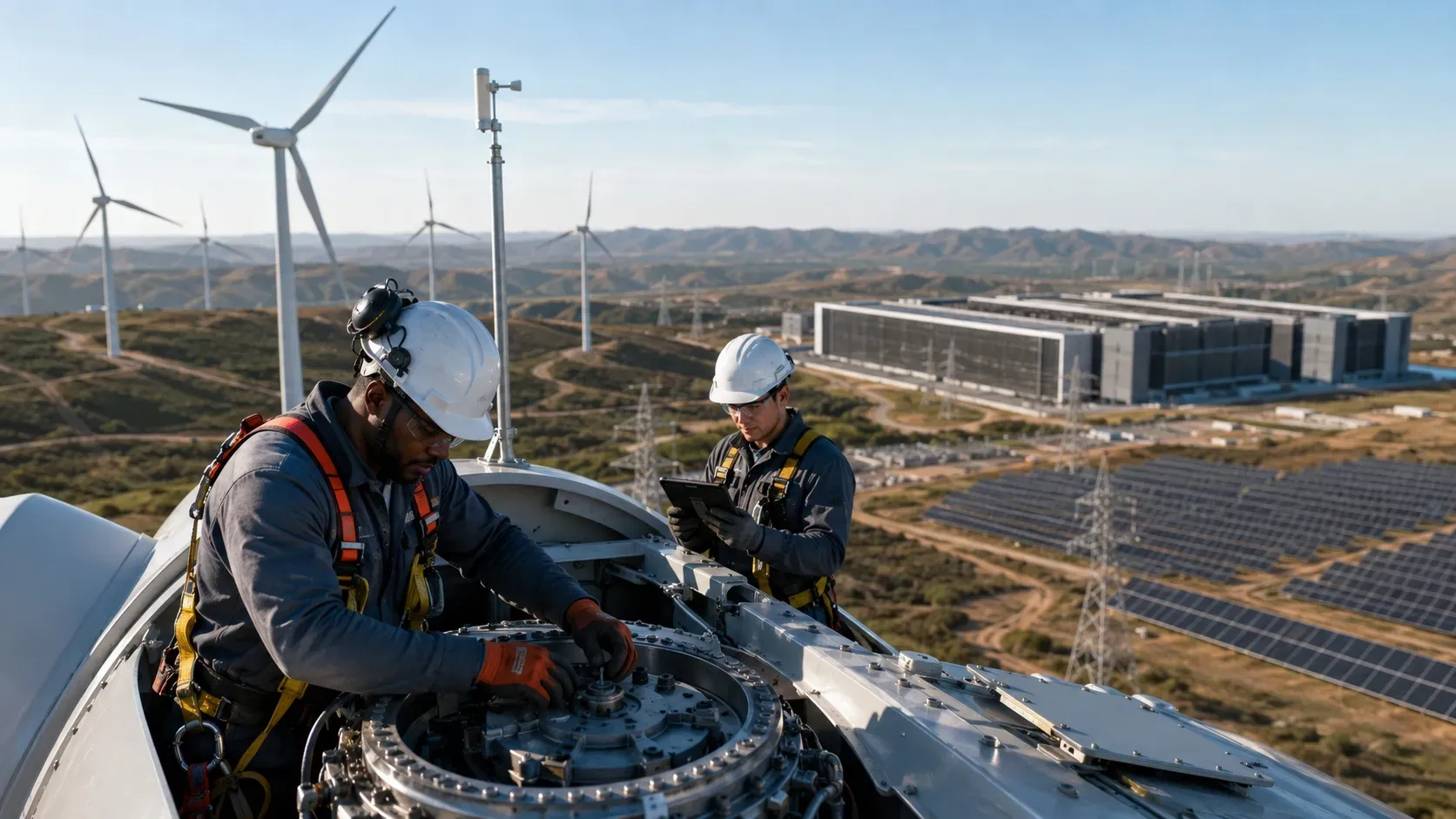
The transition toward clean energy and artificial intelligence is reshaping the future of the US labor market, with occupations tied to renewable power generation and digital technologies expected to record the strongest employment growth over the next decade, according to new projections released by the US Bureau of Labor Statistics (BLS).
The latest Employment Projections 2024 – 2034 show that wind turbine service technicians will become the fastest-growing occupation in the United States, with employment projected to increase 49.9%, adding approximately 6,800 jobs. Solar photovoltaic installers rank second, with projected employment growth of 42.1%, equivalent to roughly 12,000 new positions.
Beyond renewable energy, the projections also highlight accelerating demand for technology professionals. Data scientists are expected to see employment rise 33.5%, while information security analysts are projected to expand 28.5% as organizations continue investing in artificial intelligence, cybersecurity and digital infrastructure.
Healthcare remains another major source of long-term employment growth. Nurse practitioners are projected to expand by 40.1%, adding approximately 128,400 jobs, reflecting demographic trends, population aging and rising demand for healthcare services across the United States.
According to the BLS, these projections illustrate how structural economic changes - including the energy transition, digital transformation and healthcare demand - are reshaping workforce requirements across multiple industries.
Fastest-Growing US Occupations (2024 – 2034)
The latest BLS projections rank the fastest-growing occupations as follows:
| Occupation | Projected Growth |
|---|---|
| Wind turbine service technicians | 49.9% |
| Solar photovoltaic installers | 42.1% |
| Nurse practitioners | 40.1% |
| Data scientists | 33.5% |
| Information security analysts | 28.5% |
| Medical and health services managers | 23.2% |
| Physical therapist assistants | 22.0% |
| Actuaries | 21.8% |
| Operations research analysts | 21.5% |
| Physician assistants | 20.4% |
EcoPulse24 Analysis
The latest BLS projections reinforce a structural transformation taking place across the US economy, where clean energy, artificial intelligence and healthcare are emerging as the three dominant engines of long-term employment growth. Rather than reflecting cyclical hiring patterns, these occupations are expanding in response to fundamental changes in energy systems, technological adoption and demographic demand.
The prominence of renewable energy occupations illustrates that the energy transition is no longer measured solely by installed generation capacity or investment spending. As wind farms and solar facilities continue expanding, demand is increasingly shifting toward highly skilled workers responsible for operating, maintaining and optimizing critical energy infrastructure. This marks the evolution of renewable energy from a construction-driven industry into a mature operational sector requiring a permanent technical workforce.
The strong outlook for data scientists and information security analysts highlights another structural trend: the rapid commercialization of artificial intelligence. As enterprises deploy generative AI, cloud computing and advanced analytics at scale, organizations are investing heavily in professionals capable of managing data, securing digital assets and supporting increasingly complex technology ecosystems.
These two trends are becoming increasingly interconnected. AI infrastructure, hyperscale data centers and advanced digital services require vast amounts of reliable electricity, reinforcing investment in renewable generation, battery storage and modern power grids. In this context, the growth of clean energy employment and AI-related occupations should be viewed as complementary developments rather than separate labor market trends.
Healthcare remains the third major pillar of future employment growth, supported by an aging population and rising demand for specialized medical services. Together, these sectors demonstrate that future workforce expansion will be concentrated in industries driven by long-term structural forces rather than short-term economic cycles.
For policymakers, educational institutions and investors, the projections offer a roadmap for where capital, skills development and workforce planning are likely to converge over the coming decade. The findings also suggest that competitiveness in the global economy will increasingly depend not only on technological innovation and infrastructure investment, but also on the availability of specialized talent capable of supporting the next generation of energy, AI and healthcare systems.
Ultimately, the latest employment projections indicate that the future labor market is being shaped by a convergence of energy transition, digital transformation and demographic change - three powerful forces that are redefining economic growth well beyond the United States.
Explore Related Coverage
Sources & References
Editorial Note
Disclaimer
© 2025 EcoPulse24. All rights reserved.