AI Agents Are Shifting the Hardware Race Back to CPUs, AMD Says
AMD says AI agents' shift to real-world tasks is making CPUs more vital, as they handle execution and coordination beyond just text generation.

Santa Clara | EcoPulse24
Artificial intelligence is entering a new computing era in which the ability to complete tasks - not simply generate text - is becoming the defining measure of performance, according to AMD, which argues that the rise of AI agents is reshaping the role of CPUs alongside GPUs and NPUs.
In a technical briefing released Friday, AMD said the first wave of generative AI largely revolved around a simple interaction model: users submitted prompts, cloud-based models generated tokens, and responses were returned almost instantly.
That model, however, is rapidly evolving.
As AI systems increasingly become capable of reading files, executing code, interacting with software, and coordinating multi-step workflows, computing workloads are shifting from "tokens in, tokens out" toward "tokens in, actions out."
AI Is Moving Beyond Conversations
Unlike traditional chatbots that primarily answer questions, AI agents are designed to complete real-world tasks.
For example, instead of explaining how to file taxes, an AI agent could gather financial documents, extract relevant information, perform calculations, interact with tax software, validate the results and prepare the filing process with minimal human intervention.
That evolution fundamentally changes how computing resources are used.
Rather than generating a single response, AI agents repeatedly decide what action to take next, invoke software tools, execute commands, analyze outputs and continue the workflow until the task is completed.
CPUs Become the Execution Engine
AMD argues that this transition significantly increases the importance of client-side CPUs.
While GPUs and dedicated AI accelerators continue handling model inference, CPUs execute many of the operational tasks that transform model outputs into practical actions.
Those responsibilities include:
-
Reading and writing local files.
-
Executing Python scripts.
-
Compiling software.
-
Running terminal commands.
-
Searching project directories.
-
Managing databases.
-
Compressing and hashing files.
-
Coordinating multiple concurrent AI agents.
According to AMD, the CPU effectively becomes the execution environment that enables AI agents to operate across local applications and operating systems.
Multi-Agent Workloads Increase Hardware Demands
The shift becomes even more significant as AI systems begin running multiple autonomous agents simultaneously.
Instead of handling one request at a time, future AI workflows may involve several specialized agents working in parallel, each responsible for different parts of a larger task such as software development, document analysis or enterprise automation.
AMD said these concurrent workloads place growing demands on CPU scheduling, memory management and application responsiveness, making processor performance an increasingly important factor in total task completion time.
AMD Demonstrates Local AI Performance
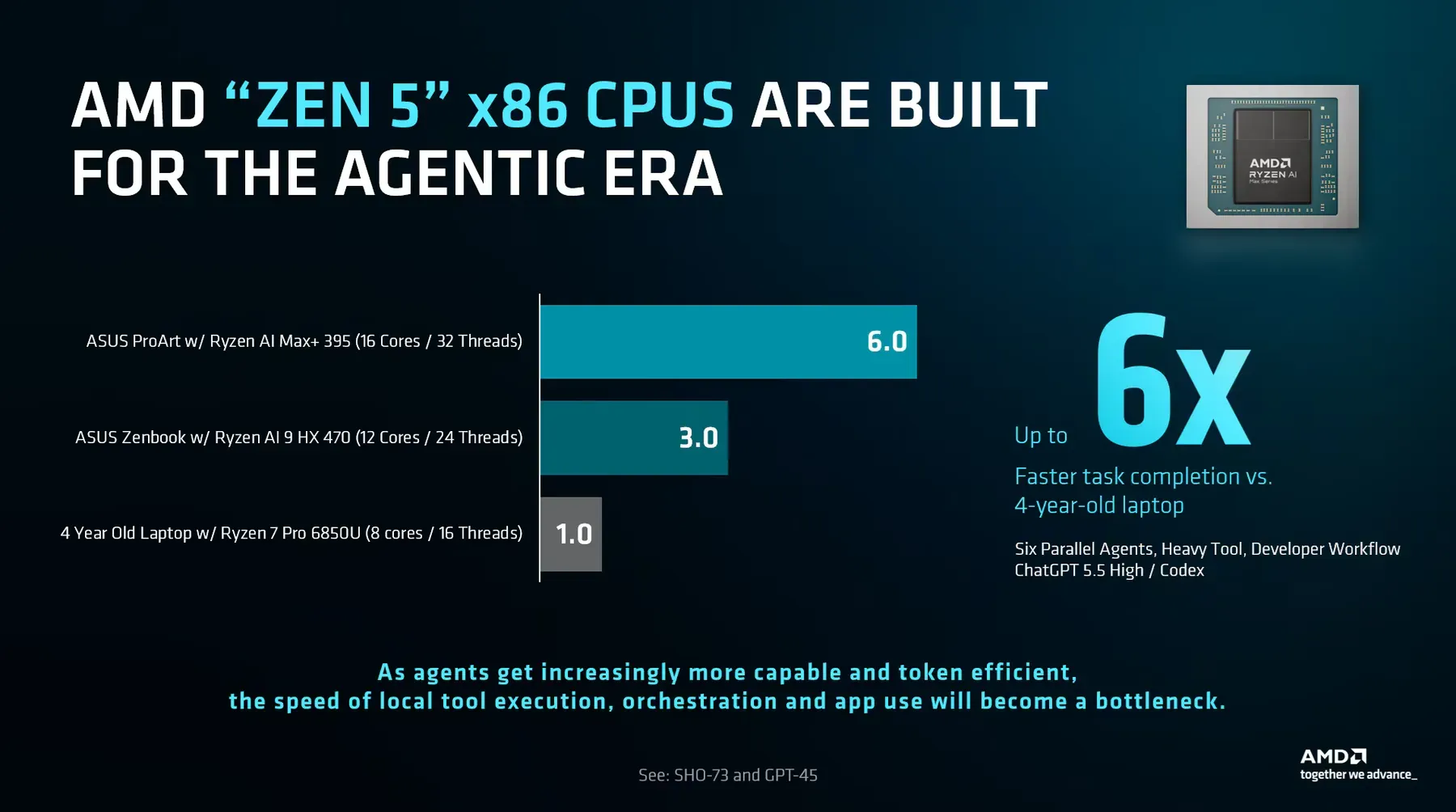
To illustrate the concept, AMD tested a developer workflow using six concurrent ChatGPT 5.5 High agents performing coding and software engineering tasks.
The workload included:
-
Static code analysis.
-
Software compilation.
-
Unit-style testing.
-
Python execution.
-
JSON and CSV serialization.
-
SQLite database queries.
-
Compression and hashing.
-
Package management.
-
Manifest operations.
According to AMD, an ASUS ProArt workstation powered by an AMD Ryzen™ AI Max+ processor delivered up to six times the CPU throughput of a four-year-old laptop during the multi-agent workload.
The company said the results demonstrate how processor performance can directly influence AI productivity as agents increasingly perform work locally rather than relying exclusively on cloud infrastructure.
CPUs, GPUs and NPUs Will Work Together
Rather than replacing GPUs, AMD said AI agents will increase the importance of balanced computing architectures.
Cloud GPUs are expected to remain essential for training and running the largest frontier models, while local GPUs and NPUs will continue accelerating private and low-latency inference on personal devices.
CPUs, however, are increasingly responsible for orchestrating execution, coordinating software processes and enabling agents to interact with operating systems and applications.
The company argues that these technologies will play complementary roles as AI computing becomes more distributed across cloud infrastructure and client devices.
EcoPulse24 Analysis
AMD's message reflects a broader shift occurring across the artificial intelligence industry. Early generative AI focused almost entirely on model quality, inference speed and token generation. Increasingly, however, enterprise customers are measuring value by how quickly AI systems complete practical tasks rather than how rapidly they produce text.
That distinction could reshape hardware priorities across the technology sector. As AI agents become capable of writing software, managing documents, operating enterprise applications and coordinating multiple tools simultaneously, the performance bottleneck may increasingly move away from inference itself toward task execution, operating system interaction and workflow orchestration.
The transition also reinforces a growing trend toward hybrid AI computing, where cloud infrastructure handles large-scale reasoning while local devices execute private data processing, software operations and user interactions. In that environment, CPUs regain strategic importance as the layer that connects AI models with real-world computing tasks.
Whether AMD's vision becomes the dominant architecture remains to be seen, but the industry's direction is increasingly clear: the next phase of artificial intelligence is likely to be judged less by how many tokens a model can generate and more by how effectively it can complete meaningful work.
Explore Related Coverage
Sources & References
Editorial Note
Disclaimer
© 2025 EcoPulse24. All rights reserved.