AI Demand Turns SK Hynix Into a Profit Powerhouse and Solidifies Its HBM Memory Dominance
SK Hynix posted record 2025 profits, driven by AI memory demand and HBM dominance, with order books filled through 2027 and strong future outlook.

Seoul | EcoPulse24
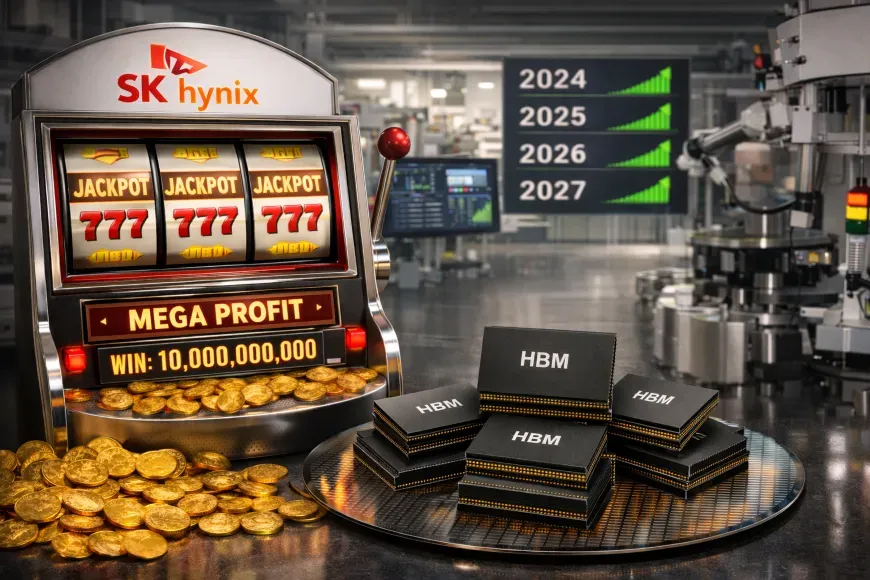
SK Hynix closed the fourth quarter of 2025 with the strongest financial performance in its history, propelled by unprecedented demand for high-bandwidth AI memory as the global memory market shifts toward advanced servers and high-compute data centers. Both quarterly and annual results reflected sharply accelerating revenues and record profit margins, with order books filled through 2027.
In Q4 2025, SK Hynix reported revenues of 32.83 trillion won, surpassing expectations of 32.13 trillion won. Operating profit reached 19.17 trillion won, exceeding the forecast of 17.73 trillion won by nearly 8%. The operating margin stood at 58%, the highest quarterly level in the company’s history, supported by a strong mix of high-value products. Year-on-year, revenues rose by 66% and operating profit surged by 137% compared to the same period last year.
Annual 2025 results were even more striking, with total revenue at 97.15 trillion won versus 66.19 trillion won in 2024, a 47% annual increase. Annual operating profit jumped to 47.21 trillion won - more than double the previous year - while net profit reached a record 42.95 trillion won, with the annual profit margin at a historic high of 49%.
The main driver of this performance was HBM memory, where SK Hynix holds a global market share of 61% to 64% and serves as the primary supplier for advanced AI chips used in Nvidia’s H100, H200, and B200 processors. HBM revenue doubled in 2025, with full production capacity sold out from 2023 through 2027. The company began shipping HBM4 in Q4 2025, with mass production set for 2026, making it the only supplier able to provide both HBM3E and HBM4 simultaneously.
Beyond HBM, SK Hynix benefited from rising prices in traditional memory. Prices for 16GB DDR5 chips quadrupled year-on-year, with further increases of 55-60% expected in Q1 2026. In the NAND market, prices saw low double-digit gains, supported by strong demand for server storage solutions.
AI server demand was a decisive factor, fueled by major investments from Google, Microsoft, Meta, and OpenAI, as data centers expanded and usage shifted from training to inference, distributing workloads across broader infrastructure. This momentum directly impacted future sales, as SK Hynix announced all 2026 products had been fully sold, including complete bookings for DRAM, NAND, and HBM contracts.
Financially, the company strengthened its position, achieving a positive net cash balance of +3.8 trillion won at the end of Q4 and improving the debt-to-asset ratio to 24%. This supports an ambitious expansion plan, with capital investments to exceed 30 trillion won in 2026 (up from about 25 trillion won in 2025), including major projects at the M15X plant in Cheongju, expansions at the Yongin cluster, and accelerated adoption of advanced 1cnm technologies.
EcoPulse24 Analysis:
SK Hynix’s results confirm that the memory market has entered a structural repricing phase led by AI applications, where scale is no longer the main factor - rather, it is the ability to deliver high-bandwidth products with long-term supply reliability. Dominance in HBM, with order books filled through 2027, gives the company rare pricing power and operational stability in a typically cyclical industry. While increased capital spending signals intensifying competition with Samsung and Micron, SK Hynix’s lead in HBM4 and current supply constraints suggest it will maintain its edge through 2026, transitioning from a memory supplier to a core infrastructure pillar in the global AI ecosystem.
Explore Related Coverage
Sources & References
Editorial Note
Disclaimer
© 2025 EcoPulse24. All rights reserved.