Why Australia? The Geopolitics Behind the World's New AI Land Rush
Australia attracts major AI investments due to its stability, land, clean energy, and alignment with Western tech governance.

Dubai | EcoPulse24
Why Australia? The Geopolitics Behind the World's New AI Land Rush
Microsoft's $18 billion bet is the latest signal that Big Tech is quietly redrawing the map of global AI infrastructure - and the reasoning goes far beyond broadband speeds
When Satya Nadella stepped on stage in Sydney on Thursday to announce Microsoft's largest-ever single-country investment - A$25 billion ($17.9 billion) committed to Australian AI infrastructure by 2029 - the headline figure drew the attention. The deeper question went largely unasked: why Australia, and why now?
The answer sits at the intersection of geopolitics, geology, and a growing anxiety among the world's largest technology companies about where it is safe to build the infrastructure that will define the next decade of computing.
The Stability Premium
Across the Asia-Pacific region, the geopolitical calculus for data center investment has become increasingly uncomfortable. Taiwan contends with cross-strait tensions. South Korea and Japan, while technologically advanced, sit in one of the world's most sensitive security corridors. The United States, the traditional anchor of global tech infrastructure, finds itself at the center of trade disputes that affect international technology flows and compliance obligations.
Australia offers a different proposition. As a stable, English-speaking nation with strong ties to Asia, it serves as a regional hub for cloud services and data routing, with submarine cable networks connecting it to Southeast Asia and the United States further enhancing its strategic appeal. For companies making 30-year infrastructure bets measured in the tens of billions, that stability carries a tangible financial value.
Australia's participation in global alliances including AUKUS and QUAD reinforces its role in digital security and regional trust - making it an attractive, low-risk destination for companies building mission-critical AI platforms, whether hyperscale data centers, sovereign cloud zones, or GPU-as-a-service workloads.
A Continent-Sized Land Bank
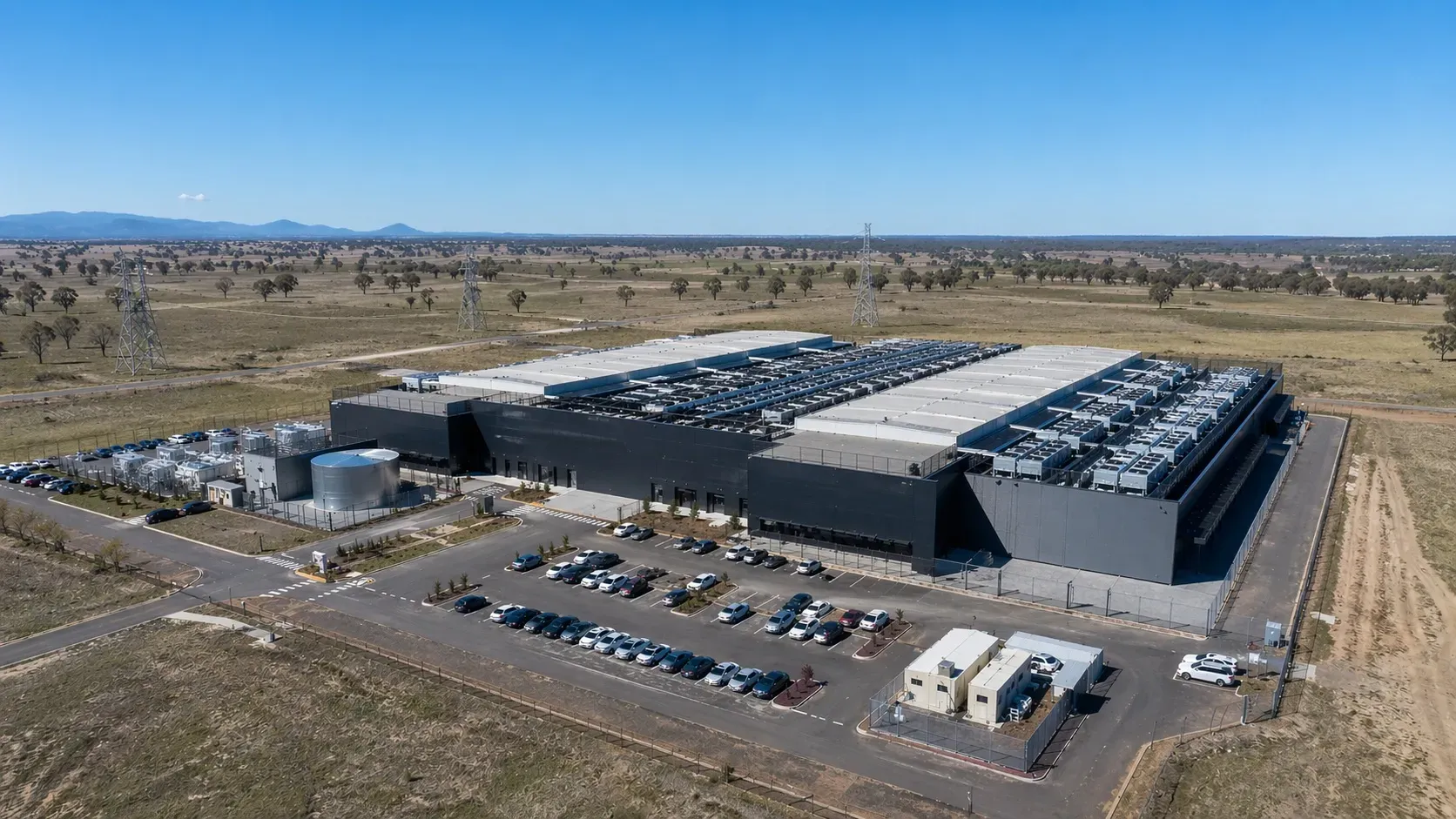
The physical requirements of modern AI infrastructure are rarely discussed in investment announcements, but they matter enormously. AI data centers bear little resemblance to their predecessors. Modern AI-ready facilities can handle rack densities of 100 kilowatts or more, compared to just 10 – 20 kilowatts in older facilities - demanding vast land footprints, reliable power, and increasingly, access to renewable energy to satisfy the sustainability commitments of the companies building them.
Australia's land, solar and wind resources, and skilled trades workforce allow it to build large-scale clean energy projects quickly. AI companies are already agreeing to absorb any energy price increases their operations would otherwise impose on households, and data centers could de-risk investment in clean-energy projects and accelerate the country's energy transition.
Australia's deployable data center capacity is projected to more than double from approximately 1,350 megawatts in 2024 to over 3,100 megawatts by 2030, requiring around A$26 billion in new investment. Microsoft's commitment today lands squarely within that build-out window.
Microsoft Is Not Alone
Microsoft's announcement is significant, but it does not stand alone. It follows a pattern that has been accelerating throughout 2025 and into 2026. Amazon Web Services secured an A$2 billion contract in 2024 to build classified data centers for Australian defense and intelligence operations, and subsequently announced an A$20 billion investment - at the time the largest technology investment in the nation's history. OpenAI has committed to a $7 billion data center deal through NEXTDC in Western Sydney. Google has explored facilities as far as Christmas Island, an Australian territory in the Indian Ocean.
The Bloomberg article notes that Microsoft and its US cloud peers - Amazon, Meta, and Alphabet - plan to spend approximately $650 billion collectively this year on data center buildout globally. Australia is capturing a meaningful and growing share of that flow, precisely because it offers what few other markets can: scale, stability, and sovereign alignment with Western technology governance frameworks.
The Sovereign AI Dimension
There is a subtler strategic logic at work that purely commercial analysis misses. The frontier of AI is being advanced by just two countries - the United States and China. Australia's 2025 National AI Plan wisely avoided any ambition to develop homegrown frontier models. But Australia still needs a foothold in the AI value chain, and ambitious data center construction is the clearest path forward, delivering economic gains and earning Australia a voice in how AI is governed.
For Microsoft specifically, the investment serves dual purposes. Commercially, tech giants that had set up data centers in the Middle East because of cheap fossil-fuel power and permissive regulatory environments may now be looking at Australia as a more sustainable long-term base - one that aligns with tightening ESG requirements and increasingly stringent data sovereignty regulations across the Asia-Pacific. Strategically, According to Bloomberg, Microsoft's Copilot has struggled to keep pace with OpenAI's ChatGPT and Google's Gemini globally. Australia represents a market where the company can compete with infrastructure advantages that rivals have not yet matched at equivalent scale.
What This Means for the Region
For GCC economies watching this capital flow, the Australia story carries a pointed parallel. The Gulf's own AI infrastructure ambitions - from Saudi Arabia's NEOM data corridors to the UAE's sovereign AI agenda - compete in the same global pool of hyperscaler attention and investment. The Australian government has released expectations that any new data centers built there serve the national interest on criteria including security, jobs, local innovation, and electricity and water supplies - a policy architecture that Gulf governments are developing their own versions of at speed.
The race to become the world's preferred AI infrastructure destination is no longer theoretical. Microsoft's Sydney announcement is the latest evidence that the map is being drawn now, and the countries that offer stability, land, clean energy, and regulatory predictability are winning the opening rounds.
Australia, it turns out, has all four.
Sources & References
Editorial Note
Disclaimer
© 2025 EcoPulse24. All rights reserved.