Global markets fall as Iran ceasefire doubts lift oil, hit equities, and expose industrial slowdown risks
Global markets fell as Iran ceasefire doubts drove oil higher, hit equities, and exposed risks of industrial slowdown and rising inflation.

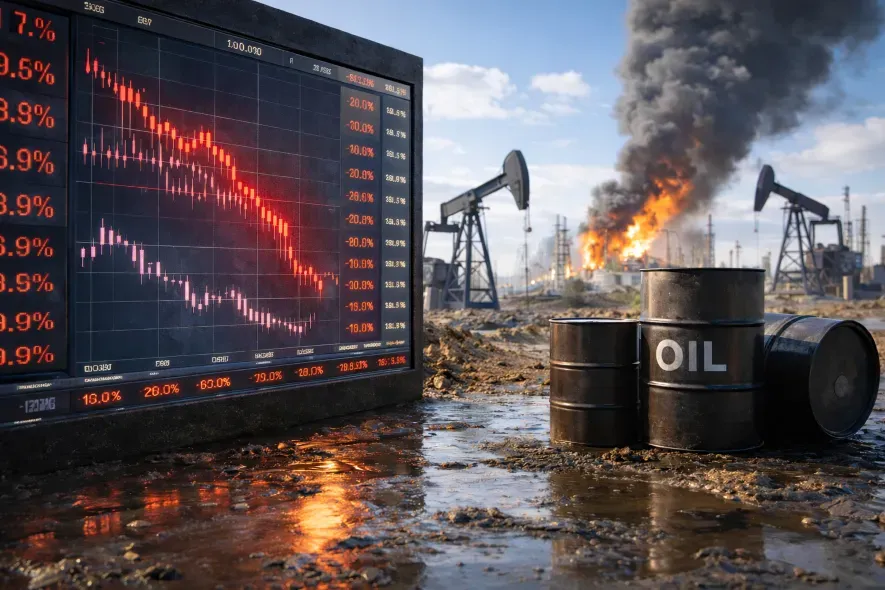
London | EcoPulse24
Ceasefire uncertainty drives oil higher and pressures global equities and industrial activity
Global markets declined on Thursday as renewed doubts over the Iran – US-Israeli ceasefire pushed oil prices higher, triggering a synchronized risk repricing across equities, bonds, and industrial sectors in Europe, Asia, and the Middle East. The shift reflects growing concern that the fragile truce may not hold, with direct implications for energy supply, inflation, and economic momentum.
European equities reversed sharply after the previous session’s rally, with the STOXX 50 falling 0.6% and the STOXX 600 declining 0.4% as investor optimism faded. The move followed Iranian warnings that parts of the ceasefire had been breached, continued Israeli strikes in Lebanon, and ongoing restrictions through the Strait of Hormuz. Cyclical sectors led losses, while energy and utilities outperformed, reflecting a defensive rotation tied to rising oil prices.
Germany’s DAX dropped more than 1%, with industrials, autos, and technology stocks under pressure, highlighting Europe’s structural exposure to energy shocks and supply chain disruptions. This reaction underscores how quickly geopolitical tension translates into equity volatility in export-driven economies.
In Asia, Japan’s Nikkei 225 fell 0.73% and the Topix declined 0.9%, as rising oil prices and geopolitical uncertainty weighed on cost expectations and external demand outlooks. Despite stable domestic conditions, Japanese equities reflected the global shift toward risk aversion, showing how energy-linked shocks propagate across regions.
In the UK, the FTSE 100 slipped just 0.1%, outperforming its European peers due to gains in energy majors such as BP and Shell. This divergence reflects the index’s structural exposure to oil-linked revenues, which act as a buffer during periods of rising crude prices and geopolitical stress.
At the same time, bond markets signaled a parallel repricing of inflation risk. The UK 10-year gilt yield rose to 4.72%, reversing the previous day’s drop, as higher oil prices and escalating tensions increased expectations that inflation could remain elevated, potentially forcing tighter monetary policy ahead.
Industrial data from Europe reinforced the fragility of the economic backdrop. Spain’s industrial production fell 1.1% year-on-year in February, marking the third consecutive contraction and the sharpest decline in a year. The weakness was broad-based across durable goods, intermediate goods, and energy output, indicating that Europe’s industrial base was already under pressure before the latest geopolitical escalation.
In the Middle East, Saudi Arabia’s industrial production rose 8.9% year-on-year in February but showed a clear slowdown from the previous month’s 10.8% growth. Oil-related activity decelerated, alongside softer expansion in non-oil sectors, while monthly output declined. This suggests that even energy-driven economies are beginning to experience moderation, despite elevated oil prices, reflecting a more complex supply-demand dynamic.
Global market and industrial performance under geopolitical stress
The following snapshot captures cross-asset and regional reactions to ceasefire uncertainty and rising energy risk:
| Market / Indicator | Latest Reading | Change |
|---|---|---|
| Nikkei 225 | 55,895 | -0.73% |
| Topix | 3,741 | -0.90% |
| STOXX 50 | - | -0.60% |
| STOXX 600 | - | -0.40% |
| DAX 40 | - | -1.00%+ |
| FTSE 100 | 10,600 | -0.10% |
| UK 10Y Gilt Yield | 4.72% | +7 bps |
| Spain Industrial Output | -1.1% | Continued decline |
| Saudi Industrial Output | +8.9% | Slowing growth |
EcoPulse24 Analysis
The current market reaction reflects a systemic shift from short-lived geopolitical optimism to renewed uncertainty, where the Iran ceasefire is no longer treated as a stabilizing anchor but as a fragile arrangement prone to disruption. This transition is critical because it reintroduces energy risk as a central driver of global asset pricing.
Oil’s rebound is not just a commodity move; it is a macro signal. The Strait of Hormuz remains a strategic chokepoint, and any restriction - partial or perceived - feeds directly into supply expectations, risk premiums, and ultimately inflation dynamics. Markets are now internalizing that energy flows are conditional, not guaranteed.
This dynamic is particularly significant for Europe, where industrial weakness, as seen in Spain, intersects with rising energy costs. The combination creates a dual pressure environment: declining production capacity alongside increasing input costs. This raises the probability of stagflation-like conditions if energy prices remain elevated.
Japan’s market response further illustrates how globalized supply chains amplify these shocks. Higher oil prices translate into higher import costs and reduced margin expectations, even in economies with stable domestic demand. This reinforces the idea that energy risk is globally transmitted, not regionally contained.
Saudi Arabia’s data adds another layer of complexity. While growth remains positive, the slowdown suggests that even oil-linked economies are not immune to shifts in production dynamics and global demand patterns. This indicates that elevated oil prices alone are not sufficient to sustain accelerated industrial expansion, especially in a volatile geopolitical environment.
Meanwhile, the rise in UK bond yields signals that markets are beginning to reassess inflation trajectories. If energy-driven inflation persists, central banks may be forced to maintain tighter policy stances longer than anticipated, delaying any easing cycle and increasing pressure on growth-sensitive sectors.
Ultimately, markets are entering a phase best described as “risk premium restoration,” where previously discounted geopolitical risks are being re-priced across asset classes. This marks a transition toward an environment where energy security, supply chain resilience, and geopolitical stability are core determinants of market direction, reinforcing the broader Energy Crisis framework shaping the global economy in 2026.
Explore Related Coverage
Sources & References
Editorial Note
Disclaimer
© 2025 EcoPulse24. All rights reserved.