Google Discover: February 2026 Core Update Launched to Combat Clickbait and Boost Local Content
Google's Feb 2026 Discover update targets clickbait, boosts local, in-depth content, and stresses topic expertise and technical quality.

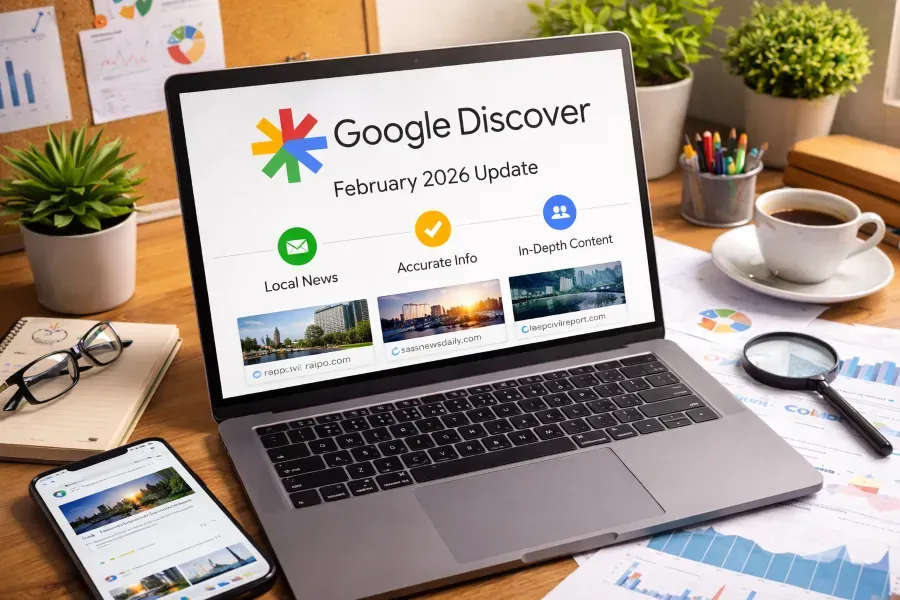
Google rolls out the February 2026 Discover Core Update to curb misleading headlines and promote locally relevant, in-depth content, with a strong emphasis on topical expertise and originality.
Exclusive – EcoPulse24 | Google
Google has officially announced the launch of its new February 2026 Discover Core Update, as confirmed by its Search Advocate John Mueller. The update is fully dedicated to enhancing user experience within Google Discover, and represents a continuation of the sweeping algorithmic changes Google initiated in late 2025, most notably with the December 2025 core update.
What Does the February 2026 Update Focus On?
The new update aims to fundamentally reshape how articles are surfaced in Discover through four primary pillars:
1. Local Content Comes First
Google will prioritize content that is geographically relevant to users, significantly improving visibility opportunities for websites publishing country-specific or regionally focused coverage. This shift strengthens the position of local and regional publishers within Discover feeds.
2. Eliminating Clickbait and Misleading Headlines
The update directly targets websites that rely on sensationalism or headlines that do not accurately reflect the substance of the content. The objective is to ensure a higher-quality, more trustworthy Discover experience for users.
3. Topic Authority Over General Site Strength
Rather than evaluating a website solely on its overall authority, Google will now assess expertise on a topic-by-topic basis. A site with strong, consistent coverage in a specific field - such as gardening, finance, or energy - can outperform larger general news outlets within that topic, even if the site itself is smaller.
4. Depth, Originality, and Insight
The update favors in-depth, analytical, and original content that provides genuine value, moving away from articles that merely aggregate, rewrite, or superficially summarize existing news.
A Continuation of the December 2025 Core Update
This February update cannot be viewed in isolation from the December 2025 core update, which focused heavily on site structure, performance, and compliance with E-E-A-T standards (Experience, Expertise, Authoritativeness, and Trustworthiness).
While the December update laid the technical and structural foundation, the February 2026 update shifts attention to editorial behavior and content integrity. Websites that successfully passed the December filters - demonstrating structural stability and clarity (as reflected by signals such as the appearance of Sitelinks) - are now subject to a deeper evaluation of headline honesty, content depth, and topical consistency.
How Can Publishers Avoid Traffic Declines?
John Mueller noted that, like all core updates, the February 2026 Discover update may result in traffic fluctuations. To maintain stability, experts recommend:
-
Avoiding click-inducing phrases such as “You won’t believe,” “disaster,” “shocking,” or “watch before it’s deleted.”
-
Focusing on clear topical specialization (niche authority) rather than covering unrelated subjects indiscriminately.
-
Updating older articles with more accurate data, deeper analysis, and added context.
EcoPulse24 Analysis | The Technical and Structural Dimensions of the February 2026 Update
The EcoPulse24 analysis team believes this Discover update represents more than a content policy adjustment - it marks a shift in how Google’s algorithms interpret site metadata and structural signals. To ensure technical alignment, the following areas require particular attention:
Enhanced Schema Markup
Traditional Article Schema alone is no longer sufficient. The current update demands precise identification of an article’s subject using about and mentions properties within structured data, enabling Google to clearly understand a site’s topic authority, a concept emphasized by John Mueller.
Strengthening Technical Trust Signals
The appearance of Sitelinks (as seen in recent search results) is a strong technical signal indicating that a site has successfully passed the December 2025 structural filters. From a technical standpoint, this reflects efficient internal linking and hierarchy, which should be preserved and reinforced.
Image Performance and LCP Optimization
Since Discover is heavily driven by visual engagement, the update closely monitors large image loading speed. Pages that negatively impact Largest Contentful Paint (LCP) may be excluded from Discover recommendations, even if the written content is of high quality. The use of optimized formats such as WebP is now critical.
Open Graph Consistency
It is essential that Open Graph (OG) titles and descriptions - used across social platforms and Discover - accurately match on-page content. Any mismatch may trigger classification as clickbait under Google’s newly enhanced machine-learning systems introduced with this update.
Technical Conclusion – EcoPulse24 Guidance
At EcoPulse24, we strongly advise developers and publishers to closely monitor crawl logs during this period. An increase in activity from bots such as GoogleByline or Google-InspectionTool indicates that a site is under active evaluation by the updated systems. During this phase, ensuring 100% error-free code, clean rendering, and stable performance is critical.
EcoPulse24 – Original Analysis
Professional, data-driven financial journalism.
Explore Related Coverage
Sources & References
https://developers.google…discover-core-update
Editorial Note
Disclaimer
Please review the Terms & Conditions.
© 2025 EcoPulse24. All rights reserved.