Hang Seng Snaps Three-Session Losing Streak on Strong China January-February Data
Hong Kong's Hang Seng Index rose 1.45% on Monday, rebounding from three sessions of losses as China's January-February 2026 activity data beat forecasts.

EcoPulse24 | Hong Kong
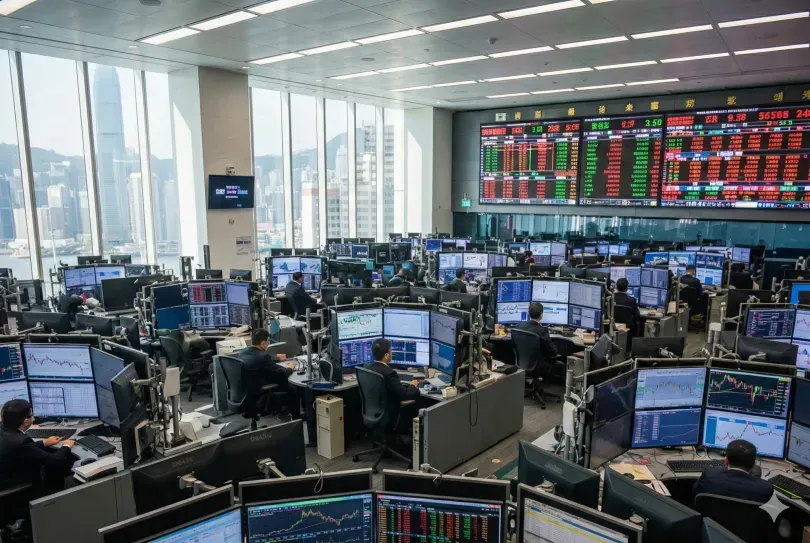
Hong Kong's Hang Seng Index surged 368 points, or 1.45%, to close at 25,834 on Monday, snapping a three-session losing streak as China's combined January – February 2026 activity data came in well above market forecasts across industrial output, retail sales, and fixed investment. The rebound came despite ongoing volatility tied to the Iran conflict and uncertainty over a potential Trump – Xi summit.
China's January – February Data Beats Expectations
China's National Bureau of Statistics reported that industrial output grew 6.3% year-on-year during the first two months of 2026, exceeding analyst consensus estimates. Retail sales of consumer goods rose 2% year-on-year, while fixed asset investment also beat forecasts, offering a broad signal that the world's second-largest economy has maintained solid growth momentum heading into the new year. The data released Monday reinforced confidence among investors who had grown cautious over potential spillover effects from the Middle East conflict, which has sent oil prices above $100 per barrel and lifted shipping costs globally. However, China's statistics bureau did caution that external pressures, geopolitical risks, and ongoing domestic structural challenges remain elevated, suggesting that the resilience may be fragile if the conflict escalates further.
Iran Conflict and Trump – Xi Tensions Weigh on Sentiment
While the upbeat China data provided a boost, gains on the Hang Seng were capped by mainland Chinese equity markets, which fell for a third consecutive session. Investors were rattled by speculation that a planned summit between US President Donald Trump and Chinese President Xi Jinping could be delayed, as Washington pressed Beijing to cooperate in reopening the Strait of Hormuz. The closure of the strait has severely disrupted Persian Gulf oil flows and strained global supply chains, making it a central point of diplomatic tension between Washington and Beijing. Major GCC exporters, including Saudi Arabia, have rerouted oil shipments through the Red Sea to bypass the Hormuz blockage, but the resulting shipping cost increases have added inflationary pressure to global trade, including China's import bill.
Sector Breakdown and Key Movers
Gains on the Hang Seng were broad-based, with standout movers including Knowledge Atlas (+14.0%), Mixue Group (+6.4%), Akeso Inc. (+6.0%), Xiaomi Corp. (+5.3%), Orient Overseas (+4.2%), and Meituan (+3.0%). Technology and consumer discretionary stocks led the advance, benefiting from the stronger-than-expected retail sales data. Energy and shipping-related equities saw more muted moves, as investors weighed rising fuel costs against improved demand signals. Orient Overseas International, a major container shipping operator, rose on hopes that improving Chinese economic activity would sustain freight volumes even as route disruptions continue around the Strait of Hormuz and the wider Gulf region.
Implications for MENA and Global Markets
China's economic resilience carries significant implications for MENA commodity exporters, particularly Gulf producers of oil, aluminum, petrochemicals, and fertilizers. A robust Chinese industrial sector underpins demand for crude oil, LNG, and metals - the core export streams of GCC economies. The beating of consensus estimates in January – February 2026 data provides a degree of demand-side reassurance for Gulf exporters even as the supply side faces disruptions from the ongoing conflict. US equity futures also traded notably higher ahead of the Federal Reserve's policy meeting later this week, suggesting broader risk appetite is recovering somewhat despite energy price pressures.
EcoPulse24 Analysis
EcoPulse24 Analysis: China's strong January – February 2026 data delivered a timely boost to Asian risk sentiment at a moment when the Iran conflict is casting a long shadow over global growth forecasts. For GCC exporters, resilient Chinese demand is a critical counterbalance to the disruptions facing their own shipping and export routes. However, the potential delay in the Trump – Xi summit adds a layer of geopolitical complexity that could undermine the demand signal if trade tensions between the two superpowers are reignited. Markets will closely watch the outcome of this week's Fed and ECB meetings for signals on how central banks intend to navigate the intersection of an energy shock and a slowing global economy.
Explore Related Coverage
Sources & References
Editorial Note
Disclaimer
© 2025 EcoPulse24. All rights reserved.