Iran Turned Hormuz Into a Toll Booth
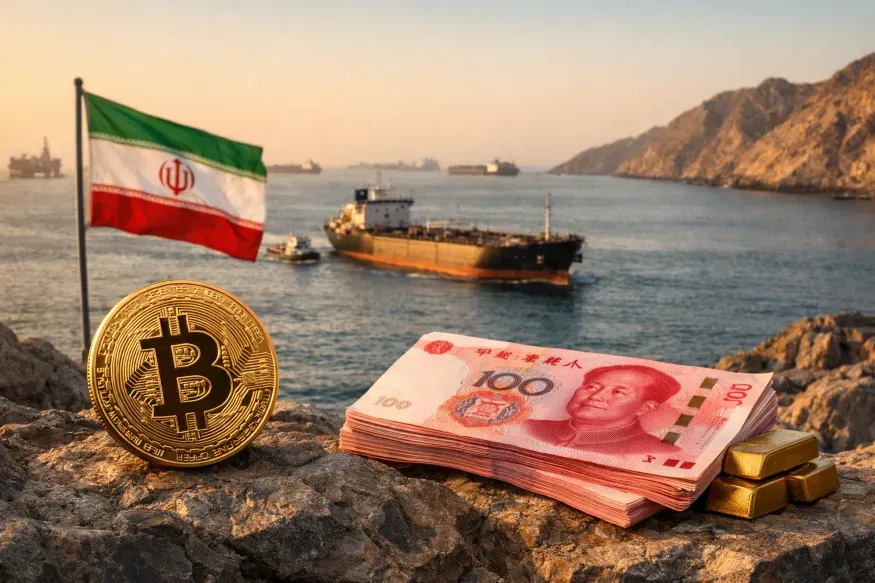
Iran now charges Bitcoin/yuan tolls for Hormuz passage, bypassing US dollars, creating a new revenue stream and challenging global norms.

Dubai | EcoPulse24
Iran Is Charging Bitcoin to Cross Hormuz. And It's Working.
Before the wire agencies caught up, the logic was already visible to anyone watching the numbers: Iran was not closing the Strait of Hormuz. It was turning it into a toll booth. And the toll is not payable in dollars.
In one of the most strategically important maritime passages in human history - through which flows one-fifth of the world's oil and a quarter of global LNG trade - tanker operators are now paying transit fees in Bitcoin and Chinese yuan. The dollar, the currency that has priced global energy for seven decades, is not accepted.
This is not a threat. It is documented practice that has been operational since mid-March 2026.
How the Mechanism Works
Iran never made a formal announcement that it would charge tolls on the Strait of Hormuz. What happened was more sophisticated than that. As the military crisis escalated, Islamic Revolutionary Guard Corps forces began treating every vessel approaching the strait as a negotiable file. A tanker seeking safe passage contacts an intermediary. Vessel ownership records, flag registration, cargo manifests, crew lists, and AIS tracking data are submitted. Then a number arrives.
For oil tankers: approximately one dollar per barrel of cargo. A fully loaded VLCC carrying two million barrels pays roughly two million dollars for passage. Container ship fees are negotiated individually.
Payment options: Bitcoin, Chinese yuan routed through Kunlun Bank via CIPS outside the SWIFT network, or in some cases stablecoins. US dollars are declined.
On March 30-31, 2026, Iran's parliament formally approved what is now known as the "Strait of Hormuz Management Plan" - legislation that codified what had already been operating informally for weeks.
The Numbers
What is happening at Hormuz is not symbolic. It is an economic operation with substantial revenues.
Estimates suggest the toll system could generate up to $20 million per day from oil tankers alone at normal traffic levels. If extended to LNG vessels, projections rise to between $600 million and $800 million per month. Annualized, that is a potential revenue stream exceeding $7 billion per year - from a waterway Iran does not legally own but militarily controls.
At least two vessels have already paid - confirmed by Lloyd's List Intelligence in early April 2026. One transit was brokered through a Chinese maritime services intermediary. Of 142 vessels tracked passing through the strait area since March 1, 67 percent carried direct Iranian or Chinese affiliation.
The Technical Architecture of Sanctions Evasion
The choice of Bitcoin and Chinese yuan is not arbitrary. It is deliberate financial engineering.
Chinese yuan payments are routed through Kunlun Bank using China's CIPS system - an alternative to SWIFT that operates entirely outside US correspondent banking oversight. Bitcoin enables near-instant settlement without touching any correspondent banking infrastructure, making real-time interception technically difficult. The IRGC is not new to this playbook. TRM Labs documented over one billion dollars flowing through IRGC-linked cryptocurrency infrastructure prior to this conflict. What Hormuz represents is the deployment of that existing sanctions evasion architecture as a direct sovereign revenue collection mechanism - a documented first in modern history.
Iran's Legal Framing
Iran has not presented the tolls as a hostile act. Officials have characterized them as payment for "security and environmental services" - naval escort through a safe corridor, environmental monitoring, navigational assistance. Iranian legislators have explicitly compared the system to the Suez and Panama Canal toll regimes.
The comparison does not hold under international law. Suez and Panama are artificial waterways built and maintained by sovereign states. Hormuz is a natural international strait governed by Article 37 of UNCLOS, which guarantees the right of transit passage for all vessels and explicitly states that right "shall not be impeded."
Article 26 of UNCLOS permits charges only for specific services actually rendered to the transiting vessel, applied without discrimination. Iran's fee is neither tied to unrequested services nor applied uniformly. It is payment for protection from a threat created by the same state collecting the fee.
Five Tiers of Access
Iran operates a classification system for vessel access through the strait:
Tier one - Iranian, Chinese, and Russian-flagged vessels: free passage, no fees. Tier two - vessels from "friendly" states including Pakistan, India, and Turkey: reduced fees, diplomatic negotiation. Tier three - neutral-state vessels: full fees with enhanced documentation requirements. Tier four - Western-flagged vessels linked to sanctions regimes: elevated fees and arbitrary conditions. Tier five - vessels linked to the United States or Israel: denied transit entirely.
This tiering system is not merely a revenue mechanism. It is a tool for fragmenting Western coalition solidarity, making bilateral commercial access more valuable than collective enforcement posture - country by country, cargo by cargo.
The Ceasefire Does Not Stop the Tolls
This is the core of today's Al Jazeera report. An Iranian official explicitly confirmed that the toll collection mechanism will continue operating under the ceasefire. This reveals the fundamental nature of the system: it was not built as a temporary wartime measure. It was built as a permanent revenue infrastructure.
Iran's strategic objective is clear. A formal toll regime on Hormuz transforms a wartime pressure instrument into a durable source of sovereign income. The distinction matters: one loses its value when the crisis ends, the other becomes more institutionalized as time passes. Tehran is pursuing the latter.
EcoPulse24 Analysis
What is unfolding at Hormuz is the most consequential economic development in the region since Egypt nationalized the Suez Canal in 1956 - not because Iran is charging tolls, but because it is collecting them in a currency Washington cannot freeze.
Bitcoin at Hormuz is not symbolic defiance. It is a calculated engineering decision that exploits the gap between blockchain settlement speed and the pace of US financial enforcement mechanisms. Unless the United States develops interception capabilities at the blockchain protocol level itself - which does not appear imminent - this collection mechanism will continue to function regardless of diplomatic outcomes.
The implications for Gulf energy markets are layered. First, sustained uncertainty around navigation freedom keeps risk premium embedded in oil prices even as direct military confrontation recedes. Second, any normalization of the toll regime - even within a post-war settlement framework - establishes a precedent with dangerous reach: that a coastal state can transform a natural international strait into a sovereign revenue source through the application of sufficient military force.
The question the coming months will answer is not whether Iran will continue collecting tolls. It almost certainly will. The real question is whether the international community will construct a financial and legal coalition sufficient to make the toll regime more costly for Iran than it is profitable. As of today, no such coalition exists.
What was clear from the numbers weeks ago is now confirmed by official Iranian statement: Hormuz has changed. The world's most important energy chokepoint now has a price - and that price is not payable in dollars.
Sources & References
Editorial Note
Disclaimer
© 2025 EcoPulse24. All rights reserved.