Japan's Nikkei Sinks 4% as AI Chip Selloff and Oil Surge Shake Global Markets
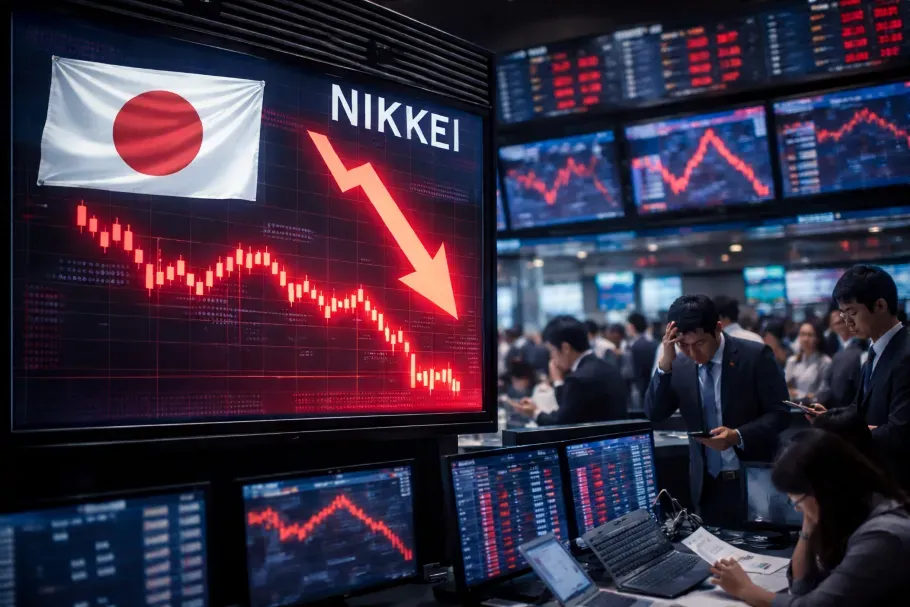
Japan's Nikkei fell more than 4% as a global semiconductor selloff, rising oil prices and renewed Middle East tensions weighed on technology shares.

Tokyo | EcoPulse24
Japanese equities suffered their sharpest daily decline in more than a month on Friday as a deepening global selloff in semiconductor stocks combined with rising geopolitical tensions in the Middle East to trigger broad-based risk aversion across financial markets.
The Nikkei 225 Index tumbled 4.03% to close at 64,140, while the broader Topix Index lost 2.72% to finish at 3,919, with both benchmarks ending at their lowest levels in over a month.
The decline extended a global retreat in technology shares as investors reassessed lofty valuations across the artificial intelligence sector while growing increasingly concerned about the sustainability of heavy AI-related capital spending.
Semiconductor Stocks Lead Broad Market Decline
Technology and semiconductor companies accounted for the largest losses during Friday's session.
Among the biggest decliners were:
| Company | Daily Change |
|---|---|
| Kioxia Holdings | -16.1% |
| Taiyo Yuden | -11.9% |
| SoftBank Group | -9.0% |
| Tokyo Electron | -8.1% |
| Advantest | -7.2% |
The weakness mirrored selling pressure seen across global AI-related equities as investors continued rotating away from high-growth technology names following months of strong gains.
Rising Oil Prices Add Pressure
Market sentiment was further weakened by the escalating conflict between the United States and Iran, which pushed crude oil prices higher and reignited concerns over inflation and interest rates.
Higher energy prices raise the risk of renewed inflationary pressures, potentially reducing the scope for central banks to ease monetary policy in the coming months.
The combination of rising geopolitical uncertainty and higher oil prices prompted investors to reduce exposure to growth-oriented assets, particularly technology companies whose valuations remain highly sensitive to changes in interest-rate expectations.
Weekly Losses Deepen
Friday's decline capped a difficult week for Japanese equities.
Over the five trading sessions:
| Index | Weekly Change |
|---|---|
| Nikkei 225 | -6.4% |
| Topix | -2.9% |
The sharp underperformance of the Nikkei reflected its heavier weighting toward semiconductor equipment manufacturers and technology exporters, sectors that have become increasingly exposed to swings in global AI investment sentiment.
Investors Reassess AI Valuations
The latest selloff underscores growing investor caution toward artificial intelligence-related companies after an extended rally fueled by expectations of sustained spending on AI infrastructure.
While long-term demand for AI computing remains robust, markets have become more sensitive to questions surrounding capital expenditure, earnings visibility, and valuation multiples.
Japanese semiconductor equipment makers, many of which are critical suppliers to the global chip industry, have benefited significantly from the AI investment cycle. That has also made them among the most vulnerable stocks during periods of risk-off sentiment.
EcoPulse24 Analysis
Friday's decline in Japanese equities reflects more than a regional market correction. It highlights how closely global financial markets have become linked through the AI investment cycle and macroeconomic expectations. Semiconductor companies sit at the center of this relationship because they are both the primary beneficiaries of AI infrastructure spending and among the most richly valued segments of global equity markets.
The renewed surge in oil prices following escalating tensions between the United States and Iran has introduced an additional layer of uncertainty. Higher energy costs could complicate the global inflation outlook, reducing expectations for monetary easing and putting renewed pressure on growth stocks whose valuations depend heavily on lower discount rates.
The scale of losses among companies such as Kioxia, Tokyo Electron, Advantest, and SoftBank suggests investors are actively reducing exposure to AI-related assets rather than reacting solely to company-specific developments. If similar weakness extends into U.S. and European trading sessions, markets may enter a broader phase of portfolio rotation away from high-growth technology shares and toward more defensive sectors.
Despite the near-term volatility, structural demand for AI infrastructure remains intact. However, the episode demonstrates that even sectors supported by powerful long-term themes remain vulnerable when geopolitical risks, inflation expectations, and valuation concerns converge simultaneously.
Explore Related Coverage
Sources & References
Editorial Note
Disclaimer
© 2025 EcoPulse24. All rights reserved.