Why Did Good Jobs News Crash the Nasdaq by 4%?
Wall Street suffers its sharpest tech selloff since April 2025

NewYork | EcoPulse24
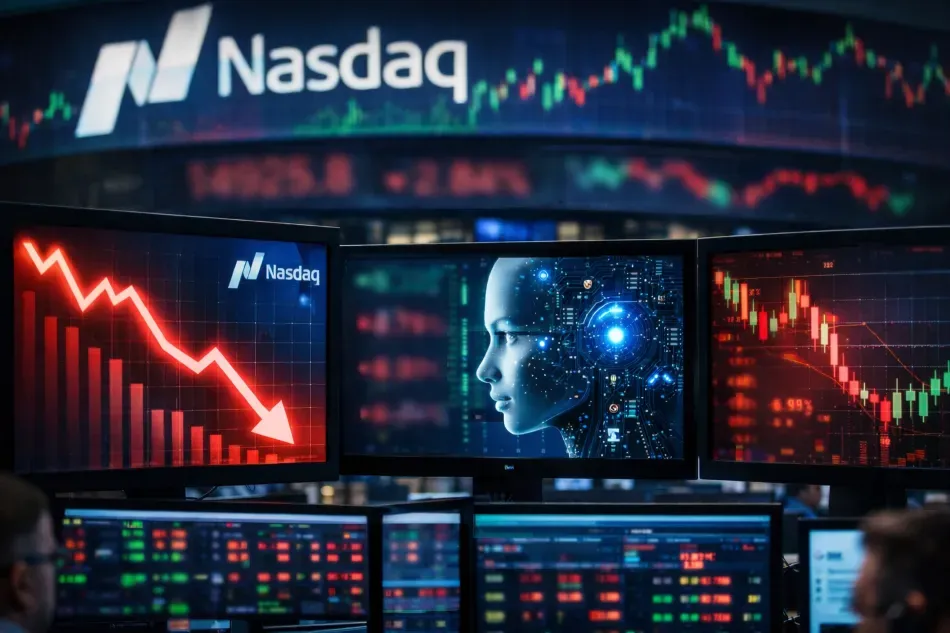
US equity markets closed sharply lower on Friday in a session defined by two simultaneous shocks: a violent collapse in semiconductor shares and a surge in Treasury yields triggered by a stronger-than-expected jobs report. The Nasdaq lost 4.18% and closed at 25,709.43 for its biggest drop going back to April 2025. The S&P 500 dropped 2.64% and ended at 7,383.74, while the Dow Jones Industrial Average lost 695.15 points, or 1.35%, settling at 50,866.78. For the week, the S&P 500 fell more than 2% while the Nasdaq lost approximately 4.7%, snapping a nine-week winning streak.
The trigger: a jobs report that was too strong for comfort
The catalyst arrived before markets opened. The Bureau of Labor Statistics reported that nonfarm payrolls increased by 172,000 in May, well above the 80,000 jobs that economists had expected to be added. Unemployment held steady at 4.3%. On the surface, a robust labour market is a sign of economic health. In the current environment, it is anything but straightforward. The surprisingly strong data prompted traders to scale back hopes for interest rate cuts, with money markets now pricing in roughly a 60% chance of a Fed rate increase before the end of 2026.
The mechanism is direct: when the economy is too strong, the Federal Reserve has less reason to cut rates - and potentially more reason to raise them. Higher rates increase the discount rate applied to future earnings, which disproportionately punishes high-growth, long-duration assets. Technology and semiconductor stocks sit at the top of that category.
Why bond yields matter for chip stocks
The 10-year yield jumped above 4.5%, while the 30-year yield advanced above 5% - key levels that revived concerns about a slowing economy and raising borrowing costs for companies helping to fuel the AI buildout. This is the transmission mechanism the market reacted to on Friday: higher yields make risk-free government bonds more attractive relative to equities, raise the cost of capital for capital-intensive AI infrastructure projects, and compress the valuation multiples that tech stocks have been trading at throughout 2026.
The AI infrastructure buildout runs on capital. Microsoft committed $80 billion in capex. Meta guided $125 – 145 billion. Alphabet just raised $80 billion in equity. Nvidia's customers collectively spend $300 billion or more annually on GPU clusters, data centres, and networking. When borrowing costs rise, the financial case for that level of investment becomes harder to sustain - and markets priced that risk on Friday.
Semiconductor stocks: the epicentre of the selloff
| Stock | Friday's Move |
|---|---|
| Marvell Technology | −~16% |
| Micron Technology | −~13% |
| Intel | −~11% |
| AMD | −~11% |
| Broadcom | −7%+ (following −12% Thursday) |
Broadcom fell approximately 15% on Thursday after CEO Hock Tan declined to raise the company's full-year AI chip sales target of $100 billion, disappointing investors who had priced in a more aggressive guidance upgrade. Revenue of $22.19 billion narrowly missed estimates of $22.27 billion, while the infrastructure software segment fell short of expectations - sufficient to trigger a broad sector selloff on Friday., triggering the semiconductor sector selloff. What began as a company-specific reaction to earnings disappointment rapidly broadened into a sector-wide liquidation. Marvell Technology and Micron absorbed the steepest losses, falling approximately 16% and 13% respectively, while Intel and AMD each declined around 11%.
Market rotation: where capital moved
Investors rotated into healthcare and staples stocks on Friday as they dumped tech shares. Colgate-Palmolive added 4%, Coca-Cola was up more than 3%, and Johnson & Johnson was up 2%. The rotation is a textbook risk-off signal: capital moving from high-growth, rate-sensitive assets into defensive sectors with stable cash flows and lower sensitivity to interest rate changes. It reflects a genuine reassessment of the macro environment rather than a technical correction.
Weekly performance - major indices
| Index | Friday | Week |
|---|---|---|
| Nasdaq Composite | −4.18% | −4.7% |
| S&P 500 | −2.64% | −2.0%+ |
| Dow Jones | −1.35% | - |
EcoPulse24 Analysis
Friday's session illustrates a dynamic that has defined equity market behaviour throughout 2026: the paradox of good economic news becoming bad market news. A labour market that adds 172,000 jobs in a single month - more than double consensus expectations - should, in a conventional cycle, be a bullish signal. In the current environment, it is the opposite, because it removes the Fed's rationale for rate relief and raises the spectre of further tightening at precisely the moment when AI infrastructure spending requires sustained cheap capital to remain economically viable.
The semiconductor sector's reaction deserves particular attention because it exposes a structural vulnerability in the AI investment thesis. The thesis rests on a self-reinforcing loop: AI demand drives chip demand, chip demand drives earnings growth, earnings growth justifies elevated valuations, and elevated valuations attract further capital into the sector. The loop functions cleanly when borrowing costs are low and the Fed is in easing mode. It becomes fragile when the 30-year Treasury yield crosses 5% and the cost of financing $300 billion in annual AI capex rises materially. Friday's selloff is the market stress-testing that loop under tighter financial conditions.
Inflation, stoked by the Iran war's effect on energy prices, is arguably a bigger threat than unemployment right now, making rate cuts politically popular but economically questionable. This is the bind the Federal Reserve now operates within: an economy generating strong employment, persistent inflation amplified by energy supply disruptions, and a technology sector that has priced in monetary easing that may not arrive. The jobs report did not create this tension - it made it impossible to ignore.
For investors tracking Gulf and emerging market implications, a sustained high-yield environment in the United States strengthens the dollar, tightens global liquidity, and raises the cost of capital across all markets. The semiconductor selloff is a US equity story today. Its transmission into global tech supply chains, Asian markets - South Korea's Kospi dropped 5.5%, its worst day of the year - and regional investment sentiment is already underway.
Explore Related Coverage
Sources & References
Tradinf Economics
CNBC
Editorial Note
Disclaimer
© 2025 EcoPulse24. All rights reserved.