Nikkei 225 Rises 0.5% to 54,000 as Easing Oil Prices Snap Three-Day Losing Streak
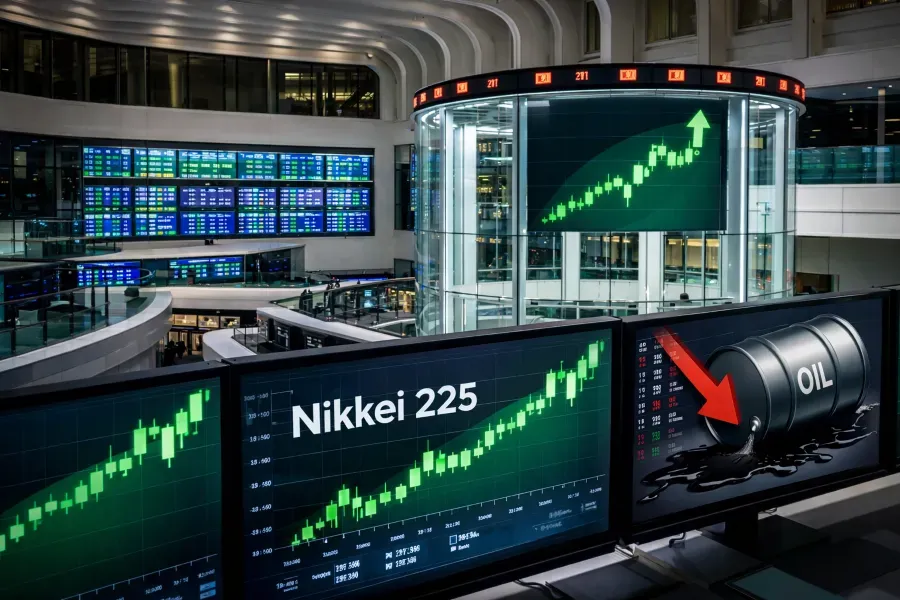
Japan's Nikkei 225 rose 0.5% to around 54,000 on Tuesday, snapping a three-day decline as easing oil prices boosted risk appetite in Asian markets.

EcoPulse24 | Tokyo
Japan's Nikkei 225 Index rose 0.5% to around 54,000 on Tuesday, while the broader Topix Index gained 1.5% to 3,665, snapping a three-day losing streak as easing oil prices helped lift investor sentiment across Asian equity markets. The rebound tracked strong overnight gains on Wall Street, where major indexes advanced as crude prices fell after several oil tankers safely navigated the Strait of Hormuz, raising hopes the critical waterway could soon reopen.
Drivers of the Rebound
The key catalyst for Tuesday's rally was the retreat in crude oil prices, which had been elevated for weeks due to geopolitical tensions in the Middle East and disruptions to shipping through the Strait of Hormuz. As oil prices eased, concerns over Japan's vulnerability as a major energy importer were temporarily alleviated, lifting sentiment across the board. Defense stocks and financial shares led the advance, with Mitsubishi Heavy Industries rising 3.5%, Kawasaki Heavy Industries gaining 2.3%, Mitsubishi UFJ Financial Group up 1.8%, Sumitomo Mitsui Financial Group adding 2.4%, and Mizuho Financial advancing 2.4%.
Technology stocks also participated in the rally, reflecting the broader risk-on tone that swept through global markets as energy price pressures appeared to moderate. The Topix, which includes a wider range of companies, outperformed the Nikkei, indicating broad-based buying rather than concentration in a few large-cap names.
Bank of Japan Watch
Investors are closely monitoring the Bank of Japan's upcoming policy meeting, where the central bank is widely expected to keep its policy rate unchanged amid heightened uncertainty stemming from the Iran conflict and its implications for the Japanese economy. BOJ Governor Kazuo Ueda acknowledged that underlying inflation is gradually moving toward the bank's 2% target, but noted that the path forward is clouded by global energy market volatility. Japan has so far declined US President Donald Trump's call to send warships to escort oil tankers through the Strait of Hormuz, adding a diplomatic dimension to its economic exposure to the conflict.
The Japanese yen remained under pressure, trading around 159.5 per dollar as verbal interventions from Finance Minister Satsuki Katayama failed to halt the currency's decline. A weak yen compounds the inflation impact for Japan by raising the cost of energy and commodity imports, keeping pressure on both consumers and businesses.
Japan's Exposure to the Middle East Conflict
Japan is among the world's most energy-dependent major economies, importing roughly 90% of its crude oil needs, a significant portion of which transits through the Strait of Hormuz. The ongoing conflict has therefore placed Japan in a particularly exposed position, with rising energy costs feeding directly into manufacturing costs and consumer prices. Analysts estimate that sustained oil prices above USD 100 per barrel could shave 0.3 to 0.5 percentage points off Japan's GDP growth in 2026.
Despite this vulnerability, Japan's equity market has shown resilience supported by strong corporate earnings, ongoing share buyback programs, and continued foreign investor interest in Japanese equities following years of corporate governance reforms. The weaker yen, while inflationary, also boosts the yen-denominated earnings of Japan's major export-oriented corporations.
EcoPulse24 Analysis
EcoPulse24 Analysis: Tuesday's rebound in Japanese equities illustrates how closely tied Asian markets remain to developments in the Middle East energy corridor. While the immediate trigger was lower oil prices, the underlying risks have not dissipated and markets may remain volatile. The Bank of Japan's cautious stance is likely to remain a weight on the yen, benefiting exporters but adding inflationary pressure. Investors should watch the BOJ's forward guidance closely, as any hints of accelerated policy normalization could trigger significant moves in Japanese assets. For GCC investors monitoring Japan, the correlation between Hormuz stability and Nikkei performance is now more direct than at any point in recent years.
Explore Related Coverage
Sources & References
Editorial Note
Disclaimer
© 2025 EcoPulse24. All rights reserved.