NVIDIA Deepens Japan AI Partnership With Enterprise, Robotics and National Infrastructure Push
NVIDIA expands Japan AI ecosystem, partnering with enterprises for AI in robotics, industry, and infrastructure to boost productivity and innovation.

Tokyo | EcoPulse24
NVIDIA on Wednesday unveiled a broad expansion of its artificial intelligence ecosystem in Japan, announcing that leading enterprises, robotics companies, manufacturers, startups and research institutions are adopting its Nemotron, Cosmos, Isaac, Metropolis and Jetson platforms to develop next-generation AI tailored to Japan's economy.
The announcements span generative AI, physical AI, robotics, industrial automation and intelligent infrastructure, marking one of NVIDIA's largest coordinated AI initiatives in a single country.
The company said the effort aims to accelerate AI adoption across manufacturing, telecommunications, healthcare, transportation, research and public services while supporting Japan's response to demographic change, workforce shortages and industrial transformation.
NVIDIA Nemotron Powers Japan's Enterprise AI Ecosystem
NVIDIA announced that Japanese enterprises, startups and research institutions are building industry-specialized AI models using NVIDIA Nemotron open models, datasets and software libraries.
According to NVIDIA, open AI models provide organizations with the ability to customize, govern and deploy AI systems while maintaining control over their own infrastructure and data.
The initiative comes as Japan seeks to strengthen productivity and innovation amid an aging population and ongoing workforce transition.
Speaking about the strategy, NVIDIA founder and CEO Jensen Huang said:
"Every nation and every company should own and control its intelligence infrastructure. Open models make that possible."
Huang added that open AI ecosystems allow countries and enterprises to inspect, improve, secure and deploy AI tailored to their own needs.
Japanese Organizations Build Local AI Models
Several major Japanese organizations are already adopting NVIDIA technologies.
The Institute of Science Tokyo developed its Swallow family of open foundation models using NVIDIA Nemotron datasets together with the NVIDIA NeMo software stack. The models improve Japanese-language reasoning while preserving English, mathematics and coding capabilities, enabling enterprise use cases including financial document translation and asset-management report generation.
SB Intuitions, SoftBank's generative AI research subsidiary, trained its Sarashina family of Japanese foundation models using NVIDIA Nemotron together with NVIDIA NeMo RL and Megatron-LM.
The company's Sarashina3 mini model has been selected by Japan's Digital Agency for specialized AI applications.
SoftBank has also deployed a Large Telecom Model (LTM) built with Sarashina and NVIDIA Nemotron to support autonomous telecommunications network operations.
Meanwhile, Stockmark introduced a Japanese-language document-understanding model based on NVIDIA Nemotron 3 Nano Omni while developing enterprise knowledge applications using NVIDIA NeMo Retriever and the Nemotron-Personas-Japan dataset for manufacturing, energy and chemical companies.
AI Expands Across Japan's Industries
Japanese enterprises are also deploying NVIDIA Nemotron to modernize critical industries.
AI robotics company avatarin is developing Japanese-language enterprise AI agents capable of speech understanding and reasoning using NVIDIA Nemotron and NVIDIA NeMo. The systems run on NVIDIA HGX B300 infrastructure, while Jetson powers edge AI capabilities for digital avatars deployed at airports and other locations.
ENEOS Holdings is using NVIDIA Nemotron together with NVIDIA AI-Q Blueprint and ALCHEMI NIM microservices to accelerate research into new energy materials, immersion cooling fluids and advanced catalysts.
NTT DATA employed the Nemotron-Personas-Japan dataset to improve question-answering accuracy within its proprietary tsuzumi 2 model while developing multi-agent enterprise AI workflows using NVIDIA Agent Toolkit.
Hitachi is integrating NVIDIA Nemotron and NVIDIA Cosmos with its operational technology (OT) and information technology (IT) expertise to coordinate enterprise-scale industrial workflows through multi-agent orchestration.
Meanwhile, Sakana AI is integrating NVIDIA Nemotron into its Fugu orchestration platform, allowing AI systems to dynamically select the most appropriate model for each enterprise task while balancing accuracy, performance and operating cost.
NVIDIA Brings Physical AI to Japan
Alongside its enterprise AI announcements, NVIDIA unveiled a major expansion of its physical AI strategy in Japan.
The company introduced Cosmos 3 Edge, a new four-billion-parameter world model built on NVIDIA Nemotron that enables robots and vision AI systems to understand environments, reason in real time and generate robotic actions directly on NVIDIA edge computing platforms.
Developers can adapt Cosmos 3 Edge to specific robots, vehicles, sensors and industrial environments in approximately one day before deploying the models across NVIDIA RTX GPUs, DGX systems and Jetson platforms, including the newly announced Jetson T2000 and T3000 modules.
NVIDIA also introduced new Metropolis libraries and development tools designed to accelerate the creation of AI-powered vision systems, enabling developers to build and operate intelligent video analytics applications up to six times faster.
Japan's Robotics Leaders Join NVIDIA Cosmos Coalition
NVIDIA announced that it is expanding its Cosmos Coalition into Japan, bringing together AI developers, robotics companies and industrial manufacturers to advance open physical AI models.
Organizations intending to join the coalition include:
-
AIRoA
-
FANUC
-
Fujitsu
-
Hitachi
-
Honda R&D
-
Kawasaki Heavy Industries
-
Kubota
-
Mitsubishi Corporation
-
Mitsui & Co.
-
Mujin
-
NEC
-
Preferred Networks
-
SoftBank Corp.
-
Sony Group
-
Telexistence
-
TIER IV
-
TRON K.K.
-
Turing
-
Yaskawa Electric
Coalition members will contribute to NVIDIA Cosmos by developing open world models, datasets and simulation frameworks capable of improving robotics, logistics, construction, healthcare, agriculture, transportation and smart infrastructure.
Manufacturing, Robotics and Smart Infrastructure
Several Japanese industrial leaders also announced new projects built on NVIDIA's physical AI stack.
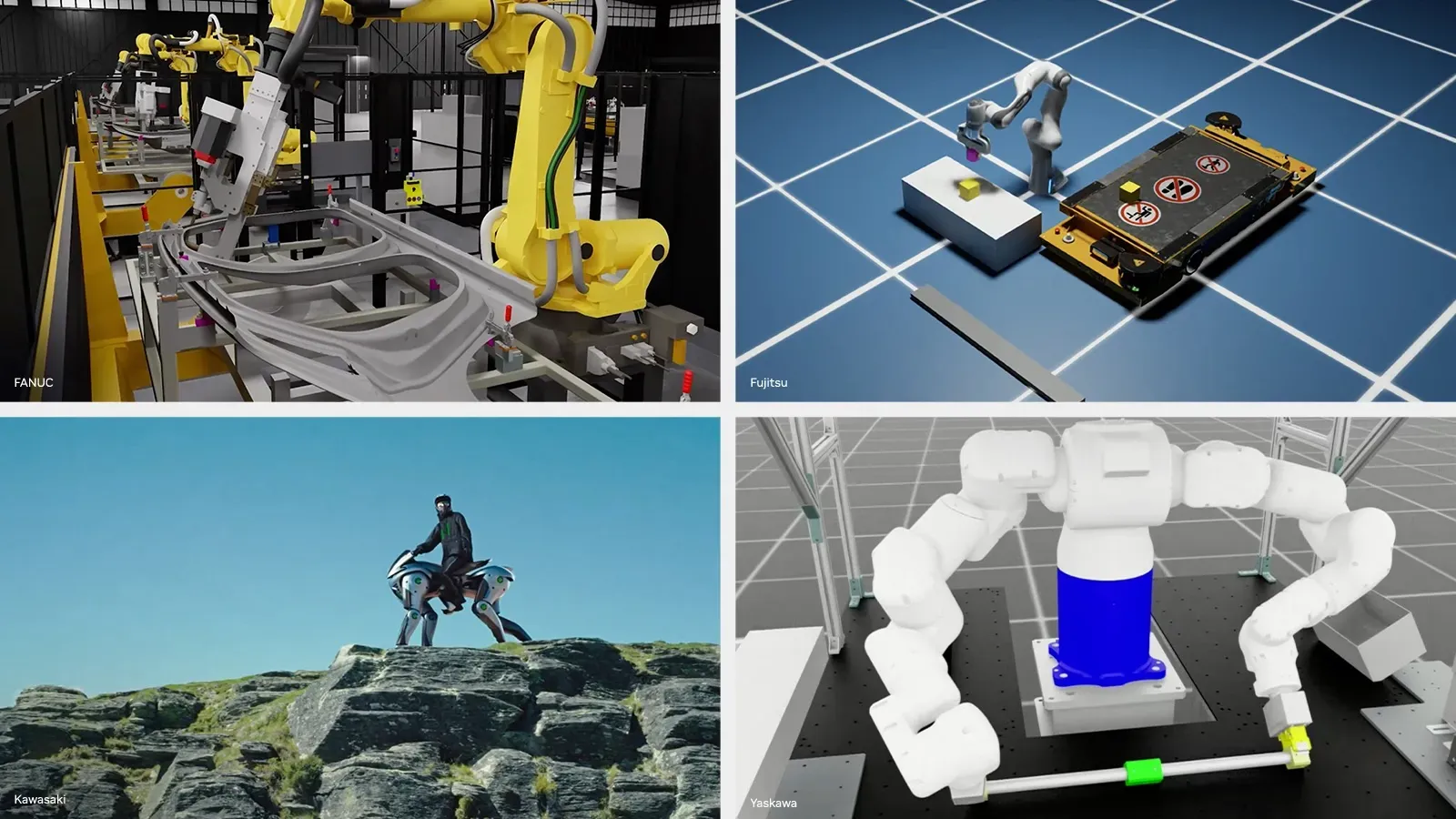
Fujitsu, together with FANUC, Yaskawa Electric and Kawasaki Heavy Industries, is exploring a collaborative physical AI control platform integrating NVIDIA Cosmos, Isaac, Omniverse and Newton technologies to bridge digital and physical industrial operations.
SoftBank is developing a physical AI platform based on Cosmos, Omniverse and Isaac Sim while expanding AI-RAN technologies using NVIDIA AI Aerial.
Kubota is exploring autonomous agriculture and smart farming powered by Cosmos.
Kawasaki Heavy Industries is applying NVIDIA physical AI technologies across healthcare, transportation, aerospace, shipbuilding and energy.
Enactic is fine-tuning NVIDIA Isaac GR00T for elder-care semi-humanoid robots.
GROOVE X continues developing Jetson-powered LOVOT companion robots.
Telexistence is using Isaac while evaluating Cosmos for retail automation.
Meanwhile, Hitachi, OMRON and Shimizu Corporation are integrating NVIDIA Metropolis and Cosmos into smart buildings, industrial inspection systems and construction safety applications.
EcoPulse24 Analysis
Rather than announcing individual products, NVIDIA is executing a broader strategy to establish national AI ecosystems.
The Japanese initiative combines generative AI through Nemotron with physical AI through Cosmos, creating a unified technology stack that spans enterprise software, robotics, industrial automation and national infrastructure.
For Japan, the collaboration supports long-term efforts to address labor shortages, improve industrial productivity and modernize manufacturing through AI.
For NVIDIA, the initiative reflects an evolution beyond supplying AI chips toward providing the complete software, model and infrastructure ecosystem required for countries to develop sovereign AI capabilities.
The announcement also reinforces a growing global trend in which governments, research institutions and major enterprises seek greater control over locally developed AI models, data governance and deployment infrastructure - placing national AI ecosystems at the center of the next phase of global artificial intelligence development.
Explore Related Coverage
Sources & References
Editorial Note
Disclaimer
© 2025 EcoPulse24. All rights reserved.