Oil surges above $100 as US imposes blockade on Iranian ports, triggering global supply shock fears
Oil tops $100 as US blocks Iranian ports, sparking supply shock fears; gold drops as markets brace for inflation and trade disruption.

New York | EcoPulse24
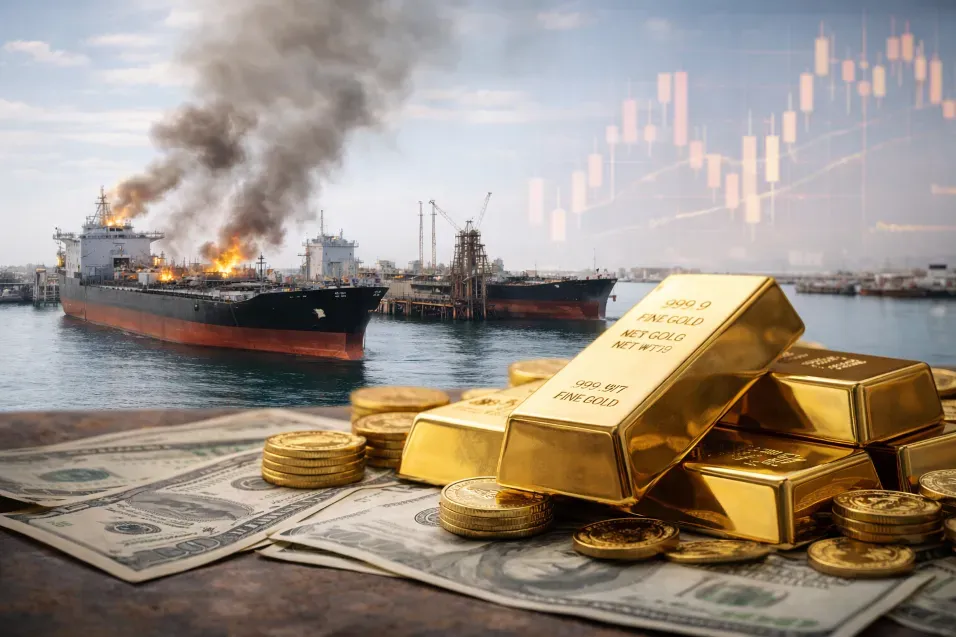
Global oil markets sharply repriced supply risk on Monday, with crude prices surging above the $100 threshold following the United States’ decision to impose a naval blockade on Iranian ports, marking a significant escalation in geopolitical tensions with direct implications for global energy flows.
Brent crude rose approximately 8.6% to $103.16 per barrel, while West Texas Intermediate (WTI) gained around 8% to reach $104.24, reflecting one of the strongest single-session moves since the onset of the current crisis. The rally underscores how quickly markets are reacting to developments that threaten physical supply routes rather than just production capacity.
The escalation comes after the collapse of diplomatic talks related to Iran’s nuclear program, prompting Washington to shift toward direct pressure through maritime channels. US authorities confirmed that naval forces have begun enforcing a comprehensive blockade targeting Iranian ports, with the objective of restricting maritime activity linked to Iranian energy exports.
According to official statements, the measures are being applied to vessels engaging with Iranian ports, while commercial shipping not directly linked to Iran is expected to continue transiting through the Strait of Hormuz. However, the distinction has done little to calm markets, given the strategic importance of the waterway, through which roughly 20% of global oil supply flows.
Iran has rejected the blockade, raising the risk of further escalation and increasing uncertainty around the stability of one of the world’s most critical energy corridors. The possibility of disruption - whether through direct restrictions or retaliatory actions - has elevated concerns that global supply chains could face sustained pressure in the weeks ahead.
The reaction extended beyond oil markets. Gold prices fell sharply by nearly $100 per ounce, dropping to around $4,560, as investors shifted focus toward the inflationary implications of higher energy costs and the potential for tighter monetary policy. The move suggests a rotation away from traditional safe-haven positioning toward assets perceived to benefit from rising rates and stronger dollar conditions.
Meanwhile, broader economic signals highlighted the uneven global impact of the crisis. South Korea reported a sharp increase in exports, driven by demand in key sectors such as semiconductors and automobiles, while Turkey faced renewed pressure after a downgrade in its credit outlook, reflecting vulnerabilities tied to external shocks and currency stability.
EcoPulse24 Analysis
This is not a typical oil rally - it is a direct repricing of geopolitical risk into physical supply expectations. The US decision to impose a blockade shifts the narrative from potential disruption to active intervention, effectively placing energy flows at the center of geopolitical strategy.
The critical factor is not just Iran’s production capacity, but the broader implications for maritime security in the Strait of Hormuz. Even without a full closure, the perception of risk is enough to tighten markets, as traders price in the probability of delays, higher insurance costs, and reduced shipping activity.
The sharp move above $100 signals that markets are transitioning into a phase where supply security dominates pricing dynamics. In this environment, oil is no longer responding primarily to demand cycles or inventory data - it is reacting to geopolitical control over trade routes.
The decline in gold further reinforces this shift. Rather than acting as a hedge against uncertainty, gold is being pressured by expectations of rising inflation and tighter monetary conditions, highlighting a complex macro environment where traditional correlations are breaking down.
If the situation persists, the global economy may face a renewed inflationary cycle driven by energy costs, with central banks forced to balance growth risks against price stability. The longer the disruption continues, the more likely it is that markets move from volatility into structural adjustment, reshaping energy flows, pricing mechanisms, and global trade patterns.
Explore Related Coverage
Sources & References
Editorial Note
Disclaimer
© 2025 EcoPulse24. All rights reserved.