Samsung and AMD deepen AI memory alliance to power next-generation computing
Samsung and AMD expand partnership to co-develop advanced AI memory and computing tech, focusing on HBM4 for next-gen AI accelerators.

Seoul | EcoPulse24
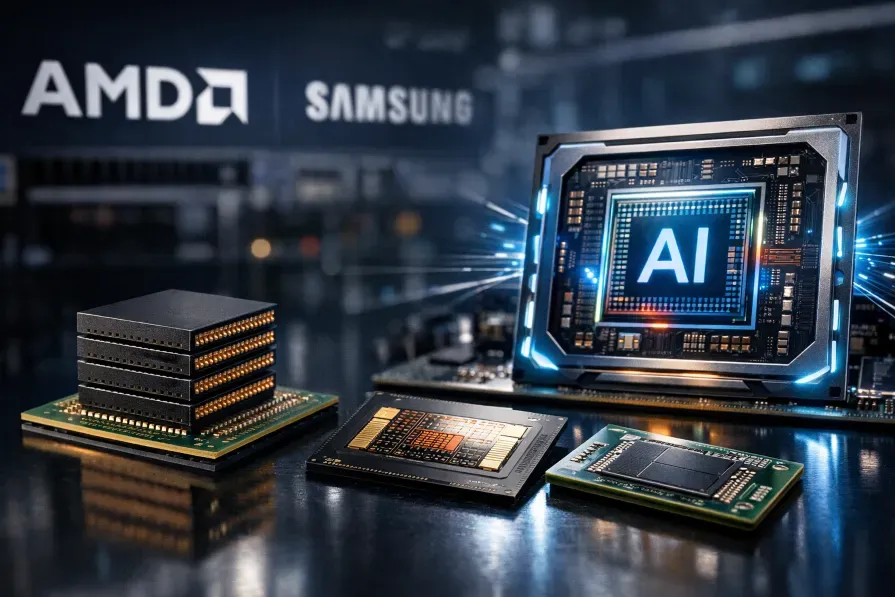
Samsung Electronics and AMD have signed a strategic memorandum of understanding to expand their collaboration on next-generation AI memory and computing technologies, marking a significant step in the race to build advanced AI infrastructure and data center capabilities.
The partnership will focus on supplying industry-leading HBM4 memory for AMD’s next-generation AI accelerators, including the Instinct MI455X GPU, alongside advanced DDR5 solutions for 6th generation AMD EPYC processors, within integrated platforms such as the AMD Helios rack-scale architecture.
The move comes as memory bandwidth and energy efficiency become critical bottlenecks in AI system performance, particularly with the rapid scaling of large language models and high-performance computing workloads.
Samsung’s HBM4 memory is built on its sixth-generation 10nm-class DRAM process, combined with a 4nm logic base die, delivering speeds of up to 13 Gbps and bandwidth of up to 3.3 TB/s, positioning it among the most advanced memory solutions in the industry.
This collaboration reflects a broader shift toward full-stack optimization, where AMD is integrating GPUs, CPUs, and system-level architectures to deliver scalable AI platforms capable of handling training and inference at scale.
In addition to HBM4, the companies will co-develop high-performance DDR5 memory optimized for next-generation EPYC processors, enhancing efficiency and throughput in data center environments.
The agreement also opens the door to potential foundry collaboration, with Samsung expected to provide manufacturing capabilities for future AMD chip designs, strengthening supply chain integration amid intensifying global competition in semiconductors.
Samsung and AMD have maintained a long-standing partnership across graphics and computing technologies, including Samsung serving as a key HBM3E supplier for AMD’s current AI accelerators, reinforcing continuity in next-generation product development.
EcoPulse24 Analysis:
This partnership highlights a structural shift in the semiconductor industry from component-level competition to system-level integration. As AI workloads scale, memory is emerging as a decisive performance factor alongside compute. Samsung’s HBM4 positions it at the center of AI infrastructure supply chains, while AMD strengthens its full-stack strategy to compete in high-performance computing. The collaboration signals that future AI leadership will depend not only on processing power, but on the seamless integration of memory, compute, and system architecture.
Explore Related Coverage
Sources & References
Editorial Note
Disclaimer
© 2025 EcoPulse24. All rights reserved.