Saudi Economic Growth Slows to 2.8% in Q1 2026
Saudi GDP growth slowed to 2.8% in Q1 2026, hit by US-Iran war disruptions and UAE's OPEC exit; IMF cuts 2026 forecast to 3.1%.

Thursday, April 30, 2026
Preliminary data released by Saudi Arabia's General Authority for Statistics showed the kingdom's gross domestic product expanded 2.8% year-on-year in the first quarter of 2026, down from 5% in the previous quarter and the lowest quarterly growth rate since mid-2024.
📊 Key Economic Indicators - Q1 2026
| Indicator | Q1 2026 | Q4 2025 |
|---|---|---|
| GDP Growth | 2.8% | 5.0% |
| Oil Sector Growth | 2.3% | 10.8% |
| Non-Oil Sector Growth | 2.8% | 4.3% |
| IMF 2026 Growth Forecast | 3.1% | 4.0% (Oct 2025) |
| Brent Crude Today | $126/barrel | - |
Oil Sector Growth Moderates
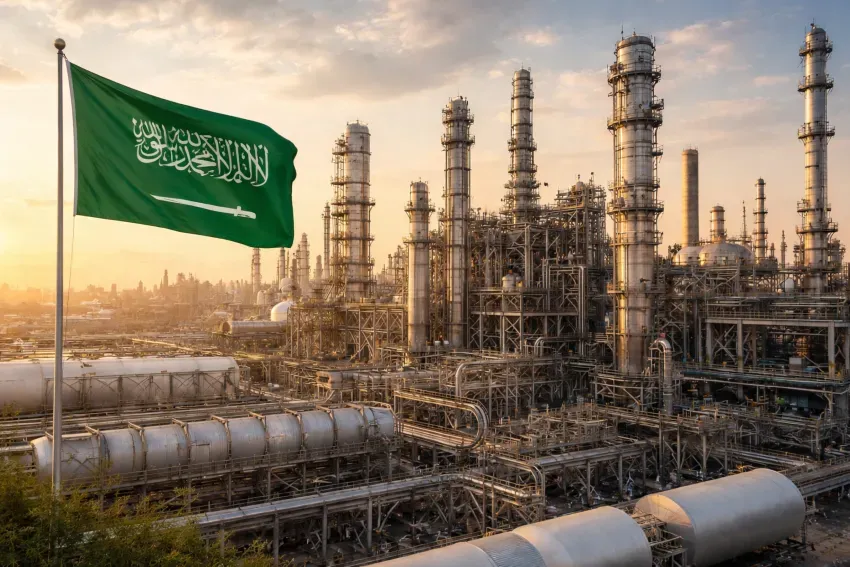
The oil sector expanded 2.3% in Q1, compared with 10.8% in Q4 2025. The slowdown reflects disruptions to production and exports resulting from the US-Iran war that began February 28, during which Iranian strikes targeted energy facilities in Saudi Arabia.
The kingdom redirected a portion of its oil exports through the East-West Pipeline to the Red Sea port of Yanbu, partially offsetting the impact of the Strait of Hormuz closure.
Non-Oil Sector Also Slows
Non-oil activity - which Saudi authorities describe as the primary focus of the kingdom's economic transformation under Vision 2030 - slowed to 2.8% from 4.3% in the previous quarter, indicating that the conflict's economic impact extended beyond the energy sector.
IMF Assessment
The International Monetary Fund revised its 2026 Saudi growth forecast down to 3.1%, a reduction of 0.9 percentage points from its October 2025 projection. Jihad Azour, the IMF's Middle East and Central Asia director, said in an interview with Bloomberg TV that "the playbook that the Saudi authorities deployed at the beginning of the crisis allowed them to be more resilient," adding that the kingdom is taking a smaller hit than some of its neighbors.
UAE Exits OPEC
The data comes as the United Arab Emirates announced its withdrawal from OPEC effective May 1, 2026 - tomorrow. Bloomberg described the move as "a significant blow to the Saudi-led group and its ability to manage oil prices by adjusting supply," noting that it is the culmination of years of tension between the two countries over oil output policy and competition for regional political influence.
Brent crude reached $126 per barrel on Thursday, its highest level since the war began.
EcoPulse24 Analysis
Saudi Arabia's Q1 data presents a difficult economic equation: record wartime oil prices alongside constrained export capacity. The kingdom's ability to redirect flows through Yanbu has provided a partial buffer - but it has not fully compensated for the loss of Hormuz transit volumes.
Three challenges will define Saudi Arabia's economic trajectory in the coming quarters. First, restoring oil export capacity to levels that allow the kingdom to fully benefit from elevated prices. Second, sustaining non-oil sector momentum under Vision 2030 amid broader economic uncertainty. Third, navigating the strategic implications of the UAE's OPEC exit - which reduces the group's collective ability to manage supply and, by extension, prices.
The IMF's assessment that Saudi Arabia is faring better than its neighbors reflects the kingdom's fiscal buffers and infrastructure investments made in advance of the crisis. Whether that relative resilience holds through Q2 will depend largely on how long the Strait of Hormuz remains effectively closed.
Sources & References
Editorial Note
Disclaimer
© 2025 EcoPulse24. All rights reserved.