Saudi Petroline Roars Back to 7 Million bpd
Saudi restores Petroline to 7M bpd after war damage, but US-Iran talks fail, keeping Gulf oil supply risks high as ceasefire nears expiry.

EcoPulse24 | RIYADH
Riyadh demonstrates world-class operational resilience as six weeks of war damage get repaired at speed - while failed US-Iran diplomacy resets the geopolitical risk premium upward
Sunday delivered two headline-defining events that pulled global energy markets in opposite directions. Saudi Arabia's Energy Ministry announced the full restoration of the East-West Pipeline (Petroline) to its maximum capacity of 7 million barrels per day - a significant engineering and operational achievement after Iranian strikes last week knocked out a critical pumping station. Within hours of that announcement, US Vice President JD Vance boarded Air Force Two in Islamabad and left Pakistan without a deal, after 21 hours of marathon negotiations with Iran's delegation collapsed over the nuclear weapons impasse.
One story signals supply resilience. The other signals that the geopolitical risk premium on Gulf crude is far from gone.
The Restoration - Facts, Figures and What They Mean
What Happened
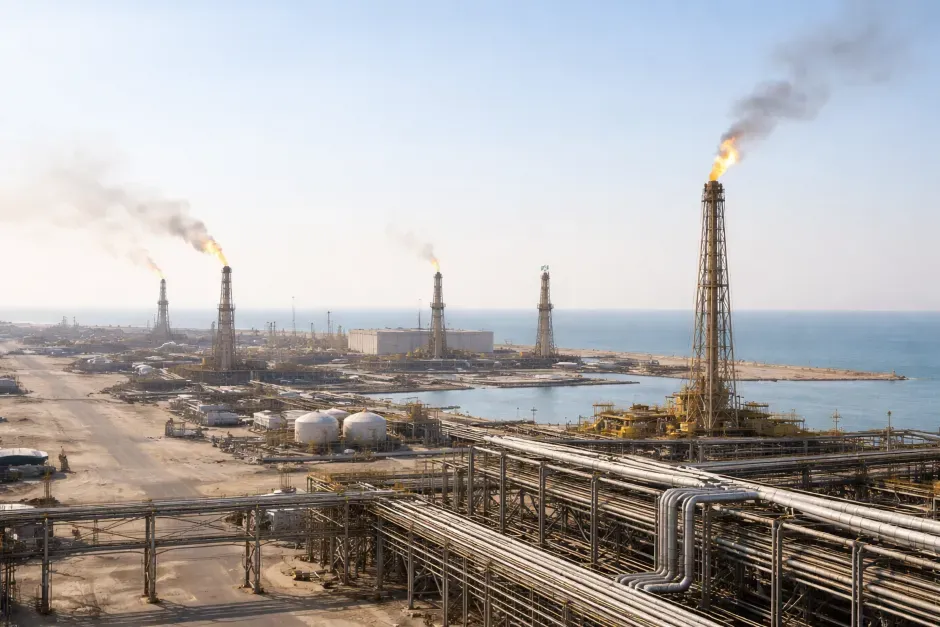
Saudi Arabia's Ministry of Energy confirmed the success of operational and technical efforts in restoring full pumping capacity through the East-West Pipeline to approximately 7 million barrels per day, and recovering affected volumes from the Manifa field production of around 300,000 barrels per day - all within a short period of time.
The timeline makes the achievement more striking. Hours after a ceasefire was declared in the Iran war, a strike damaged one of the 11 pumping stations along the 746-mile conduit, cutting throughput by 700,000 barrels per day. Repairs were completed and full capacity restored within days - a timeframe that would challenge the best energy operators anywhere in the world.
Saudi Arabia has quadrupled crude shipments from its Red Sea terminals since the end of February to work around the near-total shutdown of the Strait of Hormuz. With Petroline now back at full capacity, that bypass route is fully operational once more.
On the Manifa offshore field, the picture is also positive. Production lost to Iranian strikes - approximately 300,000 bpd - has been restored. The Khurais onshore complex, however, remains under active repair, with the ministry stating that work is ongoing and a completion announcement will follow. No timeline has been given.
The Damage Scorecard - April 12, 2026
| Facility | Capacity Lost | Status |
|---|---|---|
| East-West Pipeline (pumping station) | 700,000 bpd | ✅ Fully restored |
| Manifa offshore field | 300,000 bpd | ✅ Fully restored |
| Khurais onshore complex | 300,000 bpd | 🔄 Repairs ongoing |
| Net production still offline | ~300,000 bpd | Pending |
The Broader Damage Picture
Today's announcement, while positive, sits within a wider landscape of regional energy infrastructure damage that will take months - and in some cases years - to fully resolve.
Among the most significant facilities hit was Satorp at Jubail, a joint venture between Saudi Aramco and TotalEnergies processing 465,000 bpd and one of the world's largest export refining platforms. Ras Tanura, Saudi Arabia's largest refinery at 550,000 bpd capacity, was attacked early in the war and closed for 16 days before restarting.
Qatar's situation deserves particular attention. Ras Laffan, the world's largest LNG complex, is unlikely to return to full capacity before the end of August at the earliest, with Iranian strikes having destroyed two of its trains, removing around 17 per cent of the country's export capacity from the market for years. Qatar is mobilising engineers ahead of a planned partial resumption, with Japanese contractor Chiyoda also considering resuming construction work on the North Field East expansion.
A Pipeline Built for Exactly This Moment
The East-West Pipeline was originally constructed in 1981 during the Iran-Iraq War, after Riyadh first confronted the vulnerability of routing the bulk of its exports through Hormuz. The 1,200-kilometre, dual-pipe system connects the Abqaiq oil processing complex in the Eastern Province to the Red Sea export terminal at Yanbu. Following Houthi drone strikes on Aramco's Abqaiq facility in 2019, the company converted parallel natural gas liquids lines to carry crude oil, raising emergency capacity to 7 million barrels per day - a figure never tested at sustained flows until now.
That foresight is paying dividends in 2026.
The Diplomatic Collapse - Islamabad's Failed Gamble
What Happened
The United States and Iran failed to reach a deal after high-stakes talks in the Pakistani capital, with Vice President JD Vance saying Tehran refused to accept Washington's terms after 21 hours of negotiations - the highest-level meeting between Washington and Tehran since the 1979 Islamic Revolution.
Vance was direct in his assessment: "The bad news is that we have not reached an agreement. We leave here with a very simple proposal - a method of understanding that is our final and best offer. We'll see if the Iranians accept it."
The core sticking point was the one that has defined US-Iran tensions for decades. Vance confirmed that Washington requires a clear commitment from Iran not to seek a nuclear weapon, adding that the US "has not seen that yet."
Iran's side told a different story. Parliament Speaker Mohammad Bagher Qalibaf, who led the Iranian delegation, said his colleagues presented forward-looking initiatives but that the US side "was not able in this round of negotiations to gain the trust of the Iranian delegation."
The negotiations shifted at one point from face-to-face discussions to a text-only format - delegations exchanging written proposals rather than speaking directly - reflecting the depth of mistrust between the two sides.
The Ceasefire Clock is Ticking
The talks in Islamabad ended without agreement, with significant uncertainty over whether or when a next round will occur - just days before the fragile two-week truce is set to expire. Pakistan's Foreign Minister urged both sides to uphold the ceasefire regardless, but the structural conditions that produced the breakdown remain entirely in place.
EcoPulse24 Analysis - Reading the Competing Signals
Signal One: Saudi Resilience Is Real, Not Rhetorical
The speed of the Petroline restoration is not a PR exercise - it is hard operational evidence that Saudi Aramco has invested systematically in crisis recovery capabilities. Repairing a major pumping station and restoring 700,000 bpd of throughput within days of a strike, while simultaneously managing Manifa's restoration, reflects a level of emergency response that very few energy operators globally can match.
For international oil importers - particularly in Asia, which accounts for roughly 75% of Saudi crude exports - this is the signal that matters most in the short term. Riyadh can take a hit and keep the barrels flowing.
Signal Two: The Khurais Gap Is the Number to Watch
Markets should be focused on one specific variable today: the Khurais timeline. That 300,000 bpd of light crude production remains offline with no public schedule for restoration. It is also the grade of oil that typically flows through the East-West Pipeline toward Red Sea terminals. A pipeline at full mechanical capacity carrying less crude than planned tells a subtler story than the headline suggests. Traders pricing Saudi supply should hold that caveat.
Signal Three: Petroline Solved One Chokepoint, Created Another
Oil leaving Yanbu for Asian buyers must transit the Bab el-Mandeb strait between Yemen and Djibouti before reaching the Indian Ocean. This makes the Houthis strategically relevant. All that infrastructure remains exposed to drones, and the oil leaving Yanbu going to Asia passes through Bab el-Mandeb. Saudi Arabia bypassed Hormuz only to introduce a different geographic vulnerability. The Petroline is the answer to one question, not all of them.
Signal Four: Failed Diplomacy Reprices Everything
Before the Islamabad breakdown, a reasonable base case was that the two-week ceasefire would gradually reduce the geopolitical risk premium embedded in oil prices, even while Hormuz remained constrained. That base case no longer holds. Commerzbank analysts noted that the key issue for the oil market is whether ship traffic through the Strait of Hormuz will resume, warning that if oil supplies from the Persian Gulf remain blocked, prices are likely to rise again.
With the ceasefire days from expiring and no successor framework in place, the probability of a return to active hostilities - and fresh infrastructure attacks - is materially higher tonight than it was this morning.
Signal Five: The Market Knows, But Hasn't Fully Priced It
Strait of Hormuz traffic remained less than 10% of normal volumes, with Tehran asserting control by warning ships to keep to its territorial waters. The majority of vessels that have transited in recent days were linked to Iran. That is not a chokepoint inching toward reopening - that is a chokepoint still effectively closed. The full structural dislocation of Gulf energy flows will persist until that changes, and Islamabad's failure makes a near-term change considerably less likely.
What EcoPulse24 Is Watching Next
Oil markets (Asia/Europe open): How much of the Islamabad failure has been priced in versus the positive Petroline headline. Expect volatility in the $2 – 4/barrel range as the two signals compete.
Khurais restoration announcement: Any confirmed timeline from Aramco would be the single most market-moving piece of Saudi energy news in the coming days.
Ceasefire status: The two-week Pakistan-brokered truce expires imminently. Extension, collapse, or quiet rollover - each carries a radically different market implication.
Hormuz mine-clearing operations: US Central Command confirmed that two Navy guided-missile destroyers - the USS Frank E. Peterson and the USS Michael Murphy - transited the strait and began setting conditions to clear Iranian sea mines. The pace and success of that operation is the structural key to any durable market normalization.
Ras Laffan, Qatar: Any update on the partial LNG resumption timeline will directly move global gas and LNG prices, particularly for European buyers already facing supply stress.
The Bottom Line
April 12, 2026 will be remembered in energy market history as a day of competing headlines. Saudi Arabia demonstrated that its energy infrastructure - battered by six weeks of unprecedented strikes - can be repaired faster and more effectively than most observers expected. That is a genuine positive for global supply security and for Riyadh's credibility as a reliable exporter.
But the geopolitical architecture that produced those strikes remains intact, unresolved, and now diplomatically deadlocked. A pipeline pumping at full capacity inside a region where the ceasefire could collapse within days is a supply chain running on borrowed time. The Petroline is back. The crisis is not over.
Sources & References
Editorial Note
Disclaimer
© 2025 EcoPulse24. All rights reserved.