SpaceX Overtakes Aramco, Musk Becomes the World's First Trillionaire: The Day Markets Rewrote History
The largest IPO ever recorded didn't just break a record - it opened a new era in global capital markets

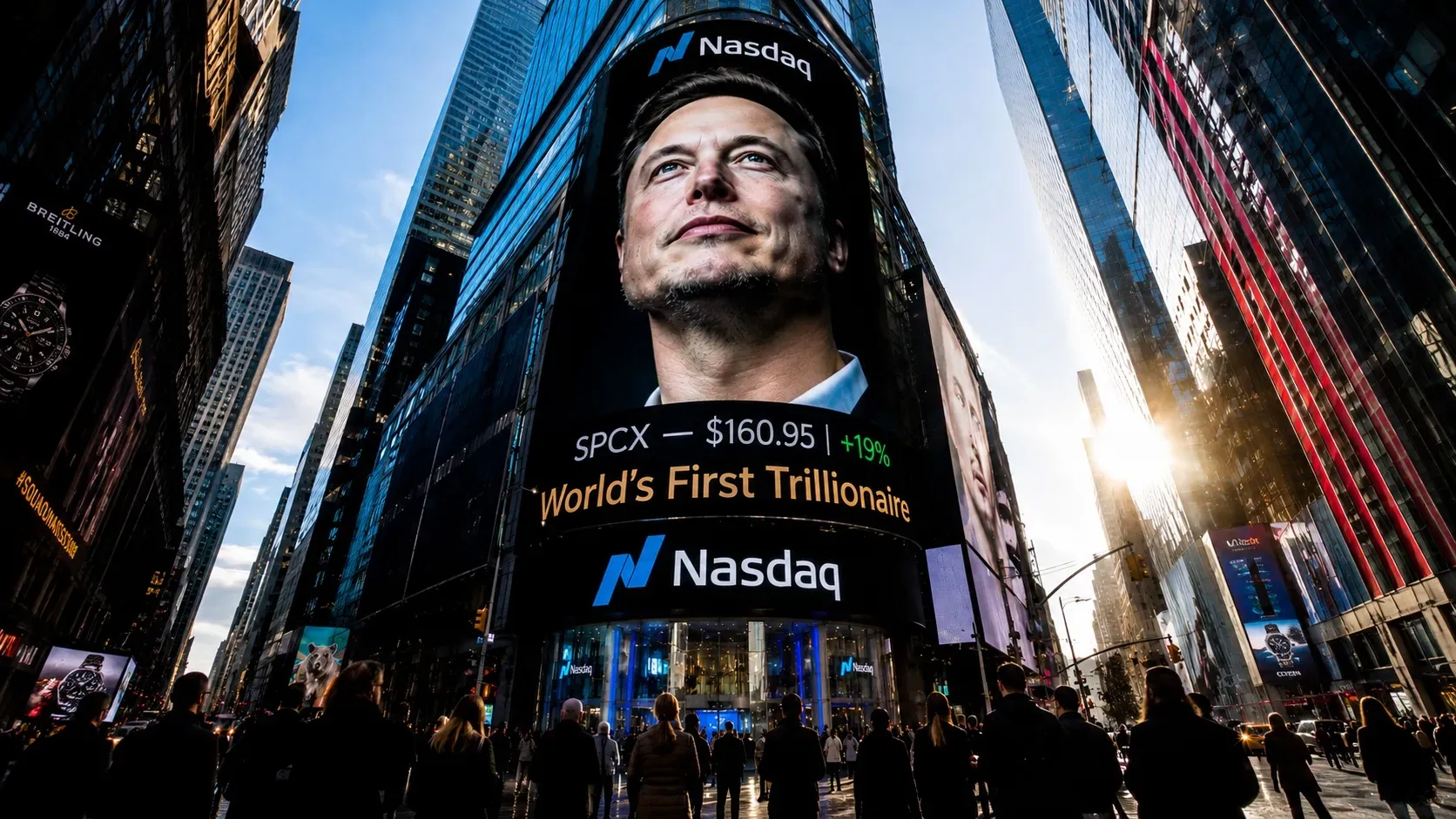
Washington / Dubai - Special Coverage | EcoPulse24
There are days that markets remember for years. June 12, 2026 is one of them.
When the opening bell rang at Nasdaq in New York, SpaceX - the rocket and satellite company that began in a warehouse in El Segundo, California - became the most consequential stock market debut in history. Within hours, it had surpassed Saudi Aramco's 2019 record, crossed the $2 trillion valuation mark, and turned its founder into the world's first trillionaire.
This was not just a listing. It was a statement about where capital is going next.
The Numbers That Made History
SpaceX shares opened at $150, surged more than 30% intraday - briefly pushing the company's market value above $2.25 trillion - before closing at $160.95, a gain of 19% over the $135 IPO price.
After markets closed, the stock continued climbing in extended trading to $166.76, adding another $80 billion in market value. More than 500 million shares changed hands during the session alone.
The company raised $75 billion selling more than 555 million Class A shares - shattering the previous record held by Saudi Aramco since 2019. To punctuate the historic day, SpaceX launched a Falcon 9 rocket in Florida approximately one hour before markets opened, delivering Starlink broadband satellites into orbit in what became the 650th flight of the rocket.
Musk: The World's First Trillionaire
The IPO made Elon Musk the world's first trillionaire, with his combined net worth now estimated at over $1.1 trillion - a milestone no individual has reached in modern financial history.
Analysts have begun calling it the "Elon Premium" - a valuation that reflects as much a bet on the founder as on the company itself, echoing the dynamic that defined Tesla's extraordinary market run.
That premium is both SpaceX's greatest asset and its most significant risk. When Musk is at the height of his influence, every company he touches commands extraordinary valuations. But any shift in his credibility - regulatory, political, or personal - transmits directly into the share price in ways disconnected from operational performance.
What the Market Actually Bought
The instinctive association with SpaceX - rockets, Mars, Starship - obscures what investors actually purchased on June 12.
The IPO prospectus filed with the SEC on May 20 reveals a company built across three distinct revenue engines: Space, Connectivity, and Artificial Intelligence. And the financial data makes clear which engine is doing the heaviest lifting.
Starlink - the orbital broadband network - generated $11.387 billion in revenue in 2025, representing 61% of total company revenue, with operating income of $4.423 billion. It is the only profitable division in the group. The Space segment and the AI division both recorded operating losses.
In short: investors did not buy a rocket company. They bought the world's largest commercial satellite internet network - with a rocket business and an AI division attached.
The Numbers Analysts Are Watching
Morningstar placed a fair value estimate of $63 per share on SpaceX - implying a valuation of approximately $830 billion - noting that the IPO price reflected a revenue multiple of 94 times, compared with 22 times for Meta and 18 times for Amazon at their respective debuts. Reaching a valuation justification by conventional metrics would require SpaceX's operating earnings to grow 75-fold from 2025 levels by 2035.
The xAI division - which includes X, the platform formerly known as Twitter - recorded an operating loss of $6.355 billion in 2025, more than four times the prior year's loss, while AI capital expenditure reached $7.7 billion in Q1 2026 alone. SpaceX is burning cash at an accelerating rate in its AI division, and the market is rewarding it regardless.
What Comes After SpaceX
Some analysts view SpaceX's historic debut as the opening signal for a broader wave of AI-related IPOs. Anthropic and OpenAI have both submitted confidential paperwork to the SEC in preparation for potential public offerings of their own.
If those listings attract comparable investor enthusiasm, global capital markets may be entering a sustained repricing of technology and AI assets - with significant implications for liquidity flows into Gulf and emerging markets.
EcoPulse24 Analysis
June 12, 2026 will not be remembered merely as the day of an IPO. It will be remembered as the day global capital formally crossed into a new era - one where space infrastructure, satellite connectivity, and artificial intelligence are no longer separate investment themes but a single, integrated asset class.
The celebration is real. The achievement is genuine. A company that began with a single rocket and a dream of making humanity multi-planetary has become one of the most valuable enterprises in the history of capitalism.
But the financial discipline that markets demand does not pause for celebration.
At 94 times revenue, with losses accelerating in its AI division and an operating model that requires sustained multi-billion dollar capital expenditure, SpaceX has written itself an extraordinary set of targets to meet over the next decade.
Three questions will define whether the $160 share price proves prescient or premature:
Can Starlink sustain its 49.8% annual revenue growth as competition from Amazon Kuiper and government-backed operators intensifies? Can Starship achieve the launch cadence on which the entire business model depends? And can Elon Musk manage a conglomerate spanning SpaceX, xAI, X, Tesla, Neuralink, and The Boring Company without any single division paying the price of his divided attention?
The market has placed its bet. The next three years will deliver the verdict.
FAQs
Reference Data Table - SpaceX IPO | June 12, 2026
Source: SpaceX S-1 Prospectus - SEC - May 20, 2026 | Morningstar | Reuters | NBC News
I - First Day of Trading
| Metric | Figure |
|---|---|
| IPO offer price per share | $135 |
| Opening price on first trading day | $150 |
| Intraday peak price | $175 |
| Closing price - Day One | $160.95 |
| Gain over IPO price at close | +19% |
| After-hours price | $166.76 |
| Market capitalization at close | ~$2.1 trillion |
| Peak intraday market capitalization | ~$2.25 trillion |
| Total capital raised through IPO | $75 billion |
| Class A shares offered | 555.6 million shares |
| Total shares traded on Day One | 500+ million shares |
II - Annual Financials
| Metric | 2024 | 2025 |
|---|---|---|
| Total company revenue | $14.1 billion | $18.674 billion |
| Net loss | - | $4.937 billion |
| Operating loss | - | $2.589 billion |
| Adjusted EBITDA | - | $6.584 billion |
III - Connectivity Segment / Starlink
| Metric | 2025 | Q1 2026 |
|---|---|---|
| Segment revenue | $11.387 billion | $3.257 billion |
| Operating income | $4.423 billion | $1.188 billion |
| Adjusted EBITDA | $7.168 billion | $2.087 billion |
| Year-on-year revenue growth | +49.8% | - |
| Active Starlink subscribers | - | 10.3 million |
| Satellites deployed in orbit | - | 9,600+ |
| Average revenue per subscriber per month | - | $66 |
IV - Space Segment
| Metric | 2025 | Q1 2026 |
|---|---|---|
| Total segment revenue | $4.1 billion | - |
| Operating loss | - | $662 million |
| R&D expenditure on Starship development | ~$3 billion | - |
V - AI Segment (xAI)
| Metric | 2025 | Q1 2026 |
|---|---|---|
| Total segment revenue including X | $3.2 billion | $818 million |
| Operating loss | $6.355 billion | $2.469 billion |
| X platform advertising revenue | $1.8 billion | - |
| Twitter advertising revenue in 2021 (for comparison) | $4.5 billion | - |
VI - Q1 2026 Financials
| Metric | Figure |
|---|---|
| Total company revenue | $4.694 billion |
| Operating loss | $1.943 billion |
| Net loss | $4.276 billion |
| Adjusted EBITDA | $1.127 billion |
VII - Valuation & Comparisons
| Metric | Figure |
|---|---|
| Morningstar fair value estimate per share | $63 (~$830 billion implied valuation) |
| Revenue multiple applied by market at IPO | 94x |
| Revenue multiple at Meta's IPO (for comparison) | 22x |
| Revenue multiple at Amazon's IPO (for comparison) | 18x |
| Operating earnings growth required by 2035 to justify current valuation | 75x 2025 levels |
| Previous global IPO record - Saudi Aramco 2019 | $29 billion raised |
| Saudi Aramco market capitalization at IPO | $1.7 trillion |
VIII - Musk
| Metric | Figure |
|---|---|
| Estimated total net worth following IPO - world's first trillionaire | $1.1+ trillion |
| Voting control over SpaceX board and strategic decisions | 50%+ |
Sources & References
Editorial Note
Disclaimer
© 2025 EcoPulse24. All rights reserved.