U.S., Saudi Arabia Near Landmark 30-Year Civil Nuclear Agreement
U.S. and Saudi Arabia near a 30-year civil nuclear deal, including a joint uranium enrichment study, boosting strategic and economic ties.

Dubai | EcoPulse24
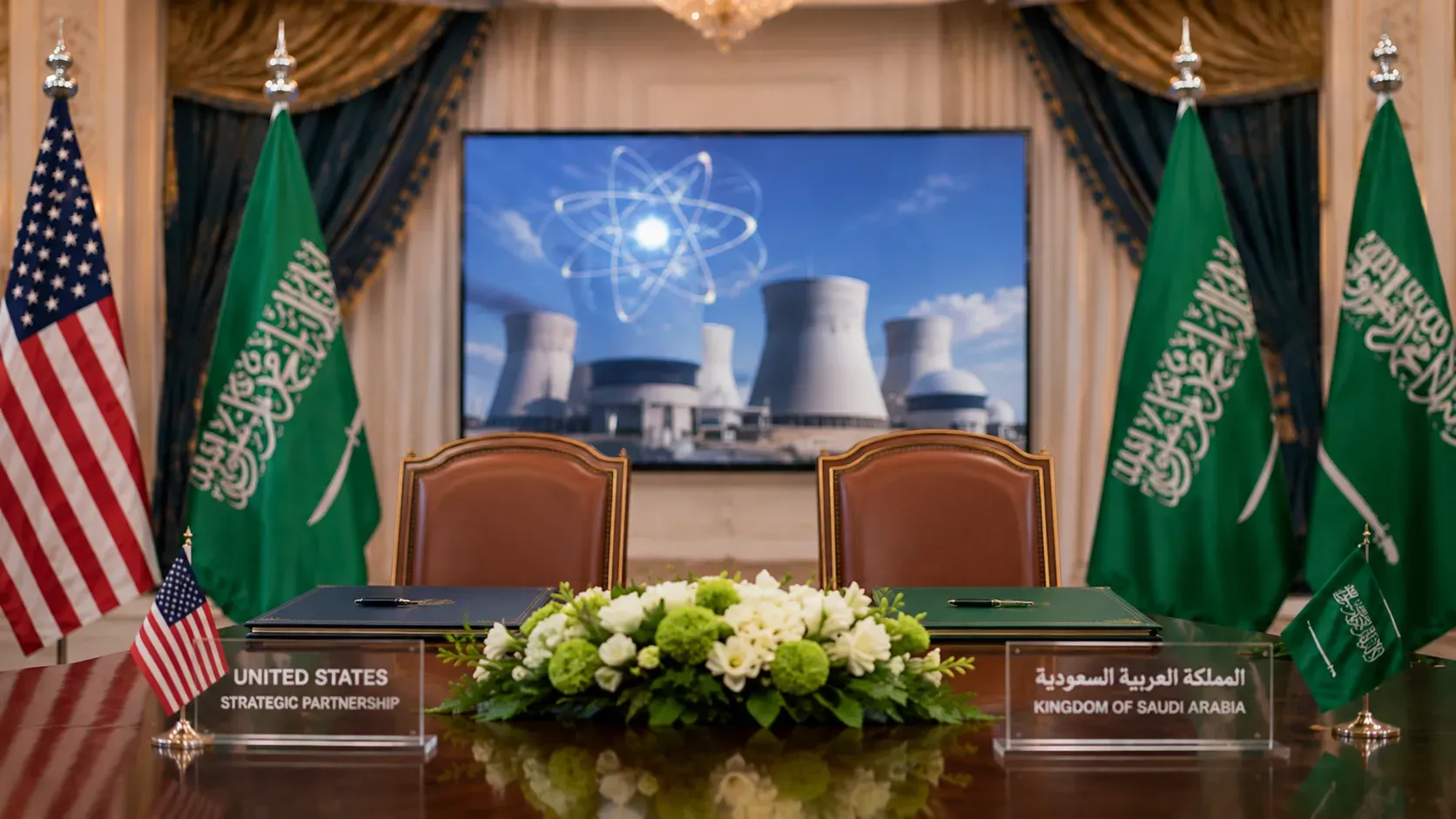
The United States and Saudi Arabia are moving closer to finalizing a 30-year civil nuclear cooperation agreement after President Donald Trump approved a framework that could allow the Kingdom to develop uranium enrichment capabilities as part of its peaceful nuclear energy program, according to people familiar with the matter who spoke to The Associated Press.
The Wall Street Journal first reported details of the proposed agreement, which is expected to become one of the most significant long-term strategic partnerships between Washington and Riyadh in the energy sector.
A formal announcement is expected in the coming weeks, although neither the U.S. nor the Saudi government has officially confirmed the agreement.
A Three-Decade Strategic Partnership
According to people familiar with the negotiations, the agreement would establish a 30-year framework for U.S.-Saudi cooperation in developing the Kingdom's civilian nuclear program.
American companies are expected to participate in designing nuclear facilities, providing engineering services, supplying technology, and supporting the long-term development of Saudi Arabia's nuclear infrastructure.
One of the agreement's most closely watched provisions calls for a joint U.S.-Saudi feasibility study on constructing a uranium enrichment facility inside Saudi Arabia.
Whether such a facility ultimately proceeds would depend on the outcome of that joint assessment and subsequent regulatory and political approvals.
The agreement follows years of negotiations under both the Trump and Biden administrations, each of which sought to establish a framework for transferring U.S. civilian nuclear technology to Saudi Arabia.
Long-Term Economic Opportunities
Beyond its geopolitical significance, the proposed agreement represents a substantial long-term commercial opportunity for the U.S. nuclear industry.
Potential projects could include nuclear reactor engineering, construction, safety systems, fuel-cycle services, operations and maintenance, workforce training, and technology transfer.
Although analysts expect the overall value of future contracts to reach tens of billions of dollars, investment would likely be deployed gradually over several decades rather than through immediate spending.
Uranium Enrichment at the Center of Attention
The proposed uranium enrichment study has emerged as the agreement's most sensitive element.
If eventually approved, an enrichment facility would provide Saudi Arabia with greater domestic control over part of the nuclear fuel cycle - a capability that has traditionally attracted close international scrutiny because of its relationship to global nuclear non-proliferation efforts.
At the same time, the proposal remains part of a civilian nuclear energy program, with no indication that it would alter Saudi Arabia's international commitments regarding the peaceful use of nuclear technology.
A Different Path from the UAE Model
The Saudi proposal differs from the model adopted by the United Arab Emirates, which signed a Section 123 Agreement with the United States before developing the Barakah Nuclear Energy Plant in partnership with South Korea.
Under that agreement, the UAE voluntarily committed not to pursue domestic uranium enrichment or spent fuel reprocessing, a policy widely viewed as a benchmark for civilian nuclear cooperation with Washington.
Any future Saudi enrichment capability would therefore receive significantly greater international attention because of the additional regulatory and non-proliferation considerations involved.
EcoPulse24 Analysis
If officially confirmed, the agreement would represent one of the most significant strategic expansions of U.S.-Saudi cooperation in decades, extending well beyond energy into advanced technology, industrial investment, and long-term infrastructure development.
Economically, the agreement could create sustained opportunities for American engineering, construction, and nuclear technology companies while supporting Saudi Arabia's efforts to diversify its energy mix under Vision 2030 and reduce long-term reliance on oil for domestic electricity generation.
From a geopolitical perspective, however, the debate is likely to center on governance rather than construction. International attention will focus on how any future uranium enrichment activities are supervised, verified, and integrated within the global nuclear non-proliferation framework.
At this stage, the proposed agreement does not alter the regional strategic balance by itself. Instead, it signals a new phase in the evolution of civilian nuclear cooperation in the Middle East and raises broader questions about how Washington will balance strategic partnerships with its longstanding commitment to preventing the spread of sensitive nuclear technologies.
Key Highlights
| Item | Details |
|---|---|
| Agreement Duration | 30 Years |
| Parties | United States & Saudi Arabia |
| Program | Civilian Nuclear Cooperation |
| U.S. Role | Engineering, technology, infrastructure development |
| Key Provision | Joint feasibility study on uranium enrichment |
| Economic Impact | Long-term contracts worth tens of billions of dollars over time |
| Current Status | Awaiting official announcement |
Explore Related Coverage
Sources & References
Editorial Note
Disclaimer
© 2025 EcoPulse24. All rights reserved.