UAE Equities Extend Gains as ADX and DFM Advance on Real Estate and Industrial Strength
The ADX benchmark index advanced 0.22% to close at 9,658.20 points, the DFM General Index climbing 0.57% to 5,692.82 points

Dubai | EcoPulse24
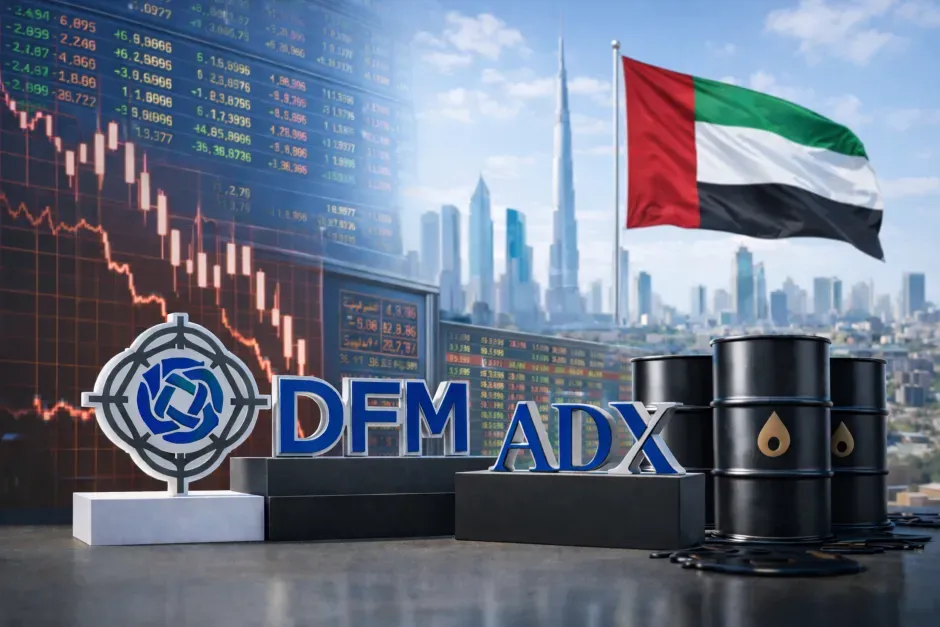
UAE equities closed higher on May 22, with both the Abu Dhabi Securities Exchange (ADX) and Dubai Financial Market (DFM) extending gains as investors continued rotating into real estate, industrial, telecom, and consumer-linked stocks despite cautious global macro sentiment tied to oil, inflation, and interest-rate expectations.
The ADX benchmark index advanced 0.22% to close at 9,658.20 points, supported by gains in insurance, healthcare, industrial, and property-related shares, while trading value approached AED 949.2 million across nearly 19,800 transactions.
Meanwhile, Dubai Financial Market outperformed regionally, with the DFM General Index climbing 0.57% to 5,692.82 points as activity strengthened around Emaar, Talabat, telecom names, and logistics-linked equities.
The positive close across UAE markets came despite broader investor caution globally surrounding energy prices, geopolitical tensions, and monetary-policy uncertainty.
Real estate and large-cap names support UAE markets
In Abu Dhabi, Aldar Properties emerged among the strongest large-cap contributors after rising 3.46%, while ADNOC Gas remained the most actively traded stock by value at more than AED 105.8 million.
Alpha Dhabi and First Abu Dhabi Bank also ranked among the highest-value traded names, reflecting continued institutional positioning in diversified Abu Dhabi-linked holdings and financials.
Trading activity on ADX remained broadly stable, with market capitalization holding above AED 2.71 trillion as investors maintained exposure to defensive and infrastructure-linked sectors.
In Dubai, Emaar led market activity by traded value at more than AED 173 million, while Talabat dominated trading volumes with over 96.5 million shares exchanged during the session.
DU Telecom and Emirates NBD also attracted strong institutional flows, reinforcing continued investor interest in dividend-generating and economically sensitive sectors within the Dubai market.
Market sentiment supported by domestic resilience
The latest gains reflect continued resilience across UAE equities as domestic economic activity, infrastructure spending, tourism growth, logistics expansion, and capital-market activity continue supporting investor sentiment.
UAE markets have increasingly benefited from:
-
strong corporate earnings
-
infrastructure investment
-
energy-linked liquidity
-
real estate demand
-
expanding foreign participation
-
IPO momentum
The positive performance also comes as Gulf investors continue monitoring oil prices near $105 per barrel and renewed geopolitical uncertainty tied to the Strait of Hormuz and broader Iran-related developments.
Despite elevated external risks, UAE equities continue demonstrating relatively stable liquidity conditions compared with several regional emerging markets.
UAE Market Snapshot - May 22
| Indicator | ADX | DFM |
|---|---|---|
| Closing Index | 9,658.20 | 5,692.82 |
| Daily Change | +0.22% | +0.57% |
| Trading Value | AED 949.2M | AED 531.7M |
| Trading Volume | 277.2M shares | 214.2M shares |
| Total Trades | 19,765 | 12,528 |
Top Active Stocks
| Market | Leading Names |
|---|---|
| ADX | ADNOC Gas, Aldar, Alpha Dhabi, FAB |
| DFM | Emaar, Talabat, DU, Emirates NBD |
EcoPulse24 Analysis
The latest session highlights how UAE equities continue benefiting from a domestic macro environment that remains relatively supportive despite increasing uncertainty across global markets.
Real estate, infrastructure, telecom, and industrial-linked stocks are increasingly acting as the backbone of UAE market resilience, particularly as investors seek exposure to sectors tied directly to long-term economic expansion and government-backed development programs.
The strength in Aldar and Emaar reflects continued investor confidence in the UAE property cycle, while sustained activity in ADNOC-linked entities and diversified holding companies signals ongoing institutional preference for scale, liquidity, and strategic economic exposure.
Dubai’s outperformance relative to Abu Dhabi also suggests investors remain comfortable with growth-sensitive sectors tied to tourism, logistics, consumer demand, and digital-platform activity, particularly through names such as Talabat and telecom operators.
More broadly, Gulf equities continue trading within a macro framework increasingly shaped by oil prices, geopolitical risk, global liquidity conditions, and interest-rate expectations. However, UAE markets are still demonstrating stronger relative resilience compared with many emerging-market peers due to stable fiscal positioning, infrastructure investment momentum, and continued international capital interest.
The combination of strong domestic liquidity, expanding capital-market depth, and diversified economic growth continues positioning UAE equities as one of the region’s most closely watched investment destinations during the current global macro cycle.
Explore Related Coverage
Sources & References
Editorial Note
Disclaimer
© 2025 EcoPulse24. All rights reserved.