From Hormuz to Venezuela: How Geopolitical Shock Is Accelerating America’s Resource Diversification Strategy
US expands resource strategy, issuing Venezuela mineral licenses to reduce reliance on chokepoints amid rising Middle East risks and inflation.

Washington | EcoPulse24
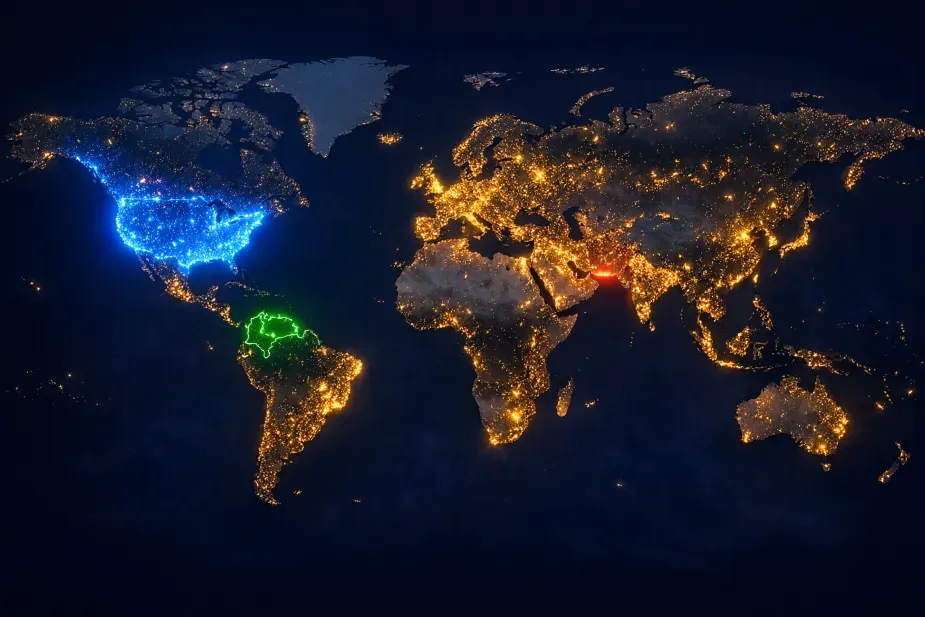
The US Treasury Department’s decision to issue new general licenses for critical minerals operations in Venezuela is not an isolated policy move. It reflects a broader strategic recalibration taking shape as geopolitical risks in the Middle East intensify.
While global markets remain focused on the Strait of Hormuz-through which roughly 15 million barrels per day of crude oil flowed before the current disruption-Washington is quietly expanding its resource strategy across multiple fronts, extending beyond energy into critical minerals. This shift signals a deeper transition: from protecting supply routes to redesigning supply systems.
From Chokepoint Vulnerability to Distributed Resilience
The near disruption of Hormuz has once again exposed the fragility of concentrated global supply routes. In response, Saudi Arabia has activated its East-West pipeline (Petroline) at full capacity of 7 million barrels per day, redirecting flows from its eastern oil fields to the Red Sea port of Yanbu.
This rerouting effort has helped stabilize markets in the short term, preventing an immediate surge in oil prices. However, it also highlights a critical limitation: infrastructure can mitigate shocks, but it cannot eliminate structural exposure to geopolitical chokepoints. US policymakers appear to be acting on that distinction.
The newly issued Venezuela licenses-which allow the provision of equipment, services, and negotiations for contingent investments in minerals-point to a broader effort to diversify access to strategic resources. Venezuela holds significant reserves of gold, coltan, bauxite, and potential rare earth elements, all of which are increasingly critical to modern industrial and technological systems.
Energy and Materials Are Now Strategically Linked
The global economy is no longer facing an energy challenge in isolation. It is confronting a combined energy – materials constraint.
Artificial intelligence systems, large-scale data centers, electric vehicles, and defense technologies all require not only stable energy supply, but also secure access to critical minerals. This convergence is redefining how governments approach resource security.
The Iran-related disruption has accelerated this shift. Oil prices have moved above the $100 – 110 per barrel range, while US gasoline prices have climbed to $3.961 per gallon and diesel to $5.375, according to Energy Information Administration data released March 24. These price dynamics are beginning to feed into broader macroeconomic pressures.
Inflation and Policy Pressure Re-Emerge
Recent inflation data had pointed toward stabilization. The February Consumer Price Index showed headline inflation at 2.4% and core inflation at 2.5%, with signs of easing in shelter costs.
However, the renewed increase in energy and transportation costs risks reversing that disinflationary trend through second-round effects. This places central banks in a more constrained position.
The Federal Reserve’s March 18 decision to hold interest rates at 3.50% – 3.75%, alongside projections indicating only one 25-basis-point cut for the remainder of 2026, reflects growing caution amid rising geopolitical uncertainty. What had been a path toward easing is now facing renewed inflation risk.
Market Signals Extend Beyond Oil
The shift is also visible across asset classes.
Gold, traditionally viewed as a safe-haven asset, has shown atypical behavior. Turkey’s central bank sold and swapped approximately 60 tons of gold-worth more than $8 billion-within two weeks following the escalation in Iran, contributing to downward pressure on bullion prices.
At the same time, gold-backed exchange-traded funds recorded significant outflows, suggesting that liquidity needs and dollar strength are currently outweighing traditional hedging dynamics. This divergence reinforces a broader point: markets are not reacting to risk alone, but to how that risk is being managed and financed.
Diversification, Not Replacement
The US approach does not signal a retreat from the Middle East. Instead, it reflects a strategic redistribution of exposure.
Oil flows are being rerouted through alternative infrastructure such as Saudi Arabia’s East-West pipeline.
Critical mineral supply chains are being expanded into the Western Hemisphere.
Dependence on concentrated geopolitical zones is being gradually reduced.
This is not risk elimination. It is risk reconfiguration.
EcoPulse24 Analysis
What is unfolding is not a temporary geopolitical adjustment, but an acceleration of a structural transformation already underway.
The Iran conflict has not created the need for diversified resource security-it has exposed its urgency.
The United States is not replacing traditional energy systems, but building parallel layers of access across energy and materials. In this emerging framework, strategic power is no longer defined solely by production capacity.
It is defined by flexibility-the ability to operate across multiple supply networks, absorb shocks, and sustain economic activity under pressure.
This marks the early architecture of a more fragmented, yet more strategically managed, global resource system-one where energy security and critical minerals security are no longer separate domains, but part of a unified geopolitical strategy.
Sources & References
Editorial Note
Disclaimer
© 2025 EcoPulse24. All rights reserved.