War Disruptions in the Gulf Reshape Global LNG Trade as Buyers Turn to the United States
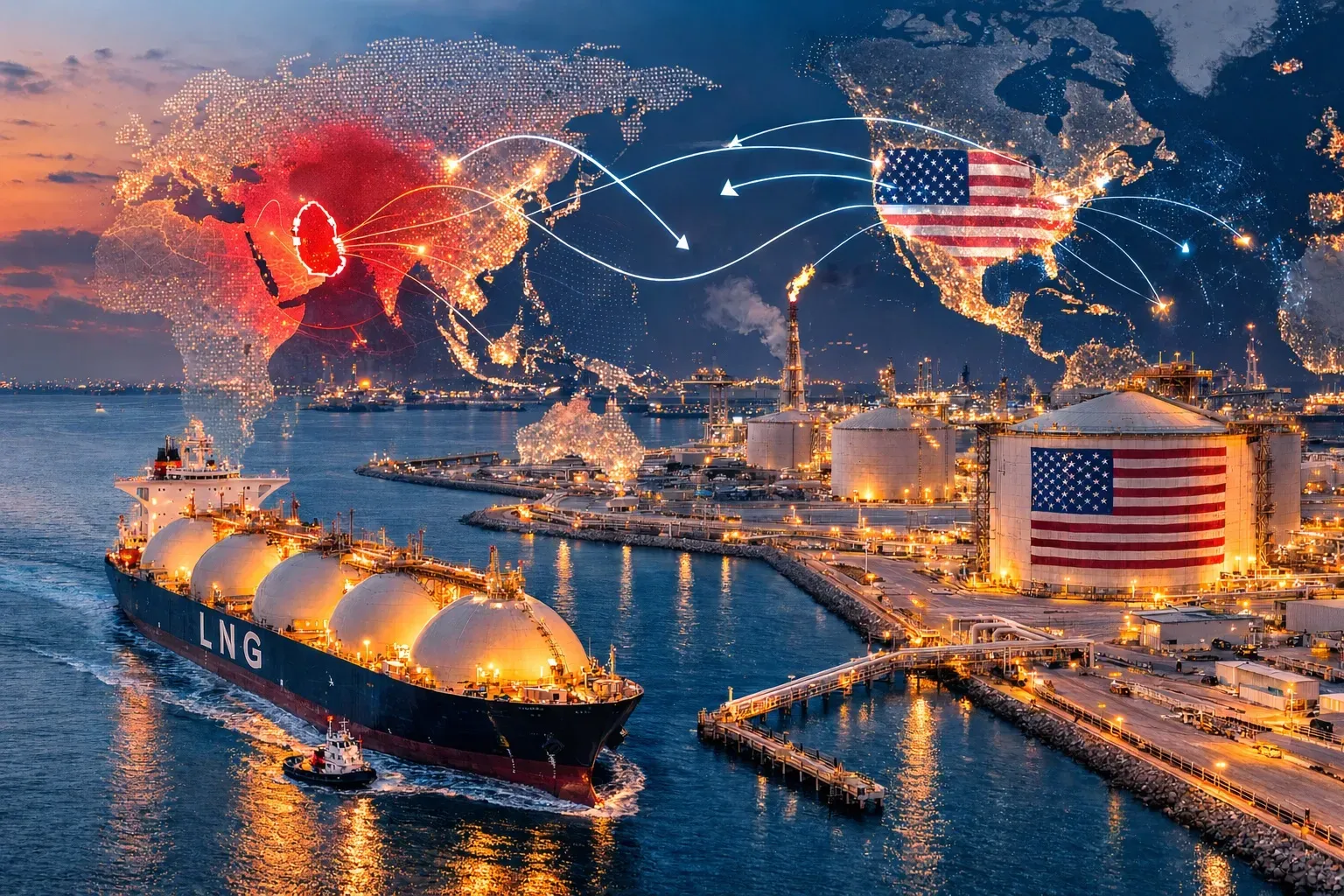
Qatar's LNG exports disrupted by conflict, boosting US LNG exports as buyers in Asia and Europe seek alternatives, shifting global energy dynamics.

Washington | EcoPulse24
Escalating tensions in the Middle East are beginning to reshape the global liquefied natural gas market, creating an unexpected opening for the United States to strengthen its position as a dominant LNG exporter as supply disruptions ripple through global energy markets.
For decades, Qatar built a reputation as one of the most reliable suppliers of liquefied natural gas, delivering cargoes to buyers across Europe and Asia without major interruptions. That reputation is now under pressure after operations at the Ras Laffan industrial complex - the world’s largest LNG export facility - were halted following an attack on the installations on 2 March, amid the widening regional conflict and disruptions to shipping through the Strait of Hormuz.
Ras Laffan plays a critical role in global gas markets. In 2025 the facility produced about 112 billion cubic metres (bcm) of LNG, alongside 300,000 barrels per day of liquefied petroleum gas (LPG) and 180,000 barrels per day of condensate, making it by far the largest LNG production hub in the world.
An extended shutdown of the complex could significantly tighten global gas markets that are already facing supply risks due to geopolitical tensions and volatile shipping routes in the Gulf.
The strategic importance of the Strait of Hormuz further amplifies the disruption. In 2025 more than 110 bcm of LNG passed through the strait, while approximately 93% of Qatar’s LNG exports relied on this route, representing nearly one-fifth of global LNG trade. There are effectively no alternative maritime routes capable of replacing these volumes.
The Strait is equally vital for oil markets. Roughly 80% of oil and petroleum products transiting the waterway in 2025 were destined for Asian economies, underscoring the region’s heavy reliance on Gulf energy supplies.
For LNG specifically, Asia is overwhelmingly the dominant destination. In 2025 nearly 90% of LNG shipments exported through the Strait of Hormuz were delivered to Asian markets, while just over 10% went to Europe.
With Qatar’s supply temporarily disrupted, many LNG buyers are now reassessing their energy strategies and exploring alternative suppliers - a shift that is increasingly benefiting the United States.
Cargoes departing from export terminals along the US Gulf Coast have already begun redirecting toward Asian markets where buyers are willing to pay higher prices to secure reliable gas supplies that Qatar cannot currently provide.
Several Asian governments are also reconsidering their long-term procurement strategies. Taiwan has signaled plans to increase LNG imports from the United States, potentially raising the American share of its supply mix significantly over the coming years. Other emerging markets, including Bangladesh, are exploring similar options as they seek to avoid electricity shortages during peak seasonal demand.
Even China which sharply reduced imports of US LNG during earlier trade tensions may ultimately reconsider American supply as energy security concerns intensify.
Global LNG Supply Landscape
Despite Qatar’s dominance, the global LNG market has diversified in recent years as new exporters have entered the market and the United States rapidly expanded production.
Top 5 LNG Exporters
Source: IGU World LNG Report 2025 | LSEG
| Rank | Country | 2024 (MT) | 2025 (MT) |
|---|---|---|---|
| 1 | 🇺🇸 United States | 88.42 | 111.0 |
| 2 | 🇦🇺 Australia | 81.04 | - |
| 3 | 🇶🇦 Qatar | 77.23 | - |
| 4 | 🇷🇺 Russia | 33.53 | - |
| 5 | 🇲🇾 Malaysia | 27.73 | - |
2025 figures for exporters ranked 2 – 5 have not yet been fully published, though preliminary data confirms that the United States has widened its lead as the world’s largest LNG exporter.
Top 5 LNG Importers
Source: IGU World LNG Report 2025 (2024 data)
| Rank | Country | 2024 (MT) | YoY Change |
|---|---|---|---|
| 1 | 🇨🇳 China | 78.64 | +7.45 |
| 2 | 🇯🇵 Japan | 67.72 | +1.62 |
| 3 | 🇰🇷 South Korea | 47.01 | +1.84 |
| 4 | 🇮🇳 India | 26.20 | +4.19 |
| 5 | 🇹🇼 Taiwan | 21.80 | +1.60 |
The table highlights Asia’s overwhelming dominance in LNG demand, explaining why disruptions in Gulf supply chains immediately reverberate across energy markets from Tokyo to Taipei.
Price Snapshot
Energy prices have already begun reflecting the growing uncertainty in supply chains.
| Commodity | Price | Change | % |
|---|---|---|---|
| Natural Gas | 3.2477 | +0.0387 | +1.21% |
| Gasoline | 2.9351 | +0.1468 | +5.26% |
| Heating Oil | 3.9900 | +0.3112 | - |
Gas prices in Europe and Asia have surged far more sharply than in North America, where abundant shale production continues to stabilize domestic markets.
A Strategic Opportunity for US LNG
The United States has already emerged as the world’s largest exporter of LNG, driven by the shale gas boom that transformed the country from a net importer of natural gas into a global energy powerhouse.
Export terminals along the Gulf Coast now supply customers across Europe, Asia and Latin America. The disruption in Qatar’s supply chain could accelerate this trend by encouraging buyers to diversify away from single-supplier dependence.
Unlike Qatar’s centralized export model dominated by state-owned QatarEnergy, the American LNG sector is more fragmented, with multiple companies operating export facilities and infrastructure projects.
While the US industry has faced challenges - including hurricane disruptions, regulatory hurdles and operational incidents at some facilities - it remains one of the few suppliers capable of scaling exports quickly when global supply shocks occur.
Reshaping the Global Energy Order
If disruptions in Qatar persist or delay the country’s massive LNG expansion projects, the global balance of energy trade could shift more dramatically.
Major projects such as the North Field expansion, which were expected to significantly boost Qatar’s LNG capacity later this decade, may face delays if geopolitical risks continue to affect construction and logistics.
Such delays could open space for additional export projects in other producing regions, including the United States, Mozambique, and Nigeria, potentially reshaping the global LNG landscape for years to come.
As geopolitical tensions intensify and shipping routes become more uncertain, energy-importing nations are increasingly prioritizing diversification and supply security.
In that environment, the United States appears well positioned to capture a larger share of global LNG trade while traditional energy supply routes through the Gulf face growing strategic uncertainty.
Explore Related Coverage
Sources & References
Editorial Note
Disclaimer
© 2025 EcoPulse24. All rights reserved.