Why Has Copper Become the 'Metal of Artificial Intelligence'? The Structural Shift Reshaping the Global Commodities Map
Copper is now vital for AI, data centers, and clean energy, making it a key strategic asset in the global digital and green economy shift.

Dubai | EcoPulse24
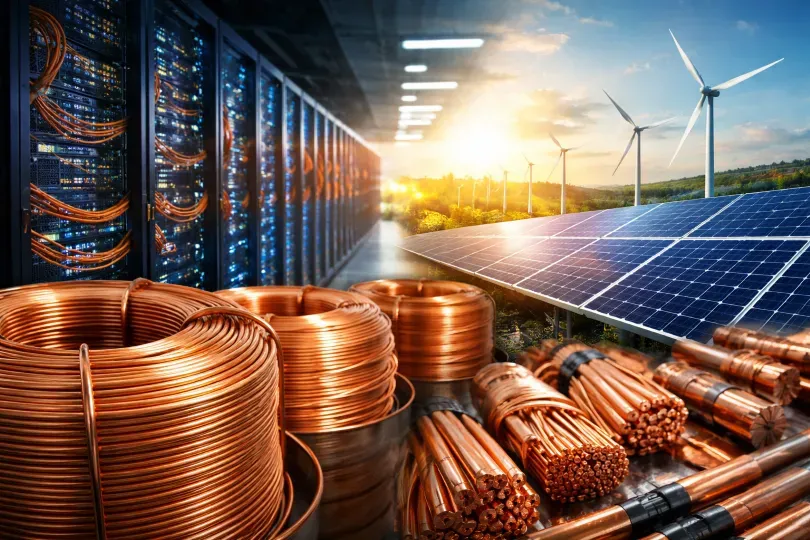
Copper is no longer just a traditional industrial metal used in wiring and electrical infrastructure; today, it is seen as a cornerstone of the new digital economy. In recent years, with the acceleration of artificial intelligence (AI), cloud computing, and the shift toward clean energy, copper has transitioned from a cyclical commodity linked to industrial activity to a strategic asset reflecting deep technological dynamics. This shift is not a temporary price boom, but a structural repositioning within global value chains.
Unlike previous tech waves, AI is not merely a software application but an energy- and resource-intensive infrastructure. Modern data centers powering large AI models require immense electrical capacity, advanced cooling systems, and highly efficient internal distribution networks. Every meter of these networks relies on copper, the main conductor due to its high efficiency, durability, and resilience. As investments in data centers double worldwide, so does the implicit demand for copper.
The story goes beyond servers and chips. AI expansion also necessitates upgrades to national power grids to accommodate new loads. The transition to renewable energy, intersecting with global sustainability agendas, further drives copper demand for wind turbines, solar panels, storage systems, and electric vehicle charging stations. This places copper at the heart of a dual digital and energy crossroads.
This convergence has reshaped investor perceptions of copper. Historically, iron ore formed the backbone of mining company profits, especially due to its direct link to construction in China. The current copper cycle, however, is driven not just by real estate or industrial spending, but by a structural change in how data is produced and energy is consumed. This makes copper demand less volatile and more tied to long-term strategic trends.
Major mining companies are now reprioritizing. Investment in high-quality copper assets is a strategic imperative, not only for higher returns but to secure a competitive position in a market with increasingly scarce supply. Developing copper mines requires years of exploration, permitting, and construction, meaning supply cannot quickly respond to sudden spikes in demand. This lag creates a sensitive pricing environment vulnerable to geopolitical or regulatory disruptions.
Geopolitics adds another layer of complexity. The largest copper reserves are concentrated in countries like Chile, Peru, and the Democratic Republic of Congo, regions facing diverse political, regulatory, and environmental challenges. Any changes in tax policies, concession terms, or sustainability standards can impact global supply flows. As copper becomes integral to tech value chains, it is now viewed as a strategic commodity with security and economic dimensions, not just a raw material.
AI is also prompting a redefinition of "critical minerals." If semiconductors represent the brain, copper is the nervous system linking all components. No data center can operate efficiently without advanced electrical infrastructure, and smart grids cannot expand without large amounts of high-quality conductors. This organic link between data and electricity gives copper a unique, hard-to-replace position.
Shifts in demand are also reflected in financial markets. Institutional investors and hedge funds view copper as a proxy for bets on AI growth and the green transition. This ties commodities and technology markets more closely together: rising AI investment expectations boost mining stocks and copper futures - and vice versa.
From a macroeconomic perspective, copper's ascent adds a new dimension to inflation dynamics. Rising demand for base metals may strain supply chains and increase production costs across sectors. Conversely, a slowdown in tech investment or tighter financial conditions could quickly impact copper prices. This dual sensitivity makes copper an early indicator of broader global economic trends.
The future challenge is balancing expanded production with environmental standards. Copper extraction is water- and energy-intensive, drawing increased regulatory and societal scrutiny. As global demand rises, producers must invest in more efficient and sustainable technologies to avoid conflicts between green transition goals and traditional extraction methods.
USGS - USGS Mineral Commodity Summaries 2025 – Copper (official data):
All figures below represent Mine Production (in thousand metric tons of contained copper):
Copper Production by Country
Country | 2023 (Actual) | 2024 (USGS Estimate)
Chile | 5,000 | 5,200
Peru | 2,600 | 2,700
DRC | 2,500 | 2,800
China | 1,700 | 1,750
USA | 1,100 | 1,150
Australia | 900 | 920
Russia | 900 | 900
Zambia | 760 | 800
Mexico | 730 | 750
Indonesia | 840 | 900
Other Countries | ~4,000 | ~4,100
Global Total | 22,000 | ~23,000
Key Methodological Notes (per USGS):
- 2023 data are revised actuals.
- 2024 figures are preliminary estimates.
- 2025 data will be officially available from USGS in January 2026.
- Figures reflect mine production only, not refined production.
In conclusion, copper has become a mirror of the broader economic transformation underway. No longer just linked to construction cycles and heavy industry, copper is now essential to the data-driven and clean energy economy. AI needs electricity, and electricity needs copper. Between these poles, a new equation is emerging that redefines the value of natural resources in the 21st century.
If investments in data centers and energy infrastructure continue to rise, copper will likely retain its role as a strategic driver in the commodities sector. If digital transformation slows or supply chains face severe bottlenecks, more volatile cycles may emerge. What is certain is that copper is no longer a secondary player; it has become a pillar of digital infrastructure and a barometer of the world's shift from an industrial economy to one powered by algorithms and clean energy.
Explore Related Coverage
Sources & References
Editorial Note
Disclaimer
© 2025 EcoPulse24. All rights reserved.