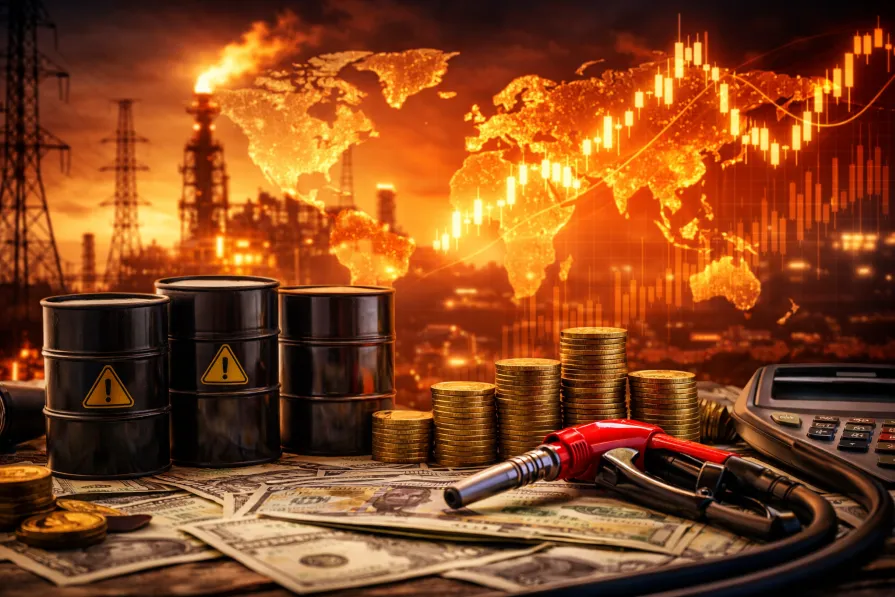
Global markets are entering a new phase where energy shocks - not monetary policy alone - are driving inflation, asset pricing, and capital flows. What began as a geopolitical escalation in the Middle East has rapidly evolved into a systemic macroeconomic force, redefining how investors, central banks, and governments interpret risk in 2026.
The resurgence in oil prices, coupled with disruptions to critical gas infrastructure and shipping routes, is injecting a persistent inflationary impulse into the global economy. This shift is not cyclical or temporary. It represents a structural transition where energy security and geopolitical risk premiums are once again central to financial market behavior.
Energy Shock Becomes the Core Market Driver
At the heart of the current environment is a sharp and sustained increase in energy prices. Brent crude has surged above $100 per barrel, at times approaching $110, driven by direct strikes on energy infrastructure and rising fears of prolonged disruption across key transit routes such as the Strait of Hormuz.
This corridor alone accounts for nearly 20% of global oil and LNG flows, making it one of the most critical chokepoints in the global energy system. Any instability in this region immediately translates into higher risk premiums, tighter supply expectations, and increased volatility across commodity markets.
The shock is not limited to crude oil. European natural gas markets have reacted sharply, while refined products such as gasoline and heating oil have reached multi - year highs. These moves are feeding directly into global inflation expectations, reversing the disinflationary trend that had begun to emerge in late 2025.
Key Energy Market Indicators
Indicator | Latest Level | Trend | Market Impact
Brent Crude Oil | ~$108–110/bbl | Strong uptrend | Inflation pressure, supply risk
WTI Crude Oil | ~$98/bbl | Rebounding | US supply tightening
European Gas (TTF) | ~€55/MWh | Volatile rebound | Energy security concerns
US Gasoline | ~$3.20/gal | Multi - year highs | Consumer inflation pressure
Inflation Repricing Across Major Economies
As energy costs rise, inflation expectations are being recalibrated across both developed and emerging economies. In the United States, stronger - than - expected producer price data has reinforced the view that inflation remains sticky, particularly as energy costs feed into transportation, manufacturing, and services.
The Eurozone is experiencing a similar dynamic. While headline inflation had moderated earlier, recent data shows renewed upward pressure driven by services and non - energy goods, with energy disinflation slowing significantly. This suggests that the transmission of higher energy costs into core inflation may be accelerating.
In Asia, the picture is more complex. Japan faces imported inflation pressures due to a weakening yen, while China is navigating a fragile recovery with mixed inflation signals. Rising global energy costs are adding a layer of uncertainty to already uneven demand conditions.
Central Banks Caught in a Policy Dilemma
This evolving inflation landscape is placing central banks in a difficult position. Policymakers are now balancing two competing risks: slowing economic growth and resurgent inflation driven by external shocks.
The Federal Reserve has maintained a restrictive stance, holding interest rates steady while signaling that only limited easing may be possible in 2026. This reflects a growing concern that premature rate cuts could reignite inflation, particularly if energy prices remain elevated.
The European Central Bank is expected to follow a similar path, adopting a wait - and - see approach as it assesses how energy - driven inflation feeds into the broader economy. Meanwhile, the Bank of Japan faces a unique challenge, as yen weakness amplifies imported inflation while domestic growth remains fragile.
Central Bank Policy Snapshot
Central Bank | Current Stance | Key Signal | Market Interpretation
Federal Reserve | Hold (3.5%–3.75%) | Limited cuts ahead | Higher - for - longer rates
ECB | Hold expected | Monitoring inflation risks | Delayed easing cycle
Bank of Japan | Ultra - loose bias | Watching yen weakness | Policy uncertainty rising
RBA | Tightening bias | Inflation concerns persist | More hikes priced in
Financial Markets React to the New Regime
Financial markets have already begun to adjust to this new macro environment. In the United States, equity markets have come under pressure as rising bond yields and inflation concerns weigh on valuations. Major indices have experienced renewed volatility, reflecting a shift away from risk assets.
European markets have also turned more unstable, with indices reversing gains as energy prices rise and inflation fears intensify. Sectoral rotation is becoming more pronounced, with investors favoring energy and industrial stocks while reducing exposure to rate - sensitive sectors such as technology and utilities.
In currency markets, the impact is equally visible. The Japanese yen is approaching critical levels near 160 per dollar, highlighting the growing divergence between US monetary policy and Japan’s accommodative stance. Meanwhile, the US dollar remains strong, supported by higher yields and safe - haven demand.
Commodities Diverge Under Pressure
One of the most notable developments in this environment is the divergence across commodity classes. While energy prices continue to surge, other commodities are reacting differently to the changing macro backdrop.
Gold, traditionally seen as a safe haven, has come under pressure due to rising real yields and a stronger dollar, which increase the opportunity cost of holding non - yielding assets. Silver has followed a similar trajectory, reflecting both monetary and industrial demand dynamics.
Industrial metals such as lithium and aluminum are showing signs of weakness, particularly in response to softer demand signals from China. At the same time, agricultural commodities like sugar are rising due to shifts in production dynamics linked to higher energy prices and biofuel demand.
This divergence highlights a key feature of the current regime: markets are no longer moving in a synchronized manner. Instead, they are responding to a complex mix of supply shocks, geopolitical risks, and monetary constraints.
Shipping and Trade Signals Reflect Underlying Demand
Despite rising volatility, certain indicators suggest that global trade has not yet entered a contraction phase. The Baltic Dry Index, which tracks shipping costs for bulk commodities, has recently moved higher, indicating continued demand for raw materials such as iron ore and coal.
This suggests that while financial markets are pricing in risk, real economic activity may still be holding up in the near term. However, sustained energy disruptions could eventually weigh on trade flows, particularly if transportation costs continue to rise.
The interaction between shipping dynamics, energy prices, and industrial demand will be a key area to monitor in the coming months, as it may provide early signals of broader economic shifts.
The New Global Risk Equation
The current environment is reshaping the global risk equation. Investors are increasingly factoring in geopolitical instability, energy security, and inflation persistence as core drivers of market behavior.
This is leading to a reassessment of asset allocation strategies, with a greater emphasis on resilience, liquidity, and exposure to real assets. Traditional correlations are breaking down, and volatility is becoming a structural feature rather than a temporary anomaly.
EcoPulse24 Analysis:
The global economy is transitioning into a new regime where energy shocks and geopolitical risks are redefining the rules of market behavior. Central banks are no longer the sole drivers of financial conditions, as external supply factors take precedence in shaping inflation and growth dynamics. This shift is forcing policymakers into a defensive stance, prioritizing stability over stimulus, while investors adjust to a prolonged period of uncertainty and repricing. The implications are far - reaching: markets are moving from a liquidity - driven cycle to one dominated by structural constraints, where energy, security, and inflation will remain the defining forces of the global financial system.