China trade data signals supply shock shift as exports slow and imports surge on energy-driven uncertainty
China's exports slowed while imports surged in March, reflecting a shift to supply security amid global energy and trade disruptions.

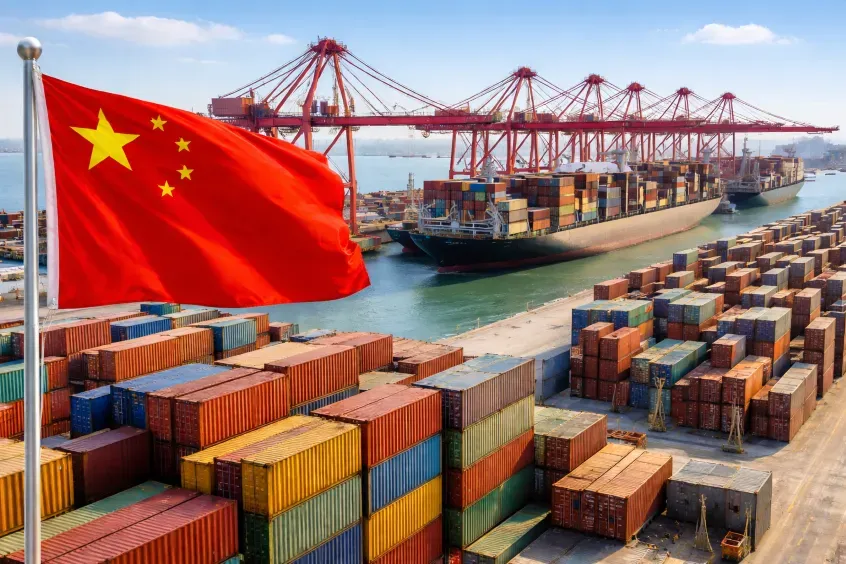
Beijing | EcoPulse24
China exports miss forecasts as imports spike on supply fears
China’s export growth slowed sharply in March while imports surged to multi-year highs, highlighting a structural shift in global trade dynamics as energy market disruptions linked to the Iran conflict reshape supply chains and demand patterns.
Exports rose 2.5% year-on-year to $321.03 billion, significantly below market expectations of 8.3% and sharply down from a 21.8% surge recorded in the January – February period. The slowdown marks the weakest export performance since October, when shipments had contracted, indicating that external demand is becoming increasingly constrained by global uncertainty.
The primary driver behind the export deceleration is the broad-based impact of the energy shock triggered by the closure of the Strait of Hormuz. Rising energy costs and disrupted shipping routes have weighed on global consumption and trade flows, offsetting pockets of strength linked to AI-driven demand. While exports to key Asian partners such as South Korea (+19.6%), Taiwan (+35.2%), and ASEAN (+6.9%) remained resilient, shipments to the United States fell sharply by 26.5%, reflecting both geopolitical tensions and weaker demand.
In contrast, import activity surged 27.8% year-on-year to a record $511.3 billion, far exceeding expectations of 11.1% and marking the fastest pace of growth since November 2021. This acceleration reflects aggressive front-loading of purchases as China moves to secure critical resources amid heightened uncertainty over global supply availability and pricing.
The composition of imports reveals a clear shift toward strategic stockpiling. Purchases of rare earths surged 159.9%, fertilizer rose 55.4%, and copper ore increased 42%, alongside gains in iron ore and grains. Technology-related imports also expanded, with data equipment rising 45.6% and integrated circuits up 41.4%, suggesting continued investment in industrial and digital capacity despite external pressures.
At the same time, imports of crude oil fell 7.1% and coal declined 8.3%, indicating that energy market volatility and logistical disruptions may already be constraining access to key fuels. This divergence between rising industrial inputs and falling energy imports underscores the complexity of the current supply environment.
On a quarterly basis, exports increased 14.7% to $977.49 billion, while imports surged 22.7% to $2.64 trillion, reinforcing the narrative that China is shifting from an export-led growth impulse toward a supply-security-driven import strategy in response to global instability.
EcoPulse24 Analysis
China’s latest trade data reflects a critical transition in the global economic cycle, where supply security is overtaking export competitiveness as the dominant strategic priority. The divergence between slowing exports and surging imports is not cyclical noise - it is a direct response to structural disruptions in global energy and logistics systems.
The Iran-linked energy shock has effectively altered the incentives for large importing economies. Instead of optimizing for cost efficiency, countries are now prioritizing availability and continuity of supply. China’s aggressive import growth, particularly in strategic materials and industrial inputs, signals a shift toward precautionary stockpiling and supply chain reinforcement.
The sharp decline in exports to the United States further illustrates the fragmentation of global trade flows. Geopolitical tensions, combined with weaker external demand and rising costs, are accelerating the decoupling trend between major economic blocs. This creates a more regionally segmented trade environment, where intra-Asia trade becomes more critical while trans-Pacific flows weaken.
The most important signal, however, lies in the imbalance between energy imports and industrial inputs. Falling crude and coal imports alongside rising demand for metals and technology components suggests that energy access - not industrial demand - is becoming the binding constraint. This dynamic could feed into higher global commodity prices, production bottlenecks, and persistent inflationary pressure.
At the macro level, China’s trade pattern is aligning with a broader “resilience economy” framework, where governments and industries prioritize redundancy, stockpiles, and supply chain control. This shift has long-term implications for global growth, trade efficiency, and inflation dynamics, reinforcing the idea that the current cycle is defined less by demand expansion and more by supply-side constraints driven by geopolitical risk.
Sources & References
Editorial Note
Disclaimer
© 2025 EcoPulse24. All rights reserved.