Coal Prices Hold Near 16-Month High as Indonesia Plans Export Curbs Amid Iran War Energy Crunch
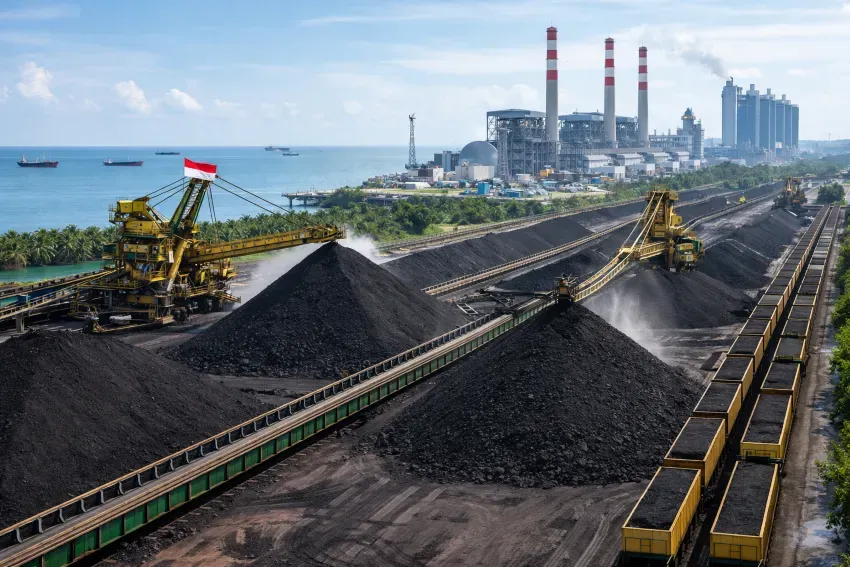
Coal held above $130 per tonne near a 16-month high as Indonesia plans to prioritize domestic supply and the Iran war diverts global energy demand to coal.

EcoPulse24 | Singapore
Coal prices held above $130 per tonne on Tuesday, hovering near their highest levels since November 2024, as Indonesia - the world's largest thermal coal exporter - signalled plans to prioritize domestic supply amid the Iran war-driven global energy crunch, while disruptions to oil and gas flows through the Strait of Hormuz continued to redirect power generation demand toward coal.
Indonesia Restricts Coal Exports
President Prabowo Subianto's administration signalled it will introduce new rules requiring domestic industrial users to be served before any coal volumes can be exported. Indonesia accounts for roughly 50% of global thermal coal supply for power generation, making this policy shift highly significant for international buyers. The move was driven by the need to protect Indonesia's rapidly expanding industrial sector from supply shortfalls and price spikes as global energy markets remain volatile. While the specific volumes or timelines for these domestic obligation rules have not yet been formally published, the announcement alone has already contributed to upward price pressure in the seaborne thermal coal market.
Iran War Redirects Global Energy Demand
The broader backdrop driving coal prices higher is the ongoing disruption to oil and natural gas flows through the Strait of Hormuz. Since Iran intensified attacks on energy infrastructure in the region, major oil and gas importers in Asia and Europe have been forced to reassess their supply chains. A prolonged disruption to Hormuz shipping could compel power generators in economies such as Japan, South Korea, India, and Pakistan to rely more heavily on coal for electricity production as liquefied natural gas (LNG) supplies tighten or become unaffordable at spot prices. This structural shift in demand expectations has supported coal prices well above the $120 to $125 range that prevailed before the conflict escalated.
Japan's 10-year government bond yield has held steady around 2.27% as the Bank of Japan assesses the inflationary impact of surging energy costs. The BOJ has so far rejected US President Trump's call to send warships to escort tankers through Hormuz, a decision that underscores the complex geopolitical calculus surrounding the crisis and its knock-on effects on energy-dependent economies.
Environmental and Market Tensions
The resurgence in coal demand stands in stark contrast to global commitments to reduce carbon emissions. Despite years of effort by environmentalists, financiers, and governments to curtail coal use, global thermal coal demand increased in each of the past two years, according to the International Energy Agency (IEA), particularly in India and Southeast Asia. The current Iran-war-driven demand surge threatens to further entrench coal in the energy mix of developing economies, at least in the short to medium term. Coal remains the most carbon-intensive fossil fuel, and any prolonged increase in its consumption risks setting back decarbonization timelines, with implications for carbon credit markets and climate-linked financial instruments.
Impact on GCC and MENA Energy Strategy
For Gulf producers, the coal price spike carries a nuanced message. While higher coal prices underscore the value of Gulf hydrocarbon exports, they also highlight the vulnerability of global energy systems to supply chain disruptions centered in the MENA region. Saudi Arabia, the UAE, and Qatar are monitoring coal market dynamics closely, as energy-price volatility ripples through Asian markets that are critical buyers of Gulf LNG and crude oil. The redirection of Asian energy demand toward coal, even temporarily, could compress spot LNG premiums and affect long-term contracting strategies for Gulf producers.
EcoPulse24 Analysis
EcoPulse24 Analysis: The coal market's approach to 16-month highs above $130 per tonne illustrates the cascading energy market consequences of the Iran war and Hormuz disruption. Indonesia's export restriction signal is a critical supply-side development that could tighten the seaborne coal market significantly if formalized. For regional investors, the key variable to watch is how long the Hormuz disruption persists - a swift diplomatic resolution would likely relieve pressure on coal prices, while a prolonged conflict would embed higher energy costs across the global economy for quarters to come. The interplay between coal, LNG, and crude oil pricing will be a defining feature of commodity markets throughout 2026.
Sources & References
Editorial Note
Disclaimer
© 2025 EcoPulse24. All rights reserved.