Presight Accelerator Demand Surges Globally as Applications Triple, Signaling Shift Toward Deployable AI Systems
Presight's AI Accelerator sees global demand triple, signaling a shift to deployable AI systems, with focus on enterprise and real-world integration.

Abu Dhabi | EcoPulse24
Artificial Intelligence UAE G42 Presight Startups Enterprise AI
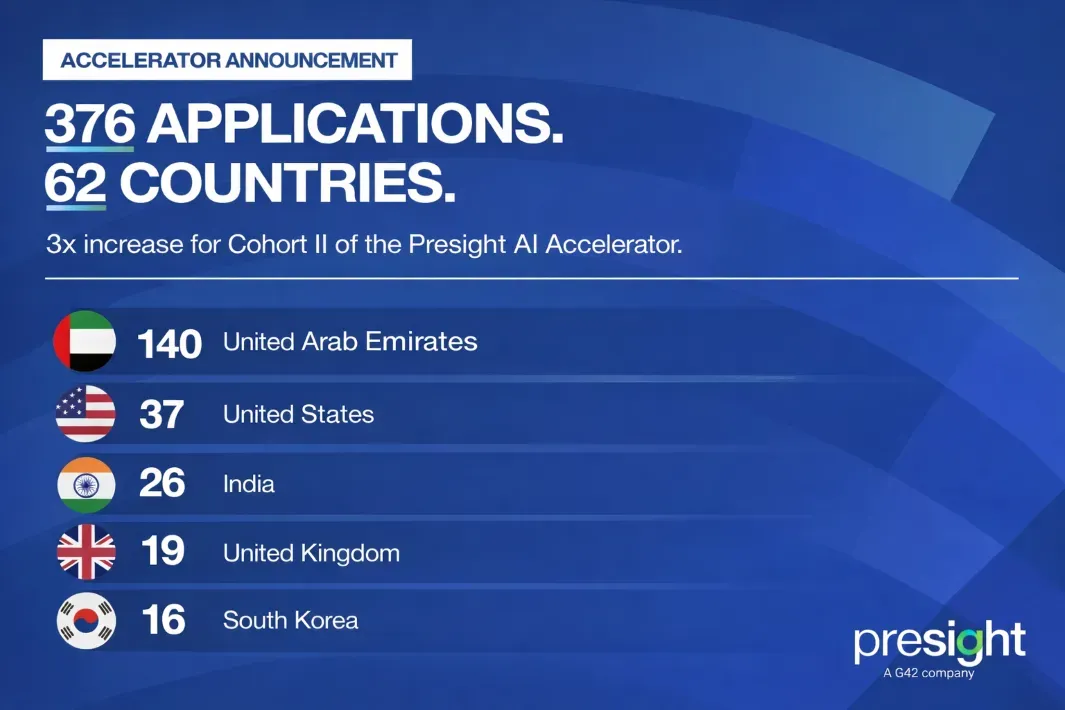
Presight has recorded a sharp acceleration in global demand for its AI Accelerator Program, receiving 376 applications from 62 countries for its second cohort, more than tripling the 120 applications from 17 countries in its inaugural intake
The expansion is not merely quantitative. The composition of applicants reveals a structural shift in the AI landscape: from experimental innovation toward commercially deployable, enterprise-grade systems. A growing share of applicants are building solutions in enterprise AI, agentic systems, automation, and advanced data analytics, with targeted use cases across financial services, healthcare, government systems, and critical infrastructure.
Geographically, the application base reflects a broadening of the global innovation pipeline. The Middle East led with 162 applications, followed by Asia-Pacific (84), Europe (65), and North America (42), with the UAE, United States, India, United Kingdom, and South Korea emerging as the most represented countries. This distribution highlights the decentralization of AI innovation beyond traditional Western hubs, with the Gulf increasingly positioning itself as a deployment and scaling center rather than just a capital destination.
Presight’s model is built around a deployment-first architecture, integrating infrastructure, capital, and institutional access. This approach appears to be resonating with a more mature class of startups. A notable portion of applicants already demonstrate commercial traction, including revenue generation, active customer bases, and prior funding - a marked evolution from earlier-stage experimentation typically seen in accelerator pipelines.
The first cohort provides early validation of this model. With a combined potential contract value of $26 million under discussion and a confirmed $1 million investment into NodeShift, the program has begun to translate technical capability into commercial pathways. Participating companies have already secured contracts and strategic agreements across the G42 ecosystem and beyond, including deployments in generative AI security, sovereign AI infrastructure, and data-driven platforms.
This progression indicates that the competitive frontier in AI is shifting. The bottleneck is no longer model development alone, but the ability to integrate systems into regulated, high-stakes environments where reliability, governance, and scalability are non-negotiable.
The selection process for the second cohort is now underway, with a multi-stage evaluation designed to filter for both technical depth and deployment readiness. Only 10 companies will ultimately be selected, reinforcing the program’s focus on quality over volume.
Analysis | EcoPulse24
The surge in applications to Presight’s accelerator reflects a broader transition in the global AI cycle. The market is moving beyond the “model era” - dominated by breakthroughs in large language models - into a “deployment era,” where value is defined by integration into real-world systems.
In this phase, access to infrastructure, regulatory alignment, and enterprise distribution channels becomes more critical than algorithmic novelty alone. This reorders the competitive landscape, favoring platforms that can bridge the gap between innovation and execution.
Abu Dhabi’s positioning within this shift is notable. Rather than competing purely on research, it is building a vertically integrated ecosystem that combines capital, compute, and government-level deployment pathways. Programs like Presight’s accelerator effectively act as filtration layers for globally sourced innovation, selecting technologies that can be operationalized at scale.
If sustained, this model could reshape how AI value chains are structured - moving influence away from purely research-driven hubs toward regions capable of orchestrating full-stack deployment environments.
Sources & References
Editorial Note
Disclaimer
© 2025 EcoPulse24. All rights reserved.