Microsoft commits $10 billion to Japan AI infrastructure as energy constraints reshape global tech expansion
Microsoft will invest $10B in Japan's AI infrastructure, focusing on data centers, workforce, and energy constraints amid global tech competition.

Tokyo | EcoPulse24
Microsoft Japan AI investment data centers energy demand
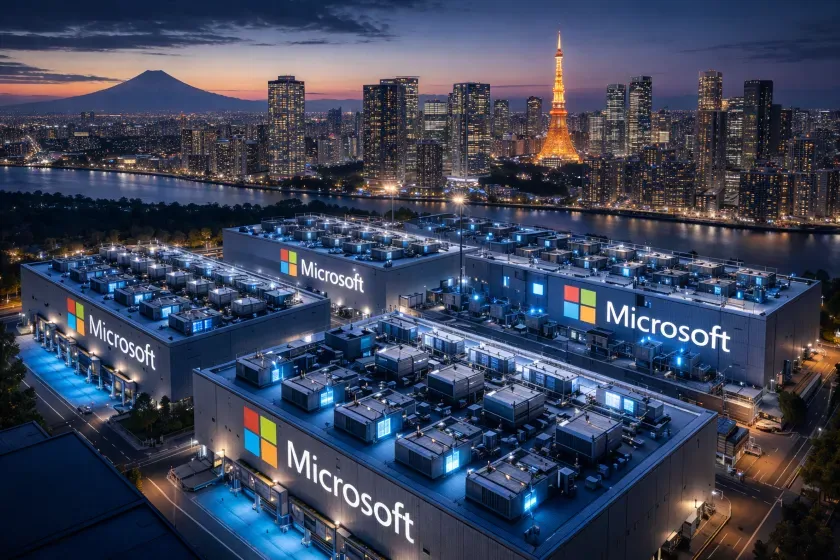
Microsoft has unveiled a $10 billion, four-year investment plan in Japan focused on expanding artificial intelligence infrastructure, as global tech competition intensifies and energy constraints begin to influence data center strategy.
The investment centers on building cloud capacity and new data centers in partnership with Sakura Internet and SoftBank, positioning Japan as a strategic hub in Microsoft’s Asia AI expansion. The initiative reflects a demand-driven approach, with the company citing clear enterprise and government signals for accelerated AI adoption.
The move comes amid escalating competition between US hyperscalers, with Microsoft, Amazon, and Alphabet racing to secure dominance in Japan’s AI ecosystem. The country is actively investing in advanced chips and targeting a significant share of the emerging “physical AI” market, leveraging its industrial robotics base.
Market reaction underscored the immediate impact of infrastructure investment signals, with Sakura Internet surging more than 20%, while SoftBank-related entities recorded moderate gains, reflecting investor expectations of increased demand for computing capacity and GPU supply chains.
The expansion also includes a workforce development component, with Microsoft aiming to train one million AI engineers by 2029, alongside strengthening cybersecurity partnerships. This signals a dual-track strategy combining infrastructure scaling with human capital development to sustain long-term AI adoption.
However, the investment highlights a growing constraint in the global AI buildout: energy availability. Japan’s heavy reliance on Middle Eastern oil and recent geopolitical disruptions have increased pressure on power supply, forcing a return to less efficient energy sources to meet rising demand from data centers.
Globally, hyperscalers are expected to deploy hundreds of billions of dollars into AI infrastructure, but these plans are increasingly tied to power availability, grid stability, and energy security. This introduces a new variable into AI competition, where access to electricity becomes as critical as access to chips.
سهم الشركات المرتبطة بالخبر
الشركة | السعر | التغير
مايكروسوفت | 373.46 دولار | +1.11%
ساكورا إنترنت | 2,967 ين | +20.27%
سوفت بنك (الاتصالات) | 218.80 ين | +1.58%
سوفت بنك جروب | 3,609 ين | +0.14%
أمازون | 209.77 دولار | +0.38%
EcoPulse24 Analysis
Microsoft’s Japan expansion reflects a structural shift in the AI race from software innovation toward infrastructure dominance constrained by physical resources. As data centers scale, energy supply becomes a binding constraint, linking AI growth directly to global energy markets and geopolitical stability. This convergence places AI infrastructure at the intersection of the Energy Crisis and Tech Competition cycles, where power availability, not just capital or algorithms, defines strategic advantage.
Sources & References
Editorial Note
Disclaimer
© 2025 EcoPulse24. All rights reserved.