Shell Posts $6.9 Billion Q1 Profit as Middle East Conflict Hits LNG Output and Distorts Cash Flow
Shell Q1 2026 profit rose to $6.9B, but cash flow dropped due to Middle East conflict, impacting LNG output and raising net debt.

EcoPulse24 | Dubai
Shell reported first quarter 2026 adjusted earnings of $6.9 billion, more than double the $3.3 billion recorded in Q4 2025, as strong upstream pricing and trading performance offset a $11.2 billion working capital outflow driven by unprecedented commodity price volatility linked to the Middle East conflict.
Key Financial Results - Source: Shell Q1 2026 Press Release, May 7, 2026
| Metric | Q1 2026 | Q4 2025 |
|---|---|---|
| Adjusted Earnings | $6.9 billion | $3.3 billion |
| Adjusted EBITDA | $17.7 billion | $12.8 billion |
| CFFO | $6.1 billion | $9.4 billion |
| Cash Capex | $4.2 billion | $6.0 billion |
| Free Cash Flow | $2.9 billion | $4.2 billion |
| Net Debt | $52.6 billion | $45.7 billion |
| Working Capital Outflow | ($11.2 billion) | $1.3 billion |
Adjusted Earnings by Segment - Q1 2026
| Segment | Adjusted Earnings |
|---|---|
| Upstream | $2.377 billion |
| Chemicals & Products | $1.925 billion |
| Integrated Gas | $1.819 billion |
| Marketing | $1.334 billion |
| Renewables & Energy Solutions | $348 million |
| Corporate & NCI | ($929 million) |
| Total | $6.915 billion |
Strong Earnings, Distorted Cash
The headline adjusted earnings figure of $6.9 billion is genuinely strong - but the cash flow picture tells a more complicated story. CFFO came in at $6.1 billion, well below the $17.2 billion CFFO excluding working capital, because an $11.2 billion working capital outflow absorbed most of the operating cash generation. Shell attributes this directly to unprecedented commodity price volatility - rising inventory values and receivables driven by the energy market disruption following the Hormuz crisis.
The working capital outflow breaks down as follows: inventory price impact of $6.2 billion, inventory volume of $0.5 billion, and AR/AP and other of $4.4 billion. Net debt consequently rose to $52.6 billion from $45.7 billion at end-2025 - a $6.9 billion increase in a single quarter. Shell describes its balance sheet gearing of 23% as resilient in the context of the current price environment.
The Middle East Factor
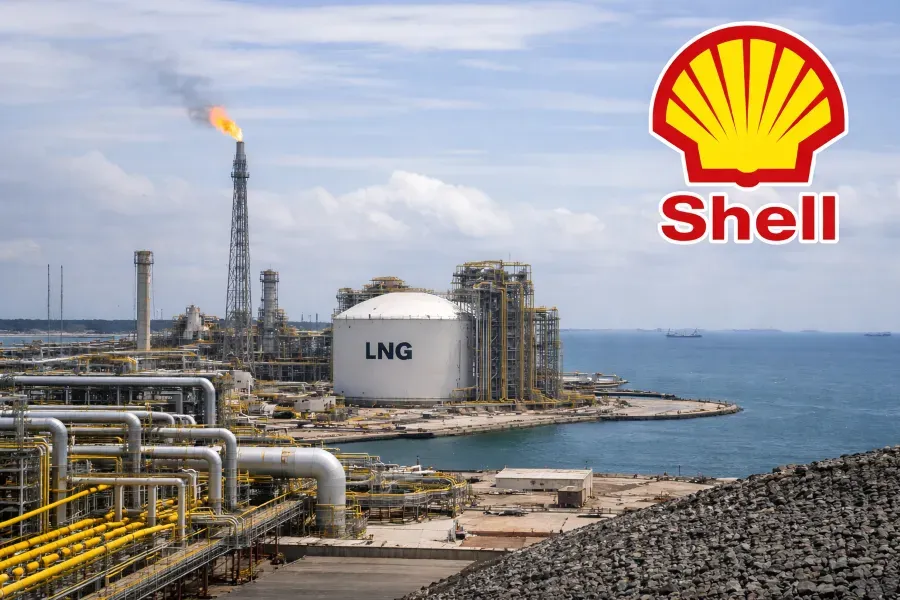
The conflict's fingerprints are visible across Shell's Q1 results and Q2 guidance. In Integrated Gas - Shell's most strategically important division for Gulf-relevant readers - production fell to 909 kboe/d from 948 kboe/d in Q4 2025, and LNG sales volumes declined to 19.2 million tonnes from 19.8 million tonnes. The Q2 2026 production outlook of 580-640 kboe/d is sharply lower, reflecting the impact of the Middle East conflict including Qatar and higher planned maintenance across the portfolio.
Qatar, where Shell has significant LNG exposure through its QatarEnergy partnerships, has seen 17% of its export capacity disrupted - a figure confirmed separately by QatarEnergy CEO Saad Al-Kaabi in March. Shell's Q2 guidance is the first major corporate disclosure to formally quantify what that disruption means for an integrated gas major's production volumes.
Shareholder Returns: Buyback and Dividend Increase
Despite the working capital pressure, Shell is returning capital to shareholders. The company is commencing a $3.0 billion share buyback programme for the next three months and increasing its dividend by 5% to $0.3906 per share - consistent with its existing policy of distributing 40-50% of CFFO. CEO Wael Sawan described the distributions as reflecting Shell's value-driven capital allocation philosophy.
Note: Shell has flagged that it will need to temporarily suspend the buyback programme between publication of the ARC Resources shareholder circular and conclusion of the ARC shareholder meeting, due to applicable securities law requirements. Any buybacks not completed during the suspension will be incorporated into remaining 2026 programmes subject to Board approval.
ARC Resources Acquisition
Last week Shell announced the acquisition of ARC Resources, adding complementary high-quality, low-cost liquids and gas assets. The deal adds 370 kboe/d of production and is expected to deliver a 4% production CAGR through to 2030 from a 2025 base. The ARC acquisition accounts for approximately $4 billion of Shell's 2026 cash capex outlook of $24-26 billion. The 2027-2028 capex outlook remains unchanged at $20-22 billion.
Upstream Strength
The Upstream segment was Q1's strongest contributor at $2.377 billion in adjusted earnings, up from $1.6 billion in Q4 2025, driven by higher realised prices. Realised liquids price rose to $72/bbl from $59/bbl. Total production was 1,843 kboe/d, modestly lower than Q4 2025's 1,892 kboe/d. Q2 2026 production outlook of 1,620-1,820 kboe/d reflects higher planned maintenance.
What This Means for Gulf Energy Investors
Shell's Q1 results are a direct data point on how the Gulf conflict is reshaping the economics of integrated energy majors. The company is simultaneously benefiting from elevated upstream prices while absorbing significant working capital distortion from commodity volatility and facing near-term LNG volume headwinds from Qatar-related disruption. For Gulf sovereign wealth funds and energy investors, the pattern is instructive: energy price elevation is good for upstream revenue but creates cash flow timing mismatches that elevate net debt in the short term.
Sources & References
Editorial Note
Disclaimer
© 2025 EcoPulse24. All rights reserved.