Agentic AI Rewrites the Data Center Equation
At AMD, we have been tracking this shift closely. We previously projected server CPU market growth at 18% annually.


EcoPulse24 | Dubai
There is a conversation happening right now in infrastructure planning meetings across the enterprise world. It goes something like this: "Agentic AI is going to change the CPU-to-GPU ratio. So we just need to add more CPUs to our existing GPU servers, right?"
It sounds logical. It is also where most people are getting it wrong.
The shift from conversational AI to agentic AI is not an incremental hardware adjustment. It is a structural transformation of data center architecture - one that demands entirely new racks of CPU servers running alongside GPU infrastructure, not simply more processors squeezed into existing designs.
For enterprise IT leaders, the lesson is clear: agentic AI rewrites the infrastructure equation entirely.
At AMD, we have been tracking this shift closely. We previously projected server CPU market growth at 18% annually. The structural increase in compute demand driven by agentic workloads changes that math significantly. We now expect the total addressable market for server CPUs to grow at greater than 35% annually, exceeding $120 billion by 2030.
The First Wave: Chatbot AI Was Built Around Model Responses
Generative AI's first wave followed a simple pattern. A user submitted a prompt. The application routed it to a model. The model returned a response. The application delivered it.
That architecture was naturally GPU-centric. In those deployments, a single CPU acted as the head node managing scheduling, I/O and system operations - while four to eight GPUs handled the heavy computation.
The prevailing ratio: 1 CPU to every 4 – 8 GPUs.
That ratio shaped billions of dollars in infrastructure investment decisions over the past three years. It is now obsolete.
Agentic AI Is Not Chatbot AI With Extra Steps
We are in the early days of the Agentic AI era. The workload profile has changed fundamentally. Rather than responding to a single prompt, an agent breaks a goal into steps, determines what to do next, calls multiple models, queries databases, connects with APIs, runs enterprise applications, checks permissions, retrieves memory, validates outputs - and then loops through the process again.
This is a categorically different infrastructure profile from prompt-in, answer-out chatbot AI.
GPUs remain essential for model execution. But the production workload surrounding model execution is now CPU-intensive. CPUs are responsible for:
- Orchestration: Managing the engine that decomposes complex tasks into executable steps
- Agent Execution and Tool Calls: Triggering APIs, enterprise software and legacy systems
- Policy and Security: Running real-time compliance checks on every autonomous action
The emerging ratio: 1 CPU to every 1 GPU - and in some deployments, more CPUs than GPUs.
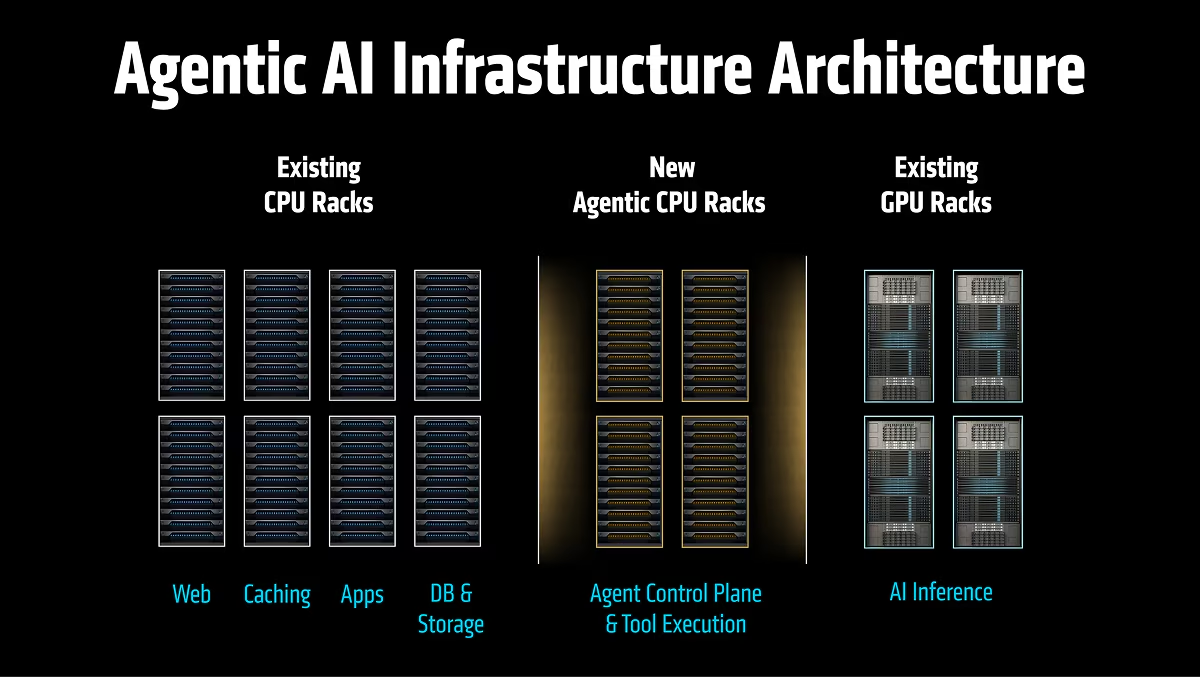
The Answer Is Not Simply "Add More CPUs"
This is where enterprise planning most commonly goes wrong. Adding more CPUs to an existing GPU-heavy rack does not solve the problem. The agentic era requires a newly engineered CPU compute layer - purpose-built for orchestration workloads, not retrofitted onto GPU infrastructure.
The AI system architecture of the next several years will not be a single unified "AI box." It will look like a distributed system with three distinct layers:
- GPU racks for dense model compute
- Fast networking with a software stack maintaining observability, security and efficiency across the system
- Agentic CPU racks for orchestration, data processing and tool execution
Balance across these layers matters more than raw compute power. If the CPU tier is undersized, GPUs sit idle waiting for instructions. If networking is treated as an afterthought, agents stall at every handoff. If the data path is poorly designed, latency compounds across every loop. If the orchestration layer cannot handle concurrency, costs rise and complexity multiplies.
Where AMD Fits
AMD EPYC™ processors give customers a portfolio of CPU choices optimized for different parts of the AI pipeline - from high-frequency performance for latency-sensitive workloads to dense-core throughput for scale-out deployments.
We continue to extend this portfolio through our current roadmap, including the upcoming "Venice" family of AI-optimized CPUs, which will further expand the options available for each compute layer in the agentic architecture.
Our goal is straightforward: provide the specialized silicon that populates every rack in your data center - and every compute instance in your cloud environment - with exactly what the workload requires.
The Practical Takeaway for IT Leaders
Agentic AI is not a software upgrade to your existing infrastructure. It is a new class of digital workforce - one that plans, decides, retrieves, calls tools and executes workflows continuously, not just when a user submits a prompt.
Sizing infrastructure for this era means:
- Planning for significantly more CPU capacity than earlier AI assumptions suggested
- Looking beyond the GPU server toward rack-level architecture, fabric design, software layers and operational balance
- Treating CPU and GPU infrastructure as complementary layers of a unified system, not competing line items in a procurement decision
In the agentic era, performance will not come from one processor doing everything. It will come from the right architecture - CPUs and GPUs working in concert to move AI from generating answers to taking action.
This article contains forward-looking statements concerning Advanced Micro Devices, Inc. (AMD), including projected growth of the total addressable market for server CPUs. These statements are based on current beliefs and assumptions and involve risks and uncertainties that could cause actual results to differ materially. Readers are urged to review AMD's SEC filings, including its most recent Forms 10-K and 10-Q.
Explore Related Coverage
Sources & References
Editorial Note
Disclaimer
© 2025 EcoPulse24. All rights reserved.