Dubai Leads GCC Gains as Masadir GCC Pulse Closes Slightly Higher Despite Saudi and Qatar Weakness
The regional composite closed at +0.02%, according to the official end-of-session snapshot

Dubai | EcoPulse24
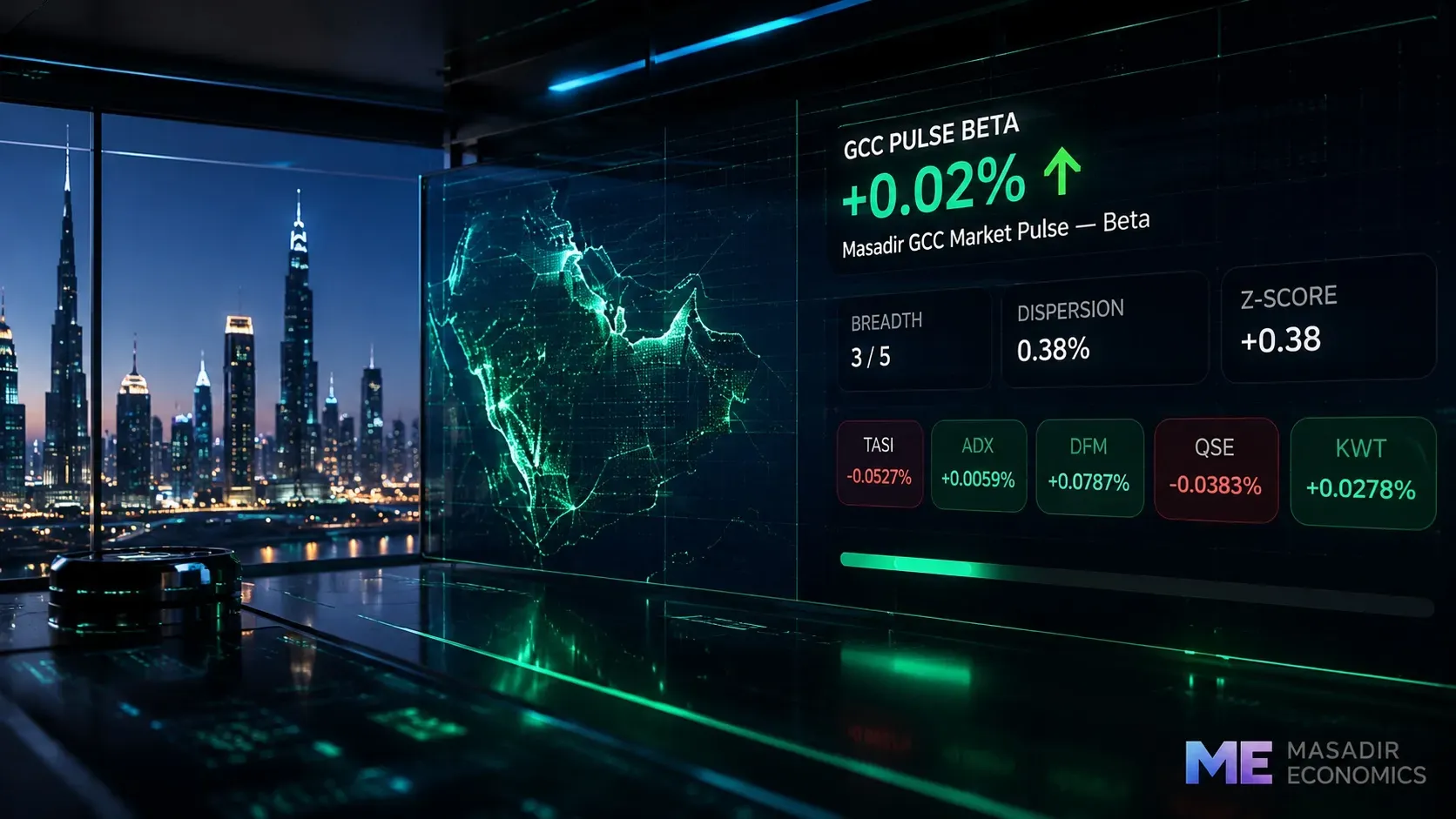
The Masadir GCC Market Pulse (Beta) ended Thursday's session marginally higher, reflecting a balanced regional trading environment in which gains in the UAE and Kuwait offset declines in Saudi Arabia and Qatar.
The regional composite closed at +0.02%, according to the official end-of-session snapshot, while market breadth stood at 3 out of 5 markets in positive territory. Dispersion reached 0.38%, highlighting notable differences in performance across GCC exchanges despite the near-flat headline reading.
Dubai Delivers the Strongest Positive Contribution
Dubai Financial Market emerged as the largest positive contributor to the regional composite, adding +0.0787% to the Pulse.
The market outperformed regional peers during the session, supported by continued strength in selected consumer, services, and growth-oriented stocks.
Abu Dhabi also contributed positively, albeit modestly, with a contribution of +0.0059%, while Boursa Kuwait added +0.0278% to the regional reading.
Saudi Arabia and Qatar Weigh on Regional Sentiment
On the downside, the Saudi Tadawul All Share Index (TASI) was the largest negative contributor, reducing the composite by -0.0527%.
The Qatar Exchange also weighed on regional performance, contributing -0.0383%.
The combined weakness in the two markets largely offset gains recorded elsewhere across the GCC.
Mixed Regional Picture
The official market closes showed:
| Market | Performance |
|---|---|
| Dubai Financial Market | +0.56% |
| Abu Dhabi Securities Exchange | +0.03% |
| Boursa Kuwait | +0.31% |
| Qatar Exchange | -0.55% |
| Saudi Tadawul | -0.11% |
Despite the mixed performance, three markets finished in positive territory, allowing the regional composite to remain slightly above the flat line.
EcoPulse24 Analysis
The significance of Thursday's reading lies less in the headline gain of 0.02% and more in the divergence beneath the surface.
Rather than moving as a single bloc, GCC equities displayed a clear split between markets attracting capital and those facing profit-taking pressure. Dubai continued to provide leadership, Kuwait maintained positive momentum, and Abu Dhabi remained stable, while Saudi Arabia and Qatar acted as regional drags.
The Pulse's Z-Score of +0.38 suggests that market conditions remained within normal trading ranges and did not signal an extreme bullish or bearish environment.
For investors tracking regional capital flows, the session reinforces a recurring theme seen in recent weeks: GCC markets are becoming increasingly selective, with performance driven by market-specific factors rather than a uniform regional trend.
Explore Related Coverage
Sources & References
https://masadir.net/datasets/gcc-market-pulse
Editorial Note
Disclaimer
© 2025 EcoPulse24. All rights reserved.