Egypt Plans National Gold Refinery to Boost Reserves and Transform Economy from Raw Exporter to Industrial Hub
Egypt plans a national gold refinery to boost reserves, curb raw exports, create jobs, and position itself as a regional industrial hub.

Cairo – EcoPulse24
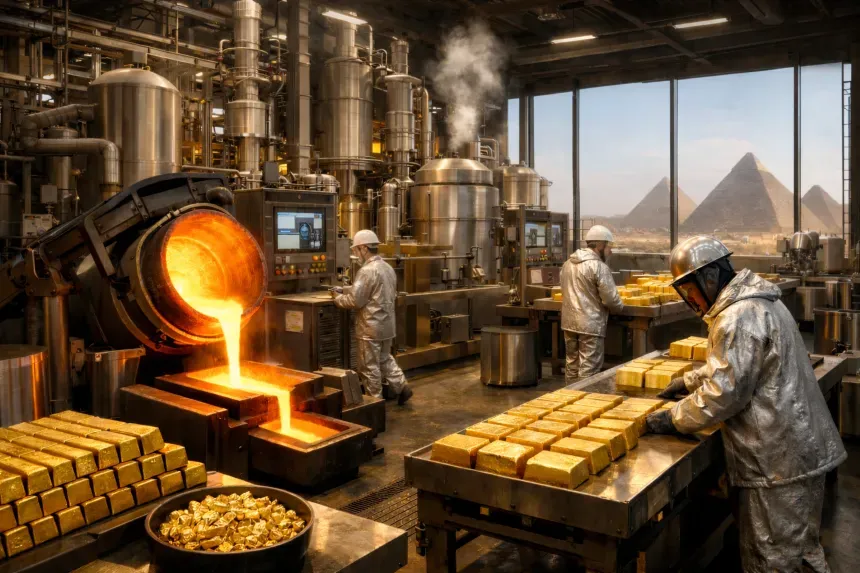
The Egyptian government has unveiled a strategic plan to establish a national gold refinery, aiming to maximize the added value of gold within the local market, strengthen Egypt’s gold reserves, and position the country as a regional industrial hub rather than a mere raw gold exporter. The announcement followed the inaugural meeting of the Supreme Gold Committee, chaired by Prime Minister Mostafa Madbouly on Saturday, January 18, 2026. The government emphasized its focus on boosting gold discoveries and improving market governance.
Project Details
Government spokesperson Mohamed Al-Homsani highlighted the refinery’s strategic importance in enhancing value addition, transforming Egypt into an industrial center, and supporting mining value chains. Three potential sites for the project are under review, with coordination underway for swift implementation.
Comprehensive Gold Sector Strategy
The Supreme Gold Committee is tasked with developing a holistic strategy for the gold sector, covering extraction (increased exploration), processing (advanced extraction technologies), refining and smelting (modern facilities), manufacturing (gold jewelry), and trading (market regulation). Legislative reforms and policy frameworks are also in scope.
Private Sector Partnership
The committee will assess proposed collaborations for the refinery, review restructuring of the Assay and Weights Authority, and ensure robust technical and administrative capacities. The project will be implemented in partnership with the private sector to curb illegal gold trading and enhance oversight mechanisms.
Prime Minister’s Statements
Prime Minister Madbouly stressed the government’s commitment to gold sector development, increasing discoveries, and market regulation. The goal is to maximize local value addition and transition Egypt into an industrial hub.
Economic Context
The move aligns with Egypt’s strategy to boost gold reserves, which reached 128.82 tons (approx. $16.5 billion) by Q3 2025. Gold’s share in Egypt’s foreign reserves rose above 35% by end-2025, reflecting a strategic shift toward safe-haven assets.
Industrial Shift
The gold refinery project marks a major shift in Egypt’s approach to mineral wealth: reducing raw gold exports, developing a comprehensive gold industry, creating thousands of jobs, attracting investment, and increasing exports of finished products.
Market Governance
Beyond the refinery, the government is reforming the Assay Authority, combating illicit trading, regulating supply chains, and protecting consumers by ensuring product quality.
Mining Potential
Egypt boasts significant mining potential, with major sites like Sukari Mine (over 400,000 ounces annually), Iqat Mine (200 kg/month), and new exploration tenders in the Eastern Desert.
Global Gold Trend
Egypt’s move aligns with a global trend of central banks increasing gold reserves amid geopolitical tensions, currency volatility, and inflation. The World Gold Council reports 95% of central banks planned to boost gold reserves over the past year.
Future Prospects
Experts anticipate the refinery will increase government revenues, improve the balance of payments, boost foreign reserves, support national industry, and create direct and indirect jobs.
Next Steps
Authorities are finalizing feasibility studies for three proposed sites, preparing legislative frameworks, engaging potential private investors, developing required infrastructure, and launching technical training programs.
Regional and Global Standing
Egypt currently ranks fifth in the Arab world and 34th globally in central bank gold reserves, holding about 1% of global reserves. The new project is expected to enhance these rankings.
Challenges and Opportunities
Key challenges include securing substantial financing, regional competition, global gold price volatility, and technical expertise needs. Opportunities lie in Egypt’s strategic location, large domestic market, promising mining prospects, strong government backing, and existing infrastructure.
Comprehensive Vision
The refinery is part of a broader vision for Egypt’s gold sector: upstream (exploration), midstream (refining), and downstream (manufacturing and market regulation).
Economic Impact
At the macro level, the project is expected to increase mining’s GDP contribution, improve the balance of payments, enhance foreign reserves, and diversify national income. For the private sector, it will open new investment opportunities, transfer advanced technology, build strategic partnerships, and develop local value chains. Socially, it will create thousands of jobs, foster local development in mining regions, build skills, and improve living standards.
Global Gold Market Position
With this strategy, Egypt aims to move from a raw gold exporter to an industrial player, compete regionally with countries like Saudi Arabia and the UAE, attract international investment, and build a global brand for Egyptian gold.
Conclusion
The national gold refinery project represents a bold strategic step to transform Egypt into a regional industrial hub for gold, with significant economic and social benefits. As the Supreme Gold Committee continues its legislative and executive preparations, the business community awaits further project details and timelines, which could reshape Egypt’s and the region’s gold industry landscape.
Explore Related Coverage
Sources & References
Editorial Note
Disclaimer
© 2025 EcoPulse24. All rights reserved.