Energy and Geopolitical Pressures Drive Selectivity in Gulf Markets as Dubai Declines and Qatar Shows Relative Resilience
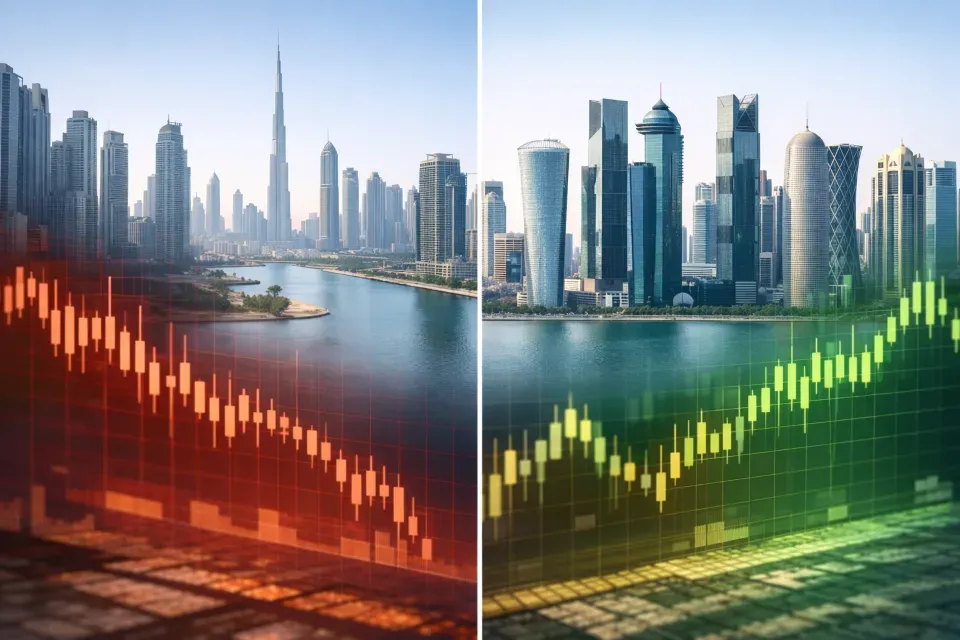
Gulf markets diverged as Dubai fell sharply, Qatar showed resilience, and energy, liquidity, and risk sensitivity drove selective investor moves.

Abu Dhabi | EcoPulse24
Gulf stock markets closed Wednesday with clear divergence in performance, as investors shifted to more conservative risk management strategies due to regional developments and direct sensitivities to energy prices, supply chains, and capital flows. The overall picture showed a market balancing oil-driven economic support against heightened geopolitical risk premiums, leading to selective liquidity and increased index sensitivity to sell-offs.
In Saudi Arabia, the TASI index closed at 10,692.69 points, up 126.95 points (1.20%), with high trading activity. Trading volume reached 321,338,489 shares and a value of SAR 6,533,868,040.94 across 534,105 transactions, involving 268 companies. This performance highlighted the Saudi market's relative resilience to regional pressures, supported by ample liquidity and a wide distribution across stocks, with a tilt toward large-cap defensive shares during periods of tension.
Abu Dhabi's stock market saw limited risk appetite, closing at 10,251.58 points, down 202.30 points (1.935%). Liquidity stood at AED 962,916,919.29 across 24,327 trades with 281,511,933 shares exchanged. Movements reflected a preference for blue-chip stocks and caution in expanding positions, as investors awaited oil trends and regional risk directions.
Dubai was the most affected by selling pressure, with the index closing at 6,197.19 points, down 306.31 points (4.71%). Trading value was AED 896,327,460.58 with 165,241,108 shares across 8,418 deals. Losses dominated most traded stocks, with only limited gains. The sharp drop reflected heightened sensitivity to risk reduction, especially as selling spread across more companies.
Qatar's exchange performed relatively better, with the QE20 index closing at 10,588.86 points, up 79.04 points (0.75%). Turnover reached QAR 602,852,405.912 with 223,372,655 shares traded in 33,477 transactions. Gains were broad-based, with 50 companies rising, 5 falling, and 2 unchanged, reflecting stronger demand for leading stocks compared to regional sell-offs.
Kuwait saw its main indices decline: the Premier Market closed at 9,015.27 points, down 49.51 points (0.55%); the Main Market 50 at 8,002.41 points, down 111.27 points (1.37%); and the All-Share Index at 8,437.81 points, down 44.32 points (0.52%). There were 9,331 trades with a volume of 112,663,166 shares and a value of KWD 46,656,087.240. Meanwhile, Kuwaiti oil rose to $80.32 per barrel, up $1.62 (2.06%), keeping energy considerations central to investor decisions.
EcoPulse24 Analysis:
Today's divergence among Gulf markets reflects not fundamental economic differences but rather varying sensitivity to risk shifts and daily liquidity characteristics. Markets with deeper liquidity and broader trading tend to absorb tensions more effectively, while those more sensitive to risk reduction experience wider swings when liquidity turns defensive. With ongoing regional uncertainty, the prevailing trend remains selectivity and focus on leading stocks and sectors directly tied to the energy cycle, as investor behavior remains driven by rapidly changing news and its impact on risk premiums.
Explore Related Coverage
Sources & References
Editorial Note
Disclaimer
© 2025 EcoPulse24. All rights reserved.