GCC Pulse Falls as Four Gulf Markets Decline While Dubai Defies Regional Weakness
Masadir GCC Pulse Beta Index down 0.51% and highlighting a growing divergence in regional market performance.

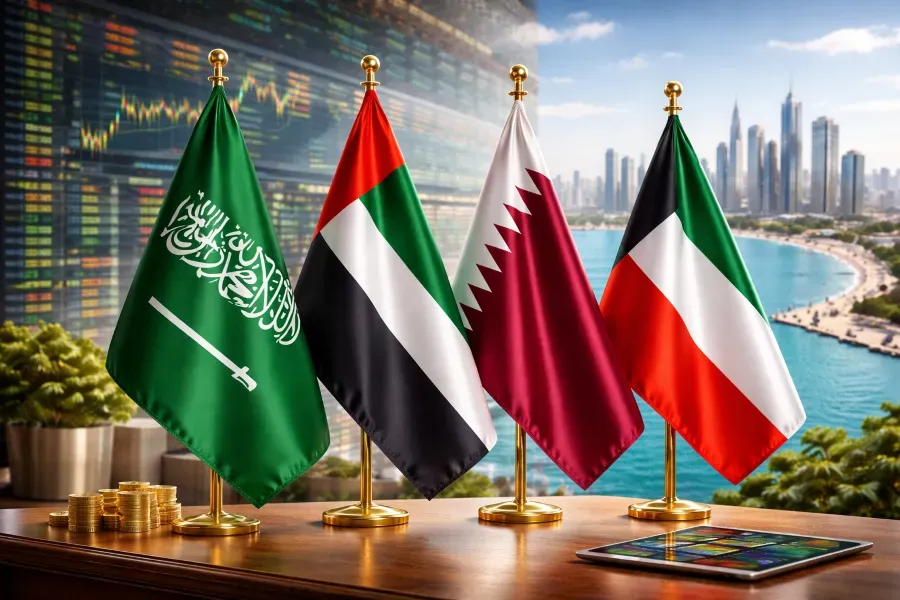
Dubai | EcoPulse24
Gulf equity markets ended Monday on a weaker footing as four of the region’s five major exchanges closed lower, pushing the Masadir GCC Pulse Beta Index down 0.51% and highlighting a growing divergence in regional market performance. Dubai Financial Market was the only GCC exchange to finish the session in positive territory, while Qatar recorded the steepest decline among major regional benchmarks.
According to Masadir Economics data, market breadth deteriorated to just one advancing market out of five, while the GCC Pulse entered a “Divergent Market” regime. The index recorded a dispersion reading of 0.46% and a Z-Score of -0.84, suggesting weakening regional momentum without reaching levels typically associated with market stress or panic selling.
Four GCC Markets Close Lower as Qatar Leads Regional Declines
The Qatar Stock Exchange posted the largest loss among Gulf markets, with the QE Index falling 1.10% to 10,438.86 points. Saudi Arabia’s Tadawul All Share Index (TASI) declined 0.62% to 11,009.52 points, while Kuwait’s All Share Index also lost 0.62% to close at 8,760.57 points.
In Abu Dhabi, the ADX General Index fell 0.53% to 9,650.53 points. Dubai stood apart from the regional trend, with the DFM General Index advancing 0.30% to 5,774.90 points.
GCC Market Performance
| Market | Close | Change |
|---|---|---|
| Saudi Arabia (TASI) | 11,009.52 | -0.62% |
| Abu Dhabi (ADX) | 9,650.53 | -0.53% |
| Dubai (DFM) | 5,774.90 | +0.30% |
| Qatar (QSE) | 10,438.86 | -1.10% |
| Kuwait All Share | 8,760.57 | -0.62% |
Masadir GCC Pulse Reading
| Indicator | Reading |
|---|---|
| GCC Pulse Beta | -0.51% |
| Breadth | 1 / 5 |
| Dispersion | 0.46% |
| Z-Score | -0.84 |
| Market Regime | Divergent Market |
Saudi Arabia Dominates Regional Liquidity Activity
Saudi Arabia remained the region’s most active market by liquidity, recording SAR 7.63 billion in traded value and more than 388 million shares exchanged during the session. Market capitalization stood at approximately SAR 9.8 trillion.
Saudi Aramco led the market by traded value with SAR 757.2 million, followed by Al Rajhi Bank with SAR 626.1 million and Saudi National Bank with SAR 417.7 million. ACWA Power and Maaden were also among the session’s largest liquidity attractors.
By trading volume, Americana Restaurants led activity with 68.7 million shares, followed by Saudi Aramco and APC.
Banking Stocks Weigh on Abu Dhabi Performance
ADX recorded AED 1.80 billion in trading value across more than 45,000 transactions. Abu Dhabi Islamic Bank topped the market by traded value at AED 251.6 million, followed by e&, Abu Dhabi Commercial Bank, and First Abu Dhabi Bank.
ADNOC Gas was the most actively traded stock by volume with more than 40.8 million shares changing hands. Eshraq Investments, Dana Gas, Invest Bank, and Americana Restaurants also ranked among the session’s most active stocks.
Talabat Surge Helps Dubai Outperform the Region
Dubai’s positive close was supported by strong gains in Talabat, which surged more than 10% during the session. The stock led the market by volume with more than 222 million shares traded and generated over AED 267 million in turnover.
Emaar Properties remained the market’s liquidity leader with AED 460.6 million in traded value despite a decline in its share price. Emirates NBD, Salik, and Dubai Islamic Bank also featured among the most actively traded stocks.
The strong performance of selected growth and consumer-facing stocks helped offset weakness elsewhere in the market and allowed Dubai to diverge from the broader regional trend.
Qatar and Kuwait Face Pressure on Regional Blue Chips
In Qatar, trading activity centered around major financial and industrial names. QNB led the market by traded value at more than QAR 113 million, followed by Qatar Islamic Bank, Industries Qatar, Ooredoo, and Vodafone Qatar.
Vodafone Qatar was among the strongest performers of the session, while Mesaieed Petrochemical, Baladna, and Qatar Aluminum Manufacturing ranked among the most actively traded stocks by volume.
In Kuwait, Kuwait Finance House led traded value at approximately KWD 14.3 million, followed by National Bank of Kuwait, National Real Estate Company, and Zain. National Real Estate emerged as the most actively traded stock by volume and delivered gains exceeding 10% during the session.
Most Active Stocks by Traded Value
| Market | Liquidity Leader |
|---|---|
| Saudi Arabia | Saudi Aramco |
| Abu Dhabi | Abu Dhabi Islamic Bank |
| Dubai | Emaar Properties |
| Qatar | QNB |
| Kuwait | Kuwait Finance House |
Most Active Stocks by Volume
| Market | Volume Leader |
|---|---|
| Saudi Arabia | Americana Restaurants |
| Abu Dhabi | ADNOC Gas |
| Dubai | Talabat |
| Qatar | Mesaieed Petrochemical |
| Kuwait | National Real Estate |
EcoPulse24 Analysis
The key signal from today’s session is not the 0.51% decline in the GCC Pulse itself but the deterioration in regional market breadth. With only one market advancing and four closing lower, investor participation became increasingly concentrated rather than broadly supportive across Gulf equities.
The breadth reading of 1/5 suggests that investors are becoming more selective in allocating capital across the region. Rather than a broad-based risk-off move, the session reflected a rotation toward specific sectors and individual opportunities while pressure remained concentrated on several financial and heavyweight index constituents.
Dubai’s ability to outperform despite regional weakness highlights the continued attraction of selected growth-oriented and consumer-linked names. Meanwhile, declines in Saudi Arabia, Abu Dhabi, Qatar, and Kuwait collectively outweighed Dubai’s gains and pushed the regional benchmark lower.
The current Z-Score of -0.84 indicates that market conditions remain within historically normal ranges and have not yet entered stress territory. However, if weak breadth persists over multiple sessions, it could signal a broader loss of momentum across Gulf equities.
For now, the GCC Pulse is pointing to a market environment characterized by selective positioning, uneven leadership, and increasing divergence between regional exchanges rather than a synchronized directional trend. This makes breadth and liquidity concentration among leading stocks critical indicators to watch as June trading unfolds across the Gulf.
Sources & References
Editorial Note
Disclaimer
© 2025 EcoPulse24. All rights reserved.