German Inflation Hits Three-Year High as DAX Rallies and ECB Rate Bets Build
German producer inflation hit a three-year high as the DAX rallied and rising Bund yields reinforced expectations of further ECB rate hikes.

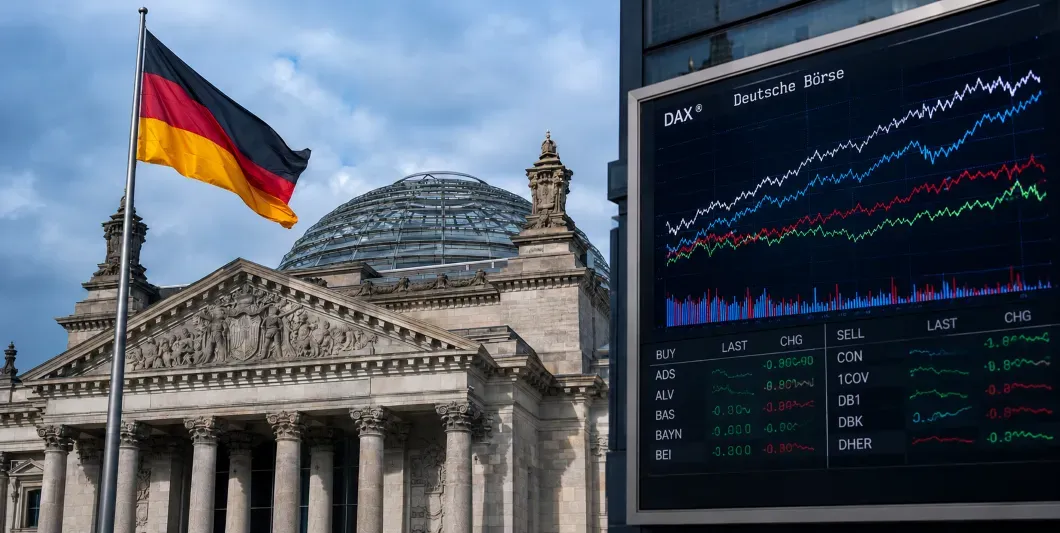
Frankfurt | EcoPulse24
Germany's economy sent mixed but increasingly important signals this week, as producer inflation accelerated to its fastest pace in three years, government bond yields rebounded, and the stock market climbed to multi-week highs despite persistent geopolitical and monetary policy uncertainties.
The developments suggest Europe's largest economy is entering a new phase in which resilient financial markets are increasingly confronting renewed inflationary pressures and the prospect of higher interest rates.
Producer Inflation Accelerates
German producer prices rose 2.2% year-on-year in May, up from 1.7% in April, marking the fastest increase since May 2023.
Although the reading came in below market expectations of 2.5%, it represented the second consecutive month of accelerating producer inflation.
The increase was primarily driven by:
| Category | Annual Change |
|---|---|
| Intermediate goods | +4.2% |
| Energy | +2.5% |
| Mineral oil products | +34.9% |
| Capital goods | +2.0% |
| Durable consumer goods | +2.0% |
| Non-durable consumer goods | -1.7% |
Excluding energy, producer prices still increased 2.3%, indicating that inflationary pressures are becoming broader than energy alone.
On a monthly basis, producer prices rose 0.3%, slowing sharply from 1.2% in April and missing expectations of 0.7%.
Bund Yields Rebound
Germany's benchmark 10-year Bund yield climbed to around 2.95%, rebounding from three-month lows reached earlier this week.
The move was driven by two factors:
-
Higher oil prices after scheduled US-Iran talks in Switzerland were abruptly canceled, raising doubts over the durability of the recent Middle East ceasefire.
-
Hawkish remarks from European Central Bank officials, who suggested further policy tightening may still be required.
ECB Governing Council member Pierre Wunsch said another rate increase could come as soon as next month if inflation pressures broaden.
Meanwhile, ECB Chief Economist Philip Lane argued that the euro-area economy may be capable of absorbing higher borrowing costs.
Money markets are now pricing in at least one additional ECB rate hike this year, following this month's 25-basis-point increase, which lifted the ECB's deposit rate to 2.25%, marking the central bank's first rate increase since 2023.
DAX Climbs to Multi-Week High
Despite renewed inflation concerns, German equities extended their recovery.
The DAX 40 rose to around 25,145 on Friday, reaching its highest level in more than two weeks and putting the index on track for a 2.1% weekly gain.
The rally was supported by gains across several cyclical sectors:
| Company | Performance |
|---|---|
| Mercedes-Benz Group | +2.0% |
| BMW | +2.0% |
| Rheinmetall | +2.0% |
| Infineon Technologies | +1.6% |
Earlier in the week, the DAX had already recorded six consecutive sessions of gains, supported by optimism surrounding the preliminary US-Iran agreement and easing concerns over global energy supplies.
Technology, industrial and travel-related shares were among the strongest performers.
Markets Caught Between Inflation and Optimism
Investors remain divided between two competing narratives.
On one hand, easing Middle East tensions and lower oil prices earlier in the week offered relief from inflation fears and supported risk appetite.
On the other hand, the rebound in producer inflation and increasingly hawkish rhetoric from the ECB suggest that borrowing costs in Europe may remain elevated for longer than previously expected.
EcoPulse24 Analysis
Germany's latest economic signals highlight a growing disconnect between financial markets and underlying inflation dynamics.
The DAX is rallying, corporate sentiment appears resilient, and investors are cautiously embracing signs that geopolitical tensions may be stabilizing.
At the same time, producer inflation has accelerated to its highest level in three years, largely due to energy costs but increasingly extending into broader categories of goods.
That combination is particularly important because Germany remains the industrial engine of Europe. Rising input costs in Germany often serve as an early indicator of future price pressures across the euro area.
The rebound in Bund yields suggests bond investors are beginning to acknowledge this risk.
The bigger question is whether the recent rise in producer inflation represents a temporary consequence of Middle East-related energy disruptions or the beginning of a more persistent inflation cycle.
If price pressures broaden further, the European Central Bank may be forced to tighten policy again despite signs of slowing economic momentum elsewhere in Europe.
For now, Germany appears to be navigating an uncomfortable but familiar environment: resilient asset markets, improving investor sentiment and inflation that remains too high for policymakers to declare victory.
Sources & References
Editorial Note
Disclaimer
© 2025 EcoPulse24. All rights reserved.