Gold Falls Below $4,100 as US-Iran Strikes Fuel Oil Surge and Rate-Hike Expectations
Gold fell below $4,100 as US-Iran tensions raised oil prices, boosting inflation and rate-hike fears, reducing gold's safe-haven appeal.

Dubai | EcoPulse24
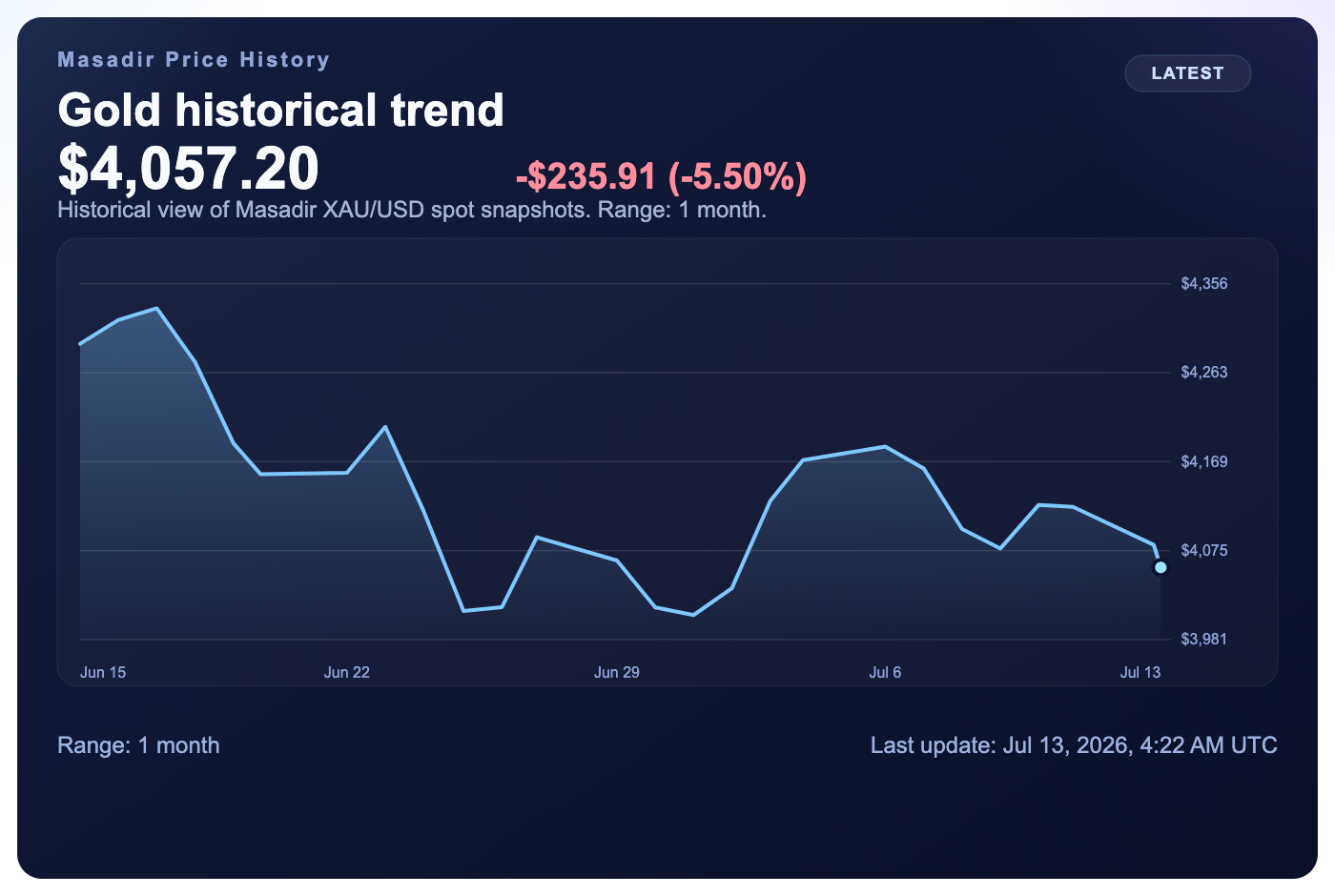
Gold prices fell to $4,057.20 per ounce, according to Masadir XAU/USD Spot Snapshots, marking a $235.91 (5.50%) decline over the past month as renewed military exchanges between the United States and Iran lifted oil prices and reinforced expectations of tighter US monetary policy.
The latest selloff highlights a shift in investor focus from traditional safe-haven demand toward the inflationary consequences of geopolitical conflict. While escalating tensions in the Middle East would normally support gold prices, the sharp rise in energy costs has instead strengthened expectations that persistent inflation could keep US interest rates elevated for longer. Higher interest rates generally reduce the attractiveness of non-yielding assets such as gold.
The geopolitical backdrop intensified after the United States launched its fourth military strike against Iran within a week, responding to an Iranian attack on a Cyprus-flagged container vessel. Iran subsequently announced that the Strait of Hormuz would remain closed "until further notice," although the statement was rejected by US Central Command. Even without a confirmed disruption to maritime traffic, the possibility of supply interruptions has increased risk premiums across global energy markets.
Investors are now turning their attention to upcoming US inflation figures, which could significantly influence expectations for Federal Reserve policy. Current market pricing suggests that policymakers may deliver one additional interest-rate increase before the end of the year if inflation remains stubbornly above target. Markets will also closely monitor Kevin Warsh's congressional appearance for any signals regarding the central bank's assessment of inflation, financial conditions and geopolitical risks.
The recent decline in gold also reflects changing cross-asset dynamics. Rising Treasury yields, a stronger US dollar and higher energy prices have combined to create headwinds for precious metals despite heightened geopolitical uncertainty. This illustrates how inflation expectations can temporarily outweigh safe-haven demand when investors believe central banks may need to maintain restrictive monetary policy for longer.
Gold Market Snapshot
The following data summarizes the latest performance of spot gold based on Masadir XAU/USD Spot Snapshots.
| Metric | Value |
|---|---|
| Commodity | Gold (XAU/USD Spot) |
| Latest Price | $4,057.20/oz |
| Daily Change | -$235.91 |
| Percentage Change | -5.50% |
| Historical Range | 1 Month |
| Data Source | Masadir XAU/USD Spot Snapshots |
| Technical Level | Below $4,100 |
| Primary Market Driver | US-Iran geopolitical escalation |
| Key Event Ahead | US Inflation Data |
| Fed Focus | Congressional testimony by Kevin Warsh |
EcoPulse24 Analysis
The current move demonstrates that financial markets have entered a phase where geopolitical shocks are increasingly being evaluated through their inflationary consequences rather than through conventional safe-haven behavior. Instead of immediately boosting gold, the latest escalation has first strengthened expectations of higher energy prices, creating concern that inflation could remain elevated across major economies.
This represents a broader macroeconomic transition in which commodity markets have become deeply interconnected. Oil now serves not only as an energy benchmark but also as a transmission channel for inflation expectations, monetary policy pricing and cross-asset capital allocation.
If tensions around the Strait of Hormuz continue, global energy markets could face renewed supply uncertainty, reinforcing inflation risks far beyond the Middle East. Such a scenario would complicate the Federal Reserve's policy path by forcing officials to balance slowing economic activity against renewed price pressures.
For gold investors, the key variable is no longer geopolitical headlines alone. The interaction between oil prices, inflation expectations, Treasury yields and Federal Reserve policy has become the dominant pricing framework. Sustained increases in real yields would continue to pressure bullion, while evidence of easing inflation or a softer Fed stance could restore support for precious metals.
The coming US inflation report therefore carries significance beyond domestic monetary policy. It may determine whether markets continue pricing a higher-for-longer interest-rate environment or begin anticipating a shift toward policy normalization. That decision will influence not only gold but also currencies, bond markets, energy prices and broader global risk sentiment.
Ultimately, the latest decline in gold reflects a market increasingly driven by the intersection of energy security, inflation dynamics and monetary policy, reinforcing the emergence of a macro regime in which geopolitical events reshape financial conditions through inflation expectations rather than through safe-haven flows alone.
Explore Related Coverage
Sources & References
Editorial Note
Disclaimer
© 2025 EcoPulse24. All rights reserved.