Historic Breakthrough: First Flexible Solar Panels Achieve 33.4% Efficiency, Revolutionizing Renewable Energy
Chinese researchers unveiled flexible solar panels with 33.4% efficiency, promising major advances in renewable energy and global markets.

EcoPulse24 | Suzhou
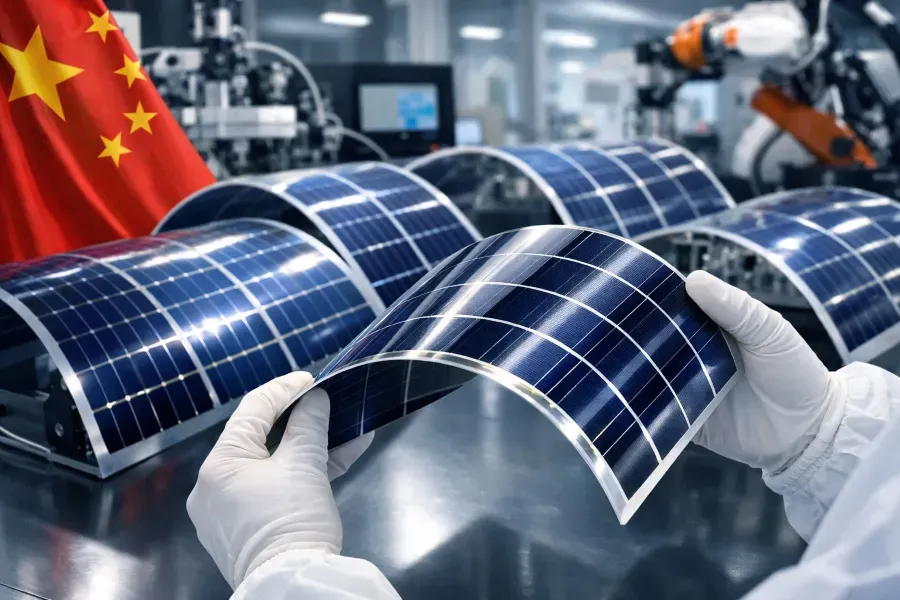
Solar technology has taken a major leap forward as a Chinese research consortium, led by LONGi in partnership with Suzhou University and Xi'an Jiaotong University, unveiled the world's first flexible silicon-perovskite crystalline solar panels. These panels can bend without breaking and achieved an internationally certified conversion efficiency of 33.4% for small devices and 29.8% for commercial-scale modules - far surpassing conventional silicon panels, which typically reach 20-24% efficiency.
The innovation relies on reducing silicon wafer thickness to 60 micrometers, enabling flexibility with a bend radius below 2 centimeters. A dual insulating layer acts as a spring mattress to absorb stress, while a denser layer efficiently extracts charge. Combining silicon and perovskite materials allows the panels to capture a wider solar spectrum, explaining their high efficiency.
Weighing under 4.4 grams each, with a power-to-weight ratio of 1.77 W/g, these ultra-thin panels are among the lightest and most efficient globally. Their flexibility opens new applications in transportation (powering vehicle electronics and refrigeration), residential and commercial buildings with curved or weight-restricted roofs, aerospace (drones, solar aircraft, satellites), military field operations, and wearable electronics.
Economic implications include reducing fossil fuel imports, creating new jobs in installation and maintenance, enhancing energy security, and attracting major investments. For oil-producing Gulf states, the technology offers a path to economic diversification, carbon neutrality, and increased oil exports by reducing domestic consumption.
Globally, the innovation is expected to accelerate the shift to renewables, impact fossil fuel demand and prices, intensify technological competition, lower the cost of clean energy, and open up multi-billion-dollar markets. It will also help countries meet Paris Agreement climate goals more rapidly and cost-effectively.
Challenges remain, including mass production costs, long-term durability, perovskite sensitivity to moisture and UV, and the need for specialized supply chains and technical workforce. Experts anticipate limited commercial launches in late 2026 or early 2027, with mass production by 2028 as manufacturing scales and costs fall. The flexible solar panel market could reach $50 billion annually by 2035, with over 20% yearly growth.
This achievement is part of a broader wave of solar innovation, including hybrid perovskite cells (over 34% efficiency in labs), hydrogel cooling, bifacial panels, and AI-powered tracking systems. Together, these advances are poised to make solar the world’s cheapest and most widespread electricity source within a decade.
In summary, flexible solar panels with 33.4% efficiency mark a pivotal point in renewable energy history, promising vast economic and industrial benefits and accelerating the global shift toward a low-carbon future.
Explore Related Coverage
Sources & References
Editorial Note
Disclaimer
Please review the Terms & Conditions.
© 2025 EcoPulse24. All rights reserved.