Why Kharg Island is key to global oil markets in the Iran war
Kharg Island handles 90% of Iran's oil exports; any disruption risks global supply, price spikes, and wider energy market instability.

Dubai | EcoPulse24
Kharg Island has emerged as the most critical oil export hub in the Iran war, handling nearly 90% of Iran’s crude shipments, making any disruption a direct threat to global supply chains and oil price stability.
Kharg Island functions as Iran’s primary oil export gateway
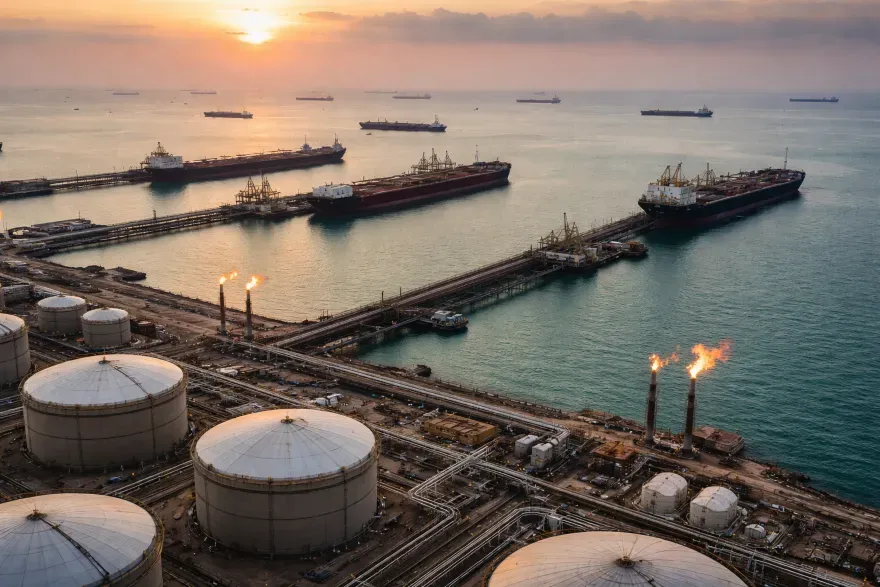
Kharg Island, located about 24 kilometers off Iran’s coast, serves as the central loading terminal for Iranian crude exports. Oil is transported from inland fields through subsea pipelines to the island, where it is stored before being loaded onto tankers. The facility has a storage capacity of up to 30 million barrels and can load more than 6 million barrels per day, reaching up to 10 million barrels in peak conditions.
This concentration of infrastructure makes Kharg Island a single-point dependency for Iran’s export system, where any disruption directly halts export capacity rather than just reducing output.
Nearly 90% of Iran’s oil exports depend on one terminal
The island handles approximately 1.5 million barrels per day, representing around 90% of Iran’s crude exports, most of which are shipped to China. This level of concentration places Kharg Island at the center of global oil supply calculations, particularly for Asian demand flows.
Traders and governments closely monitor shipments from the terminal, as any fluctuation in export volumes can quickly influence market expectations and pricing dynamics.
Strait of Hormuz amplifies global supply vulnerability
All crude shipments from Kharg Island must pass through the Strait of Hormuz, one of the world’s most critical energy transit routes. Since the start of the conflict, maritime traffic in the region has slowed due to heightened security risks, although Iran has continued exporting its own crude at broadly stable levels.
This creates a dual chokepoint dynamic, where both the export terminal and the shipping route are exposed to geopolitical disruption, significantly increasing global supply risk.
Pre-conflict surge in oil loadings signals strategic risk management
Prior to the escalation, Iran increased oil loadings at Kharg Island, likely aiming to move as much crude as possible into global markets ahead of potential disruption. Tankers continued loading after hostilities began, indicating a strategy focused on maintaining export flows despite rising geopolitical tensions.
This pattern reflects early anticipation of supply risk and highlights the importance of Kharg Island in sustaining Iran’s oil exports under stress conditions.
Any disruption to Kharg Island would trigger immediate oil price shock
Although no major damage has been confirmed, any direct strike on Kharg Island’s oil infrastructure would likely halt most of Iran’s exports for an extended period. Such a disruption would remove significant supply from global markets, tightening availability and driving oil prices higher.
The impact would extend beyond energy markets, increasing inflationary pressure in major economies and reinforcing the link between geopolitical conflict and global price movements.
Regional escalation risk could expand energy disruption beyond Iran
An attack on Kharg Island would likely prompt a broader response from Iran, which has already targeted energy infrastructure across the region. This raises the risk of a wider disruption affecting oil and gas facilities in multiple Gulf countries.
Such escalation would transform the situation from a localized supply issue into a systemic energy shock with global consequences.
Potential US intervention introduces uncertainty over oil flow control
A potential US operation to take control of Kharg Island, rather than destroy it, could allow direct influence over Iranian oil exports. However, such a move carries significant risks, including infrastructure damage, military escalation, and immediate volatility in oil markets.
Even without physical disruption, uncertainty over control of supply could lead to sharp price movements as markets react to geopolitical developments.
| Metric | Value | Significance |
|---|---|---|
| Share of Iran exports | ~90% | Single-point dependency |
| Export volume | ~1.5M bpd | Global supply impact |
| Storage capacity | ~30M barrels | Buffer capability |
| Max loading capacity | Up to 10M bpd | Surge export ability |
| Main destination | China | Demand concentration |
EcoPulse24 Analysis
Kharg Island has become a structural pricing lever in global oil markets, where concentrated export infrastructure amplifies the impact of geopolitical risk. The Iran war is shifting oil market dynamics from production-driven supply to infrastructure-driven vulnerability, where disruption at a single node can alter global pricing expectations. This reinforces a broader transition in energy markets, where strategic chokepoints such as Kharg Island and the Strait of Hormuz play a decisive role in shaping supply security, inflation trends, and macroeconomic stability.
FAQs
1) Where is Kharg Island located?
Kharg Island is located in the Persian Gulf, about 24 kilometers (15 miles) off the northwestern coast of Iran.
2) Why is Kharg Island important to Iran’s oil exports?
Kharg Island serves as Iran’s main oil export terminal, handling around 90% of the country’s crude shipments, making it the central hub for loading and shipping oil to global markets.
3) How could disruption at Kharg Island impact global oil markets?
Any disruption to operations at Kharg Island could significantly reduce global oil supply, leading to higher prices, increased volatility, and broader inflationary pressure across major economies.
Sources & References
Editorial Note
Disclaimer
© 2025 EcoPulse24. All rights reserved.