Force Majeure: When a Contract Cannot Stand Against Reality
A legal and economic concept repeated across headlines without explanation EcoPulse24 breaks it down

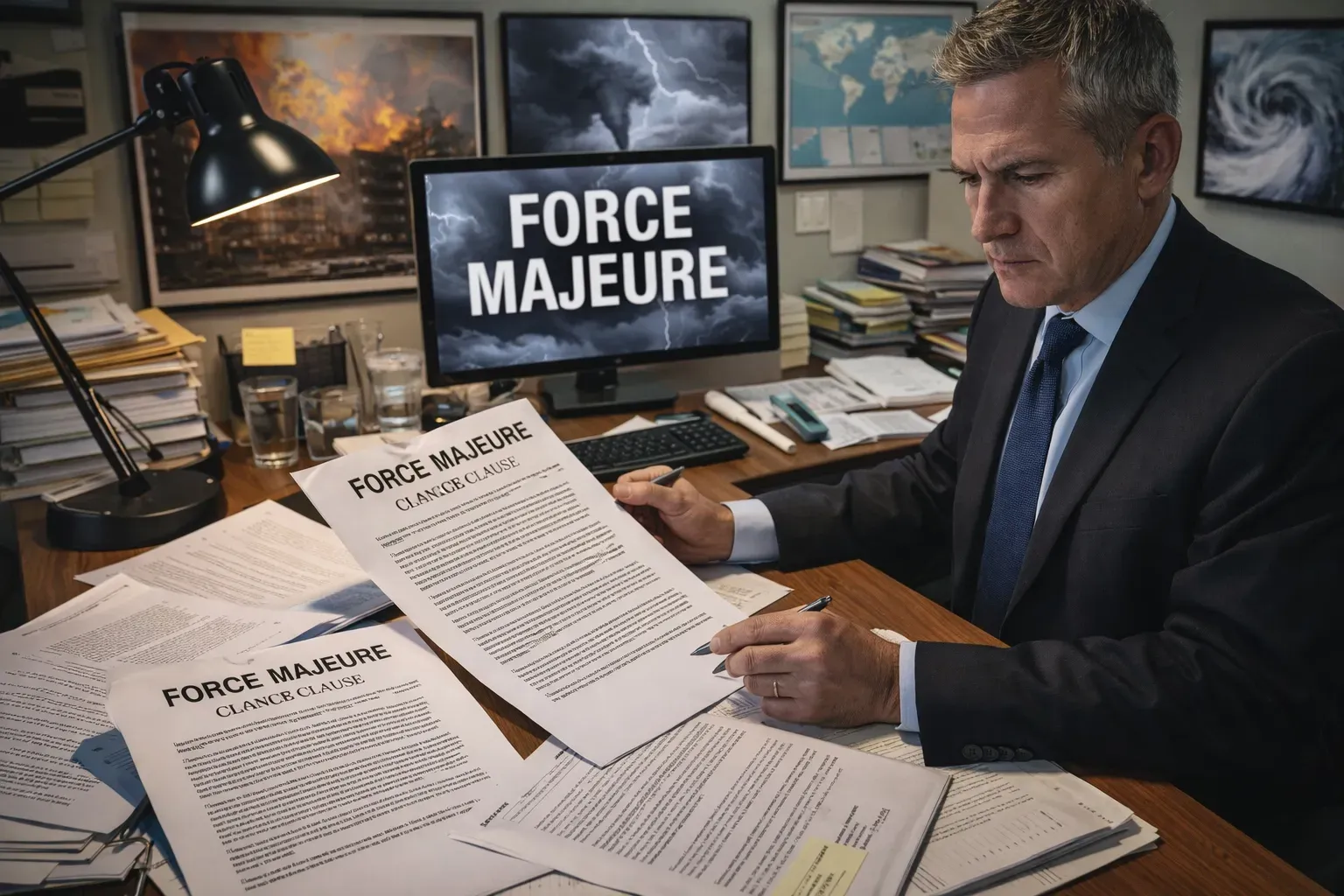
Economic Analysis Desk | EcoPulse24 | March 2026
In every major crisis a pandemic, a war, a natural disaster, or a sharp geopolitical shock one phrase surfaces consistently across corporate filings, bank statements, and commodity contracts: "force majeure." Financial media treat it as self-explanatory, yet a large portion of readers have little grasp of its legal substance or its real economic consequences. This article fills that gap.
What Is Force Majeure?
Force majeure is a legal concept referring to an extraordinary event beyond the control of contracting parties that makes the fulfillment of contractual obligations impossible or excessively burdensome, without either party being at fault or in default. Three cumulative conditions define it:
Exceptionality: The event was not reasonably foreseeable at the time the contract was signed.
Externality: The event lies entirely outside the control of the parties involved.
Impossibility: Performance of the obligation has become impossible, or would impose an unreasonable and unacceptable burden.
The concept in plain terms
Imagine you signed a contract to supply goods from a factory in another country, then war broke out and the borders closed. Neither you nor the other party made a mistake. Yet performance became impossible. This is precisely where force majeure applies, releasing both parties from legal liability for the delay or failure.
Where Does the Term Come From?
The term originates from French civil law (Code Civil), specifically from the nineteenth century. From France it spread to legal systems across the world, including Arab civil codes in Egypt, Iraq, Kuwait, and the UAE.
In international contracts, force majeure is also addressed through UNIDROIT Principles and the UN Convention on Contracts for the International Sale of Goods (CISG), which adopts a parallel concept under the term "impediment."
What Does Force Majeure Cover?
There is no fixed universal list. The scope is determined in each case by the contract's wording and the governing law. That said, the following categories are widely recognized across most legal systems:
Natural events: Earthquakes, floods, hurricanes, and severe drought.
Political events: Wars, revolutions, economic blockades, and sudden government decisions.
Health crises: As seen clearly during the Covid-19 pandemic (2020-2021).
Regulatory actions: Export or import bans, and the sudden suspension of licenses by government decree.
What does not qualify as force majeure
Rising costs, falling profit margins, or supplier insolvency due to financial difficulties - none of these constitute force majeure. Economic hardship alone does not excuse a party from contractual obligations. The key standard is impossibility, not mere difficulty.
What Are the Legal Consequences of Invoking Force Majeure?
Invoking force majeure is not a magic clause that voids a contract instantly. It is a structured legal procedure with specific consequences:
Suspension of obligations: The affected party may pause performance temporarily without incurring penalties.
Immediate notification: The affected party must notify the other side in writing and without delay. Late notification can forfeit the right to invoke the clause entirely.
Documentary proof: A claim is not enough. Tangible evidence of the event and its direct causal link to the failure to perform must be provided.
Time limits: If the situation persists beyond a defined period, either party may move to terminate the contract under its terms or applicable law.
No compensation: In most cases, neither party is entitled to claim damages for losses arising from the force majeure event itself.
Force Majeure in Gulf Markets
Across the Gulf region, national civil codes govern force majeure provisions, though details vary by jurisdiction. The UAE Civil Code, in Article 273, permits termination or suspension of performance where impossibility is complete, and allows for mitigation where impossibility is only partial.
In the Gulf context, force majeure has come into sharp focus during three recent episodes: the Covid-19 pandemic, when hundreds of companies in tourism and construction invoked the clause; the Ever Given grounding in the Suez Canal in 2021, which suspended major supply chains; and international sanctions linked to geopolitical conflicts that disrupted Gulf financial institutions connected to affected counterparties.
A note for Gulf investors
Force majeure is not purely a legal matter. In the Gulf sukuk and bond markets, and across large infrastructure project contracts covering energy, transport, and desalination, invoking the clause has a direct impact on cash flows and credit ratings. Always examine its wording carefully in offering documents before committing capital.
How Do Analysts and Investors Read It?
From a risk assessment perspective, widespread invocation of force majeure across a sector signals systemic fragility rather than isolated disruption. When multiple companies in the same industry invoke it simultaneously, it indicates that the shock is structural, prompting a serious review of existing risk models.
Financial analysts monitor these notifications in listed company disclosure reports, as IFRS and GAAP standards require disclosure of contingent liabilities and material contractual risks. Reading force majeure clauses in major contracts, particularly in energy and infrastructure, provides a clearer picture of where future cash flow vulnerabilities lie.
Points of Contention and Debate
Force majeure is not a concept that commands universal legal consensus. Several substantive disputes run through courtrooms and arbitration chambers worldwide:
Does severe inflation constitute force majeure? Most courts say no, though certain international arbitration panels have accepted exceptional cases.
Where does "control" end? Do informal government pressures qualify? This is typically resolved case by case by arbitration bodies.
Predictable climate events: As extreme weather becomes more frequent, some legal scholars argue these events can no longer meet the exceptionality threshold because they are now, in a meaningful sense, foreseeable.
Conclusion
Force majeure is not a niche legal abstraction. It is a fundamental protective mechanism embedded in the global economic and contractual order. Understanding it allows investors to assess contract risk with greater depth, gives business owners clarity on their rights and obligations when crises strike, and helps economic observers interpret what a company truly means when it formally announces the invocation of force majeure.
In an era of growing complexity, where supply chains intertwine and geopolitical interests collide with economic ones, force majeure has become a contractual clause that demands reading not only through a legal lens, but through the eyes of the financial analyst and risk manager as well.
Want to understand another economic or legal term? Follow us at ecopulse24.com
Sources & References
Editorial Note
Disclaimer
© 2025 EcoPulse24. All rights reserved.