Desalination and Energy Risks Converge in MENA as Water Security Faces Growing Pressure
Qatar's LNG disruption exposes MENA's water security risks, highlighting desalination's energy ties and the need for resilient, diversified systems.

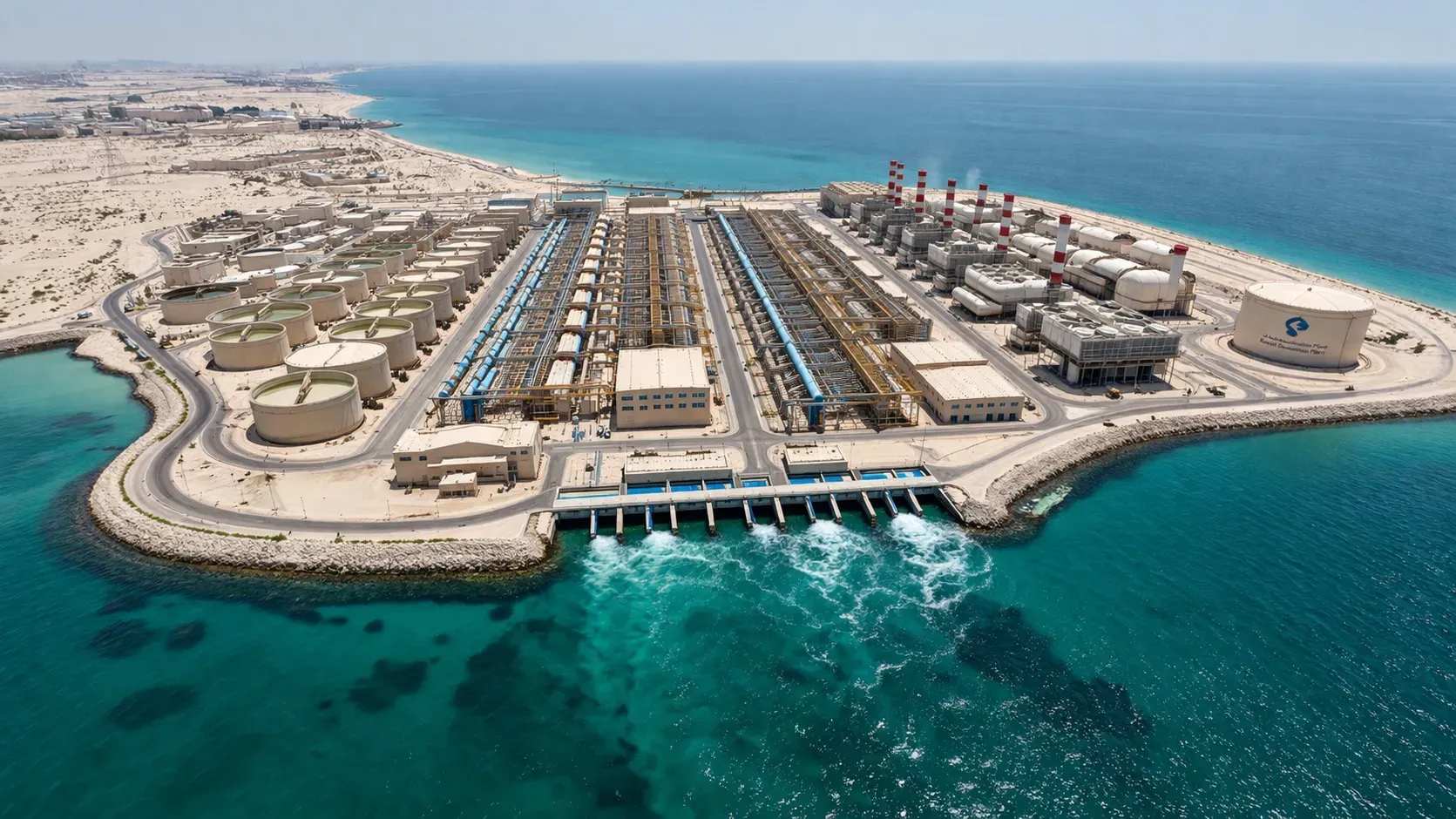
Doha | EcoPulse24
The recent disruption to LNG supply from Qatar’s Ras Laffan industrial complex is increasingly revealing a broader layer of systemic risk-one that extends beyond energy markets into water security across the Middle East and North Africa (MENA). As global gas markets adjust to a structural supply shock, attention is turning to another critical dependency: desalination.
According to International Energy Agency analysis...Water stress is already a defining constraint. Global freshwater withdrawals exceed 4,000 billion cubic metres annually, with around 1,500 bcm consumed, while more than 3 billion people live in highly water-stressed regions. In MENA alone, over 70% of the population remains exposed to high or extreme water stress, according to data from the International Energy Agency.
In this context, desalination has become essential infrastructure. The MENA region accounts for over 40% of global desalination capacity, with Gulf Cooperation Council countries alone representing about 33%. The region produces roughly 12 bcm of desalinated water annually, equivalent to the flow of the Euphrates River, with around two-thirds used for drinking water.
Despite its critical role, desalination contributes less than 1% of global freshwater withdrawals, and only about 3.5% even in MENA, highlighting the acute dependence of certain regions despite its relatively small global share.
The sector is also undergoing a structural transformation. Reverse osmosis and other membrane-based technologies now account for over 60% of installed capacity in MENA and more than 80% globally, reflecting a shift away from thermal desalination toward electricity-driven systems. As a result, electricity consumption for desalination has doubled since 2010, with the IEA projecting an additional 190 terawatt-hours of global electricity demand by 2035, as electrification rates rise from 28% today to around 50%.
This shift has strengthened the link between water and energy systems. Thermal desalination processes can require up to 250 MJ per cubic metre for core operations, while total electricity use in thermal plants ranges between 7 and 14 MJ/m³. Seawater reverse osmosis systems typically consume between 9 and 22 MJ/m³ across the full process. At scale, the largest desalination plants-producing around 1 million cubic metres per day-can consume as much electricity as a city of 200,000 households.
At the same time, desalination infrastructure itself is not insulated from geopolitical risks. Recent incidents have affected facilities in the region, including a desalination plant on Iran’s Qeshm island, which disrupted water supply to multiple communities, and damage to infrastructure in Bahrain. Historical precedents, including the 1991 Gulf War and conflicts in Yemen, further demonstrate the vulnerability of such assets during periods of escalation.
The concentration of desalination capacity in coastal, geopolitically sensitive areas amplifies these risks. In parallel, some authorities maintain strategic water reserves, but these may only cover days or weeks in certain cases, limiting the system’s ability to absorb prolonged disruptions.
Taken together, these factors point to a deeper structural issue: the concentration of critical infrastructure. Just as the Ras Laffan disruption exposed vulnerabilities in global LNG supply chains, similar concentration risks exist within water systems, where a limited number of large-scale facilities underpin essential supply.
While governments are investing in resilience-including water reuse, storage expansion, and efficiency improvements-these measures require time and capital. Moreover, the continued expansion of desalination is likely to increase electricity demand further, reinforcing the interdependence between energy and water systems rather than reducing it.
EcoPulse24 Analysis
The current environment highlights a critical shift in risk dynamics. Energy disruptions can no longer be assessed in isolation; their implications now extend directly into water security through tightly coupled infrastructure systems.
This evolving interdependence suggests that future resilience strategies must address both sectors simultaneously. Diversification of supply, decentralised infrastructure models, and lower-energy desalination technologies are likely to become central to long-term planning.
Ultimately, the Ras Laffan disruption may represent more than an isolated energy event. It signals a broader stress test for interconnected resource systems-where shocks in one domain can rapidly propagate into another, reshaping risk across the region.
Explore Related Coverage
Sources & References
Editorial Note
Disclaimer
© 2025 EcoPulse24. All rights reserved.