Oil Pressures and Geopolitical Tensions Shake Indian Markets: Rupee Drops, Bond Yields Rise Despite Strong Economic Activity
Indian markets drop as oil prices and Mideast tensions hit rupee, bond yields, despite strong economic activity and robust demand.

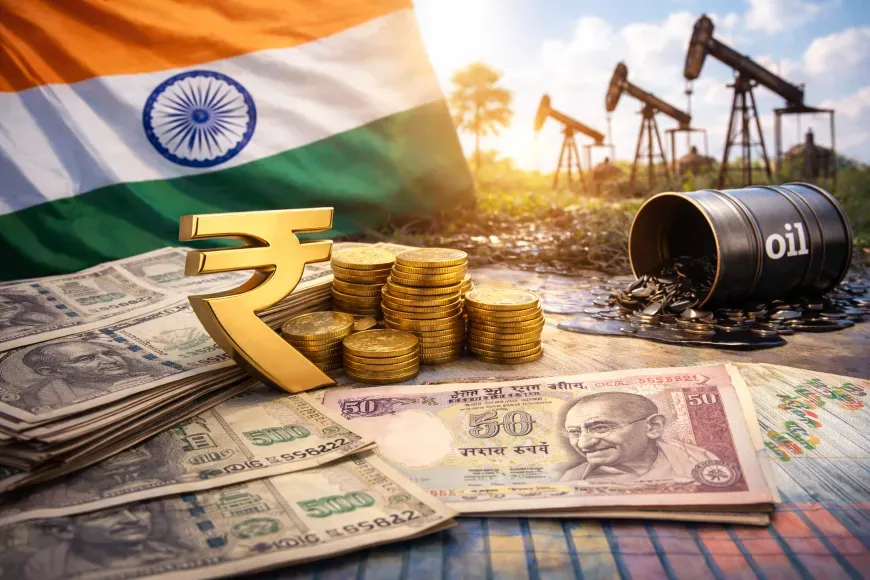
Mumbai | EcoPulse24
Indian financial markets are under increasing strain amid escalating geopolitical tensions in the Middle East and surging global oil prices. These factors have weighed on the stock market, the rupee, and government bond yields, despite continued strong expansion in India's economic activity indicators.
The BSE Sensex opened Wednesday down about 2% at 78,661 points, its lowest level since April 2025, marking the fourth consecutive session of losses. The sharp rise in oil prices heightened investor concerns about the impact of higher energy costs on inflation and the trade balance.
Most listed sectors saw notable declines at the session's start, led by finance, industry, energy, and metals. Notable individual stock drops included Larsen & Toubro (-6.1%), Tata Steel (-4.6%), InterGlobe (-4.3%), Reliance Industries (-3.4%), and Mahindra & Mahindra (-3.2%).
Earlier in the week, the Sensex closed at 80,238.85, down 1.3% - its lowest since September 2025 - amid broad-based selling due to oil and geopolitical fears.
The rupee came under heavy pressure, nearing 92 per US dollar, a record low, as Brent crude surpassed $85 per barrel. Concerns about potential supply disruptions through the Strait of Hormuz, a critical route for India's oil and gas imports, contributed to the decline.
A global risk-off mood led to foreign outflows, with investors pulling more than $350 million from Indian equities in a single session. The Reserve Bank of India intervened in spot and forward FX markets to curb volatility and support the currency.
Ten-year government bond yields rose to 6.7%, marking a third straight session of gains, reflecting concerns about rising inflation pressures due to higher oil prices and a weaker rupee, as well as fears of a widening current account deficit.
Investors are awaiting a central government debt auction later this week, and market expectations suggest the RBI may intervene in secondary markets to calm bond yield volatility.
On the macro front, current account data showed the deficit widening to $13.2 billion in the quarter ended December 2025, up from $11.3 billion a year earlier. The goods trade deficit grew to $93.6 billion from $79.3 billion, while the services surplus rose to $57.5 billion from $51.2 billion.
Industrial production growth slowed in January 2026, rising 4.8% year-on-year versus 8% the previous month, below market expectations of 6.5%. Manufacturing, which accounts for about 80% of industrial output, grew 4.8% (down from 8.4% in December), supported by gains in autos (+10.9%), machinery (+6.2%), and basic metals (+13.2%). Mining output grew 4.3%, and utilities/energy output rose 5.1%.
Despite this, economic activity indicators showed continued strong demand. The composite Purchasing Managers' Index (PMI) rose to 58.9 in February 2026 (from 58.4), its highest since November. The services PMI registered 58.1 (vs. 58.5 in January).
While new order growth in services slowed to a 13-month low amid rising competition, international sales grew at their fastest pace since August, supporting overall activity. Companies increased hiring, with job creation surpassing historical averages, and backlogs rose for a second month due to operational pressures.
Cost pressures accelerated to a two-and-a-half-year high on rising food, energy, labor, and commodity prices, pushing selling prices to a six-month high.
EcoPulse24 Analysis:
Recent Indian economic developments reveal a clear contrast between strong domestic demand and mounting external pressures. While economic activity remains robust, driven by services and industry, higher energy prices and global market volatility are straining the rupee and financial markets. This underscores India's sensitivity to global energy fluctuations, given its reliance on oil imports, making energy market stability critical for macroeconomic balance going forward.
Explore Related Coverage
Sources & References
Editorial Note
Disclaimer
© 2025 EcoPulse24. All rights reserved.