OpenAI Launches GPT-5.2 Amid Competition with Google
OpenAI launches GPT-5.2 to enhance capabilities amid competition from Google's Gemini 3, focusing on programming and complex tasks.

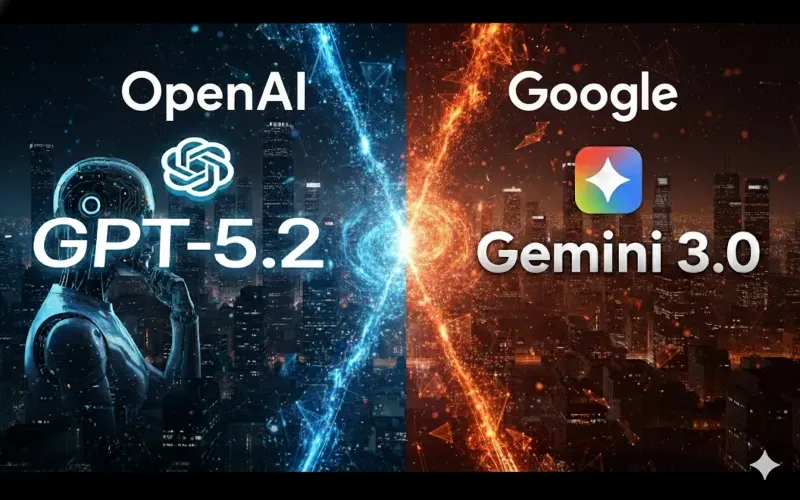
OpenAI has announced the launch of its new model GPT-5.2, aimed at enhancing ChatGPT's capabilities in programming, sciences, and executing complex tasks, just weeks after Google introduced its highly praised Gemini 3 model, which has reshaped competition in the rapidly evolving AI market.
Enhanced Speed and Reasoning Abilities
According to the company's statement, the new model features improved information retrieval and translation capabilities, with a special focus on mimicking human thought processes to tackle long and complex problems such as mathematics and algorithms.
The model is available in three different tiers, targeting a broader range of professional applications, from creating spreadsheets and presentations to efficiently writing code.
Intense Competition: OpenAI Under Pressure from Google and Anthropic
After being at the forefront for years, OpenAI finds itself facing a new wave of competition:
- Google Gemini 3: It achieved strong results in reasoning and programming tests, topping model assessment platforms like LMArena and Humanity’s Last Exam.
- Anthropic: Continues to enhance the reach of its Claude models with improved accuracy and interpretation capabilities.
These developments have pushed OpenAI into what resembles a "state of emergency," reallocating resources to expedite improvements to ChatGPT, according to internal memos.
Massive Investments and Economic Expansion Strategy
OpenAI aims to attract more institutions and companies through advanced services based on GPT-5.2, with a commitment to invest over one trillion dollars in the infrastructure needed to support the accelerated training of future models.
The company believes the new model can "create greater economic value for users" through advanced productivity tasks including data management, reporting, and intelligent process automation.
The model will begin reaching paid subscribers starting Thursday.
Previous Releases and Accelerated Development
OpenAI's latest releases have shown a clear acceleration:
- August 2025: Launch of GPT-5 amid mixed reviews.
- November 2025: Release of version 5.1 overshadowed by the rise of Gemini 3.
- December 2025: GPT-5.2 returns to solidify the company's position in a highly competitive market.
In media statements, CEO Sam Altman noted that the impact of Gemini 3 has been "less than expected," asserting that the company anticipates emerging from its "alert status" by January.
New Feature: User Age Estimation
Alongside the new model, OpenAI has begun rolling out a feature for estimating users' age categories to enhance controls related to interactions with minors. This step is a precursor to the launch of Adult Mode, aimed at users over 18, set to be released in the first quarter of 2026.
Company officials explain that this feature will allow for adjusting the level of content directed at various age groups, as part of a broader policy to promote the safe use of AI.
EcoPulse24 Analysis
OpenAI's recent moves reveal three central trends reshaping the AI market in 2026:
1. Race for Speed vs. Quality
The rapid launch of GPT-5.2 closely following GPT-5.1 confirms that competition with Google has driven major companies to adopt shorter development cycles, focusing on reasoning and programming - areas where Google has led this year.
2. Rise of Enterprises as Demand Drivers
OpenAI's emphasis on business tools (spreadsheets, presentations, automation) reflects a clear shift: the real market is no longer the individual consumer, but companies seeking cost reduction and productivity enhancement.
This explains the company's massive investments in data centers and infrastructure.
3. Regulatory and Compliance Dimensions
The age estimation feature and the upcoming launch of "Adult Mode" indicate that OpenAI is preparing for stricter regulations in 2026 and 2027, particularly in the U.S. and EU, suggesting that competition will not only be technical but also legal and regulatory.
Why 2026 and 2027?
Because the period 2026–2027 will witness:
- Implementation of the EU AI Act.
- Tightening of child and adolescent protection rules on technology platforms.
- The U.S. moving toward a comprehensive AI regulation framework.
- Expansion of data privacy regulations (COPPA+, GDPR updates).
Thus, adding "2027" is not merely a linguistic correction but reflects a reality-based legislative analysis.
Sources & References
Editorial Note
Disclaimer
© 2025 EcoPulse24. All rights reserved.