RBA March Minutes Warn Oil Shock Could Push Australia Inflation to 5% in Q2 2026
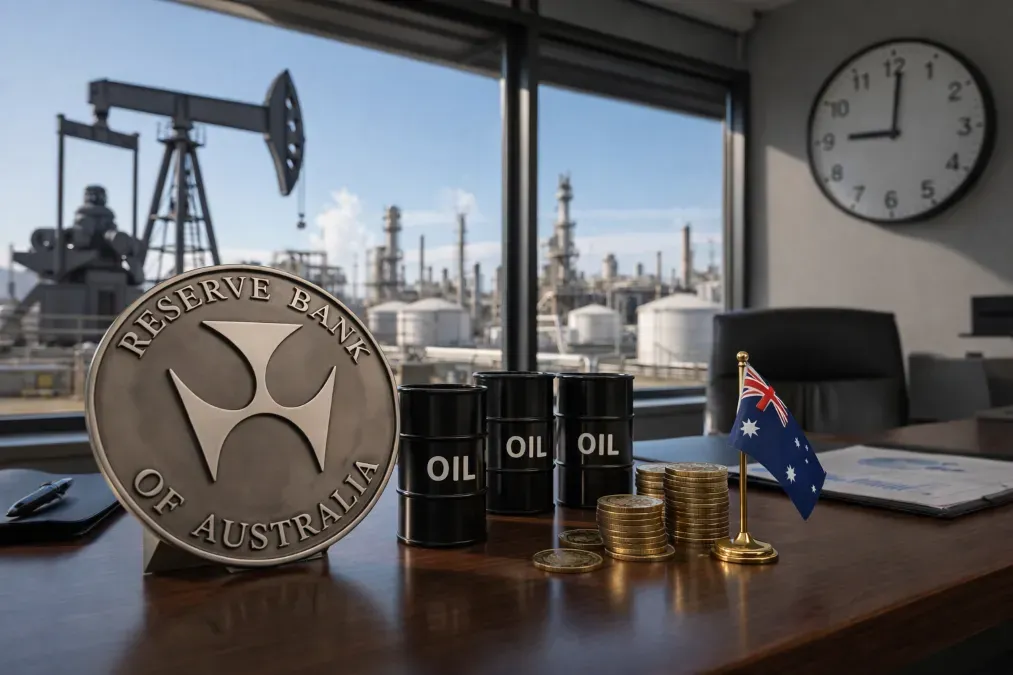
Australia's RBA March minutes warn oil prices could push headline CPI to 5% in Q2 2026 if crude holds near USD 100 a barrel.

EcoPulse24 | Sydney
Minutes from the Reserve Bank of Australia's March 2026 policy meeting reveal that board members flagged rising oil prices as a key near-term inflation risk, with policymakers estimating that if crude oil holds near USD 100 per barrel, Australia's headline consumer price index could rise to approximately 5% in the June quarter of 2026, according to Trading Economics.
Key Findings From the Minutes
The RBA minutes show that most board members judged further interest rate increases were likely necessary to return inflation to the central bank's target range, with risks tilted to the upside. Policymakers noted that financial conditions had tightened slightly but questioned how restrictive current monetary settings truly were relative to neutral levels. The board assessed that higher energy costs are expected to weigh on growth both domestically and globally, though the full scale of impact remains uncertain given the dynamic nature of the current environment.
Long-term inflation expectations were described as remaining anchored, a factor the board viewed as preserving some policy flexibility. However, policymakers warned that supply constraints could worsen amid ongoing geopolitical developments, adding further upward pressure on input costs and consumer prices. The demand outlook was characterized as unclear, given Australia's dual role as both an energy exporter and an economy reliant on import-exposed sectors.
Oil Prices and the Inflation Outlook
The RBA's explicit reference to oil at USD 100 per barrel as a potential trigger for headline CPI reaching 5% is notable. Australian headline inflation has already been elevated, and the energy component has become an increasingly significant driver in recent months. The minutes noted that rising oil prices, driven by disruptions to global energy supply amid ongoing regional tensions, were identified as a key near-term inflation driver, lifting short-term expectations even as longer-term ones stayed anchored.
For Australian households, the pass-through from global oil prices to domestic fuel costs and transport services can be relatively direct, making energy market developments a central variable in the RBA's inflation modelling. The board's assessment aligns with a broader pattern seen among central banks globally, where energy-driven inflation is being treated as a distinct risk requiring heightened vigilance even when core inflation dynamics remain more contained.
Monetary Policy Path
The minutes confirm that the RBA's March meeting leaned toward further tightening, with most members agreeing that additional rate hikes would likely be necessary. This positions the RBA among a group of central banks globally that continue to signal a restrictive policy bias despite signs of slowing economic activity. Australia's unemployment rate has remained low by historical standards, providing the board with some room to prioritize inflation control without a sharp deterioration in labor market conditions.
Markets had been pricing in some uncertainty about the RBA's near-term path heading into the March meeting, but the minutes' tone suggests policymakers retain a clear preference for action over pause if inflation data continues to surprise to the upside. The next key data points-including Q1 2026 CPI and the May budget-will heavily shape the May rate decision.
Global and MENA Relevance
The RBA's oil-inflation warning is part of a broader global narrative in which central banks from Sydney to Riyadh to London are recalibrating their outlooks around the persistence of elevated energy prices. For MENA economies, the RBA minutes serve as a useful data point illustrating how a major commodity-exporting nation is navigating the dual pressures of higher oil revenues and the inflationary spillovers of a global energy shock. GCC central banks, which largely peg to the US dollar and import monetary policy from the Federal Reserve, are watching similar dynamics as they assess inflation trajectories in their own economies.
EcoPulse24 Analysis
EcoPulse24 Analysis: The RBA March minutes provide a clear illustration of the inflation calculus facing central banks globally: elevated oil prices create near-term upside risks to CPI that may compel further tightening even in economies already running restrictive policy settings. The 5% CPI threshold cited by the RBA for Q2 2026 should be watched as a potential policy trigger. For global investors, the RBA's guidance reinforces the broader narrative of a higher-for-longer rate environment in commodity-sensitive economies, with implications for asset pricing and capital allocation across Asia-Pacific and beyond.
Sources & References
Editorial Note
Disclaimer
© 2025 EcoPulse24. All rights reserved.