RBI Holds Repo Rate at 5.25% as Middle East Conflict Drags Down India's FY27 Growth Outlook
The RBI simultaneously revised its GDP growth forecast for FY2026/27 downward to 6.6% from 6.9% and raised its inflation projection to 5.1% from 4.6%

Mumbai | EcoPulse24
RBI keeps benchmark rate unchanged for third straight meeting as external shocks reshape India's macro outlook
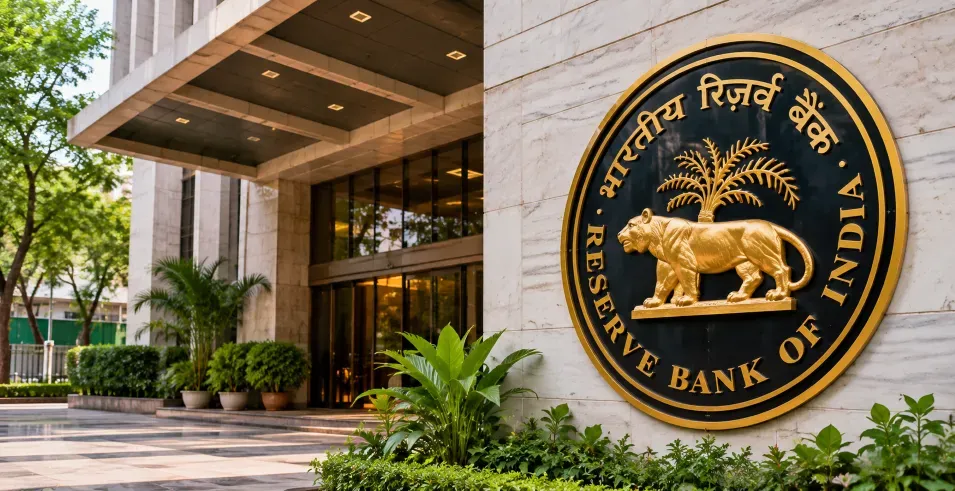
The Reserve Bank of India held its key repo rate unchanged at 5.25% for the third consecutive policy meeting in June, maintaining a neutral stance as a weakening rupee and Middle East-driven inflationary pressures constrained the central bank's room to maneuver. The RBI simultaneously revised its GDP growth forecast for FY2026/27 downward to 6.6% from 6.9% and raised its inflation projection to 5.1% from 4.6%, acknowledging that external disruptions have materially altered the country's economic trajectory.
Rate decision aligns with expectations, but context is anything but routine
The hold itself was in line with market consensus. What was not routine was the reasoning behind it. The Middle East conflict has introduced a new layer of structural uncertainty into India's macro picture - pushing up energy import costs, weakening the rupee against the dollar as capital flows toward safe-haven assets, and tightening the trade balance at a moment when domestic demand still requires support. The RBI finds itself caught between two competing mandates: defending growth and containing imported inflation. Neither can be fully served simultaneously under current global conditions.
Revised growth path reflects quarter-by-quarter deceleration
The bank's new quarterly growth path for FY2026/27 shows 6.6% in Q1, slowing to 6.3% in Q2, before a modest recovery to 6.5% in Q3 and 6.8% in Q4. The mid-year compression - particularly the Q2 dip to 6.3% - signals that the RBI expects the peak impact of external headwinds to hit India's economy in the second quarter of the fiscal year. Any recovery in the second half is conditional on a stabilisation of geopolitical conditions that remains far from guaranteed.
Inflation trajectory points toward a sustained elevated phase
The revised inflation forecast is arguably more consequential than the growth revision. At a projected average of 5.1% for FY2026/27, inflation is now running meaningfully above the RBI's 4% midpoint target. The quarterly path - 4.2% in Q1, rising to 5.1% in Q2, and reaching 5.9% in both Q3 and Q4 - describes an acceleration rather than a temporary spike. Core inflation is projected at 4.7%. Primary drivers include higher LPG prices, base metals, plastics, and rubber - all categories directly sensitive to energy costs and global supply chains under geopolitical stress.
Key Economic Projections - FY2026/27
| Indicator | Previous Estimate | Revised Estimate |
|---|---|---|
| GDP Growth | 6.9% | 6.6% |
| Inflation (Average) | 4.6% | 5.1% |
| Q3/Q4 Inflation | - | 5.9% each |
| Core Inflation | - | 4.7% |
| Repo Rate | 5.25% | 5.25% (unchanged) |
| SDF Rate | - | 5.00% |
| MSF Rate | - | 5.50% |
Imported inflation binds the RBI's policy options
What makes India's situation particularly constraining is the nature of its inflation problem. This is not demand-pull inflation generated by excess domestic liquidity or overheating consumption. It is cost-push inflation transmitted through global commodity channels - energy prices, materials costs, and a depreciating currency that amplifies every import bill in rupee terms. Traditional monetary tightening is a blunt instrument against this type of inflation, and easing is equally off the table when consumer prices are accelerating toward 6% in the back half of the fiscal year. The RBI is effectively operating in a policy-constrained space where the correct action is to hold and wait.
EcoPulse24 Analysis
The RBI's June decision reflects a broader macro phenomenon now playing out across emerging market central banks: the collapse of the policy option space when external supply shocks coincide with currency weakness. India is the world's third-largest oil importer, and any sustained disruption to Gulf energy flows translates directly into both a wider current account deficit and a higher domestic inflation trajectory - a combination that simultaneously weakens the rupee, raises import costs further, and erodes real purchasing power. The feedback loop is self-reinforcing and difficult to break through monetary policy alone.
What distinguishes the current cycle from previous episodes of imported inflation is the simultaneity of the shock. Energy prices, metals, petrochemical inputs, and the exchange rate are all moving in the same direction at the same time. The RBI's revised quarterly inflation path - particularly the 5.9% projection locked in for both Q3 and Q4 - strongly implies that the institution does not expect external conditions to improve materially within the current fiscal year. That is a significant admission from a central bank that only months ago was navigating an environment of easing inflation and improving growth prospects.
For emerging market investors and macro strategists tracking the Gulf region, the Indian data point carries signal value beyond South Asia. When an economy of India's scale and sophistication is forced to simultaneously downgrade growth and upgrade inflation on the back of Middle East disruption, it confirms that the conflict has crossed from a regional risk event into a global macro variable - one that is actively repricing sovereign growth trajectories, central bank reaction functions, and cross-border capital flows. The Gulf's energy infrastructure is no longer just an energy story; it has become a monetary policy story for every oil-dependent economy in the world.
The RBI will face intensifying pressure in H2 of the fiscal year. If Q3/Q4 inflation does materialise at 5.9% as projected, and growth continues to disappoint in Q2, the bank will face demands from both directions - rate cuts to defend growth, rate holds to contain inflation. In the absence of a geopolitical resolution, neither path is clean. The likely outcome is an extended pause, with the RBI using liquidity management tools and foreign exchange intervention to manage pressure at the margins while keeping the repo rate anchored. The era of easy rate decisions for Asian central banks appears to be over for this cycle.
Explore Related Coverage
Sources & References
Editorial Note
Disclaimer
© 2025 EcoPulse24. All rights reserved.