Regional Escalation Halts Trading in Qatar and Kuwait, Freezes Air Traffic as Saudi Market Remains Active
Qatar, Kuwait halt trading and air traffic amid Gulf tensions; Saudi market stays open. Investors shift to safe assets as volatility rises.

Riyadh | EcoPulse24
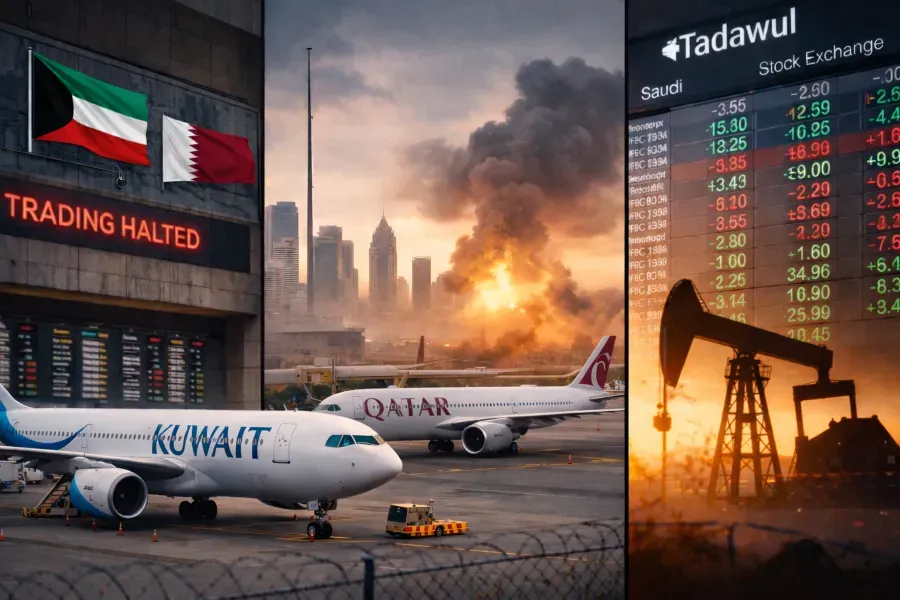
The Gulf region's markets entered an exceptional phase of risk management following a wave of rapid security developments over the past 24 hours. These events directly affected stock exchanges and air traffic, amplifying global investor concerns about a potential 'energy shock' tied to shipping routes in the region. According to simultaneous international economic coverage, global portfolios have shifted toward safe-haven strategies amid escalating conflict and rising supply chain disruption risks.
Energy and metals market prices became less accessible to some investors as the weekend approached, with global trading sentiment turning defensive - especially regarding navigation risks in the Strait of Hormuz, the region's most critical oil and maritime chokepoint. Maritime activity became more cautious as security warnings increased, bringing geopolitical risk premiums for oil and gas back into focus and raising the likelihood of heightened volatility upon the full resumption of trading.
Risk management approaches within the Gulf varied sharply. The Qatar and Kuwait stock exchanges suspended all trading for the day, a precautionary step usually aimed at calming markets, preventing panic selling, and allowing time to assess information and update disclosure and settlement requirements. By contrast, the Saudi market continued trading on the Tadawul platform, reflecting a different operational stance and placing Saudi liquidity at the center of investor response.
The most immediate impact was seen in the transport sector, with flight suspensions and airport closures increasing pressure on travel and supply chains, raising insurance and transportation costs, and intensifying the sensitivity of aviation, tourism, and logistics sectors to any prolonged shutdown. If disruptions extend for more than a few days, the effects could spread to shipping costs, commodity prices, inflation indicators, and global monetary policy expectations.
In such crises, value shifts not only through spot prices but also via risk repricing. Global markets were already sensitive in recent weeks to inflation fluctuations and U.S. trade policies. With a new geopolitical risk factor, investors typically reduce exposure to high-risk assets in favor of gold, government bonds, and the Swiss franc, while closely monitoring U.S. bond yields and volatility indices. Prolonged energy disruptions could further raise inflation expectations and complicate interest rate cuts in major economies, especially if combined with persistent inflation data or rising production costs.
As news develops rapidly, the key variable for markets in the coming days will be the actual extent of disruption to energy flows and navigation, and how long operational restrictions on air and sea transport persist. The continued suspension of trading on some Gulf exchanges alongside ongoing trading in Saudi Arabia creates two parallel pricing paths: one that manages risk through temporary halts, and another that allows the market to absorb information gradually through trading and liquidity.
EcoPulse24 Analysis:
The current landscape is driving investors toward hedging, as the event is no longer just a 'political headline' but a factor repricing energy, inflation, and supply chain risks all at once. The suspension of trading in Qatar and Kuwait and the closure of air traffic point to a priority on operational stability and short-term risk management, while ongoing trading in Saudi Arabia makes it the most direct arena for investor reaction in the Gulf. In the near term, risk premiums are likely to rise and volatility may spike when global liquidity returns, with oil and maritime factors being pivotal in determining whether the shock is temporary or prolonged.
Explore Related Coverage
Sources & References
Editorial Note
Disclaimer
© 2025 EcoPulse24. All rights reserved.