Saudi Stocks Face Broad Sell-Off Amid Heightened Risk Aversion and Regional Tensions
Saudi stocks fell 2.43% amid regional tensions, with most sectors down and investors shifting to risk reduction despite steady trading activity.

Riyadh | EcoPulse24
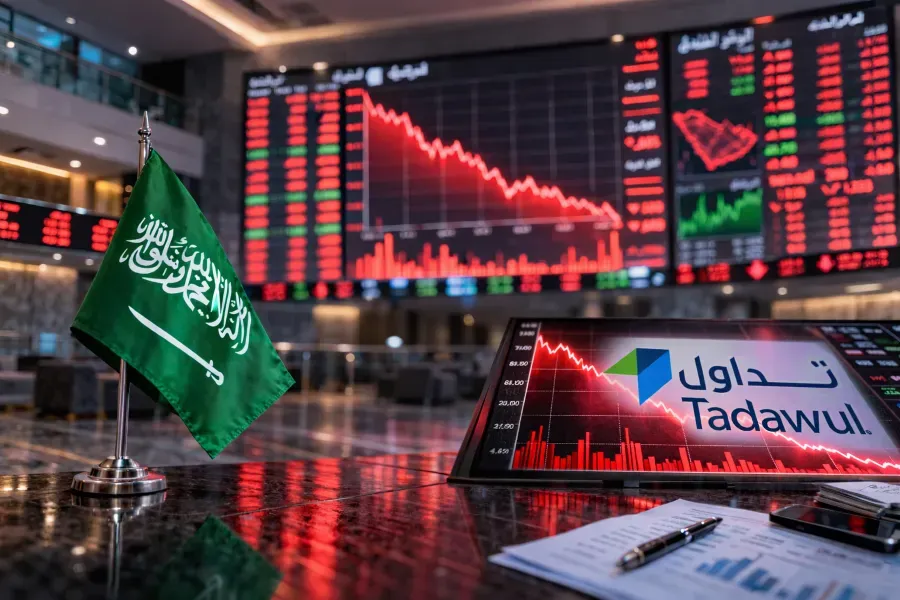
Saudi stocks declined during Sunday’s session on March 1, 2026, under broad selling pressure amid regional tensions and heightened investor caution, with trading operations continuing uninterrupted despite volatility.
The main market index closed at 10,448.67 points, down 2.43%. The parallel market index dropped 1.68% to 22,410.27 points. Financial derivatives lost 2.63%, while the sukuk and bond market was nearly flat, down 0.01% at 922.44 points.
Traded value reached about SAR 3.72 billion, with 184.96 million shares exchanged and a market capitalization close to SAR 9.14 trillion. Of 268 listed companies, 253 declined while only 12 advanced, reflecting dominant selling activity.
Sector-wise, transport led losses with a 4.12% drop, followed by commercial and professional services (3.00%), long-term goods (2.60%), and consumer services (2.37%), underscoring the sensitivity of cyclical sectors to external shocks impacting supply chains and economic activity.
Gains were limited, led by Al Rajhi Takaful, up 4.16% to SAR 77.60, followed by L’azurde (2.68%), Saudi Aramco (2.56%), AMAK (2.20%), and Saudi Ceramic (1.61%). Aramco’s rise reflected support for energy stocks amid oil price sensitivity to geopolitical developments.
In disclosures, Arabian Drilling’s board decided against distributing cash dividends for 2025, citing the general assembly’s authorization for interim payouts and last year’s challenging rig demand, along with local and international expansion plans. The stock fell 6.28% in direct response to the announcement and sector outlook.
EcoPulse24 Analysis:
The Saudi market demonstrated operational resilience and uninterrupted trading despite regional pressures. However, the breadth of declines and the number of losing stocks indicate a shift by investors toward risk reduction rather than selective repositioning. Sustained liquidity above SAR 3.7 billion points to ongoing activity, mainly focused on portfolio restructuring. The market’s next direction will depend on developments in energy and regional shipping; further escalation could heighten volatility, while any signs of de-escalation might prompt a swift technical rebound in leading stocks.
Explore Related Coverage
Sources & References
Editorial Note
Disclaimer
© 2025 EcoPulse24. All rights reserved.